
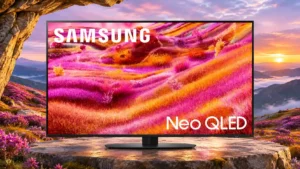
Samsung QN90F Feature Scores
Overall Scorata score: 4.2/5
Based on 24 analyzed reviews · View source samples
Explore all 155 feature scores for Samsung QN90F, organized into pros and cons.
Scores by Feature
Summary
155 reviewed features-
Very positive 4.5-5.054 (35%)
-
Positive 3.5-4.457 (37%)
-
Neutral 2.5-3.419 (12%)
-
Negative 1.5-2.424 (15%)
-
Very negative below 1.51 (1%)
Pros
Sort
-
The matte Glare-Free treatment disperses strong direct reflections exceptionally well; some viewers notice slightly softened screen clarity.
-
Direct lamps and overhead lighting become diffuse rather than sharply mirrored, making viewing comfortable in illuminated rooms.
-
The QN90F presents a bold, detailed image with impressive daytime legibility, balanced by disputes over blooming, motion and color saturation.
-
Mini-LED dimming often produces impressively deep blacks for LCD, though OLED rivals and some dark, moving scenes expose limitations.
-
Single-digit to roughly 10ms game-mode lag makes controllers and mouse input feel remarkably immediate.
-
The 165Hz ceiling gives high-end PC gamers additional headroom over 120Hz. That high refresh figure does not prevent motion smearing on difficult transitions.
-
Four high-bandwidth HDMI 2.1 inputs are generous for households connecting several consoles or PCs at once.
-
HDR highlights are intensely bright and punchy, with impressive sparkle even when bright elements share the screen with deep blacks.
-
Peak light output is a flagship strength, making bright HDR objects vivid even if some cheaper competitors measure higher.
-
Its slender profile, minimal borders and compact metal pedestal create a polished, understated look.
-
Very slim borders draw attention to the picture rather than the cabinet, particularly on the larger screen sizes.
-
The combination of intense SDR brightness and dispersed reflections keeps daytime programming easily visible with lamps or windows nearby.
-
Backlight control yields dark blacks and bright highlights, but testers disagree substantially on haloing and dark-scene artifacts.
-
Clean HD and even standard-definition video are sharpened convincingly without routinely introducing obvious fake detail.
-
4K textures and well-mastered HD upscales look crisp, while especially fine detail in poor-quality sources remains limited.
-
Bold highlights and deep blacks make HDR look impactful, but color coverage, firmware-related calibration and scene transitions invite caveats.
-
Tizen provides a broad range of major streaming services, Samsung apps and content hubs, leaving relatively few mainstream gaps.
-
A remarkably slim mini-LED body helps the set appear sleek on a stand or hung close to a wall.
-
Bright skies, snow and specular highlights retain subtle texture rather than turning into featureless patches.
-
All four full-bandwidth HDMI ports make 4K/120Hz gaming straightforward with compatible consoles and PCs.
-
Bright highlights stand out against deep shadows in many scenes, though controlled comparisons sometimes favor the older QN90D or OLED models.
-
The QN90F wins praise as a premium, versatile LED TV, but its cost and motion behavior prevent an unqualified consensus.
-
High refresh rates and low lag receive broad praise, yet poor pixel transitions and motion trails lead to sharply divided gaming recommendations.
-
Ambient-light charging and USB-C backup reduce dependence on disposable batteries and make daily remote ownership simpler.
-
Bright saturated HDR colors can look striking, yet SDR saturation and demanding dark colors are less competitive than top rivals.
-
Fast scenes are smooth with the right settings in several assessments, but slower pixel transitions lead to inconsistent results.
-
The substantial central base keeps the display steady with minimal wobble for a screen of this size.
-
Ordinary TV and daytime sports stay bright enough to overcome substantial room light without relying on HDR content.
-
Samsung TV Plus provides a substantial selection of free channels, although its prominence in the home interface can be overbearing.
-
Large QN90F sizes create a striking, theater-like image with thin borders that seem to disappear from normal seating distance.
-
Compatible Samsung soundbars can play alongside the TV speakers, expanding the soundfield compared with the built-ins alone.
-
Tizen has wide content coverage and useful gaming and home hubs, yet menu clutter, ads and inconsistent speed frustrate some owners.
-
The cabinet and pedestal feel solid and premium overall; limited back-panel flex and individual panel issues temper that impression.
-
A wide adaptive-refresh range greatly reduces tearing and supports fluid games, including low frame rates via compensation.
-
The set remains unusually bright even across large white scenes, rather than relying solely on tiny HDR highlights.
-
Game Bar conveniently gathers refresh information, picture controls and visibility aids in a single overlay.
-
Full-bandwidth connections enable modern high-refresh 4K signals and adaptive sync without having to choose a single premium port.
-
Image processing usually sharpens lower-resolution material and enhances sports without obvious artificial edges, though results depend on settings.
-
The sturdy metal pedestal looks premium and supports the television without dominating the furniture beneath it.
-
Adaptive refresh support helps reduce tearing with suitable gaming hardware, including supported Xbox and PC configurations.
-
Sound modes make a substantial difference: Amplify frequently lifts volume, bass weight and dialogue projection beyond the restrained default.
-
Color-boosting options add extra vibrancy and warmth when desired, but the stronger settings trade some accuracy for impact.
-
Filmmaker Mode and careful processing render convincing textures and restrained colors, avoiding the exaggerated look of some picture presets.
-
Standard programming looks vibrant and polished, while Filmmaker Mode offers a more faithful, less exaggerated presentation.
-
Many scenes display little haloing, but some tests uncover obvious halos or grid-like backlight zones, especially with dark content and motion.
-
The slim body looks smart on a wall and supports standard mounting, though recessed sockets are less accessible afterward.
-
The solar-powered remote is compact and convenient, but its sparse controls and missing dedicated input button divide opinion.
-
Software adds features and refinements but has also caused important regressions, including unreliable HGiG game HDR.
-
The center stand raises the screen enough for many soundbars to sit below without blocking the picture.
-
On-screen dialogue and effects can sound correctly located, particularly when the more dynamic Amplify mode is selected.
-
The SDR-to-HDR enhancement can add punch without an overly artificial look, although purists may prefer accurate unconverted SDR.
-
Voices are generally clear at ordinary volume, with amplification tools available; some demanding film mixes still bury speech under effects.
-
The narrow pedestal fits many cabinets more easily than widely spaced feet would.
-
HD and many DVD sources scale well, although heavily compressed streaming still exposes visible block artifacts.
-
Tizen feels snappy to some viewers but sluggish or cluttered to others, especially while navigating content hubs.
-
Color can look natural and convincing, particularly in Filmmaker Mode or after calibration; default settings and some HDR shades are less faithful.
-
As an LCD television, the QN90F avoids the permanent OLED burn-in risk, making static content less worrying over time.
-
Careful picture selection or calibration brings close-to-reference color and white balance, improving on uneven out-of-box settings.
-
Optional gaming interpolation smooths slower games but introduces additional input latency, so it is not ideal for every genre.
-
Standard 24p films are generally free of judder, while certain 25p-over-60p signals can produce distracting uneven motion.
-
SmartThings, Matter and supported assistant functions make the TV a useful control point for compatible lights and devices.
-
The mounting hardware and compact stand can be assembled with little fuss, though large-screen handling is easier with help.
-
Standard and Movie settings emphasize punch, while Filmmaker Mode prioritizes fidelity; small shadow and dimming tweaks improve consistency.
-
On the subdued matte screen, displayed artwork can look convincing and attractive when the TV is not being watched.
-
Deep shadow texture is often impressive, but some picture presets crush near-black details until their settings are adjusted.
-
Built-in audio is serviceable to surprisingly engaging after adjustment, but bass and room-filling dynamics lag a good soundbar.
-
Some find Tizen quick and polished; others report laggy navigation or unnecessary steps before reaching key picture controls.
-
The screen covers much of the commonly used HDR color space, but competing mini-LED and OLED displays can reproduce a wider range.
-
HDR10+ provides dynamic HDR compatibility as a practical alternative, but it cannot fully replace the missing Dolby Vision catalog.
-
Movie HDR tracking is often accurate, though dark details and midtones can vary by mode; game HDR calibration became less reliable after firmware changes.
-
The integrated audio can play fairly loud with reasonable clarity, although its tonal balance deteriorates toward maximum output.
-
Separate profiles and recommendations make the interface more useful to households with different viewing habits.
-
Built-in assistant control reaches many settings and searches, reducing the need to dig through complicated menus.
-
Voice-amplification processing can raise the intelligibility of speech without simply increasing every sound in the mix.
-
Picture processing adjusts scenes for extra punch and clarity; the most aggressive settings may appear less natural than Filmmaker Mode.
-
A 1440p/120Hz feed works well for modern consoles, adding flexibility beyond the usual 4K and 1080p choices.
-
The adaptive gaming tools can choose picture settings without constant manual adjustment, though the best result still depends on the game.
-
With local dimming active, dark areas look impressively even, with only small amounts of glow near isolated bright objects.
-
Filmmaker Mode provides a more restrained, faithful alternative to the vibrant Standard preset, particularly for movies.
-
The supplied remote and installation equipment are useful, and some regional packages include both a full-button and minimalist remote.
-
The on-screen language assistance is seen as a welcome practical convenience for compatible content.
-
Near-black areas are notably even in controlled testing, without obvious vertical banding in the measured panel.
-
A detachable lead makes routing and replacing the power cable easier than with permanently attached wiring.
-
Native 4K detail looks impressively crisp, especially on sharp sources and larger panels viewed at sensible distances.
-
Initial setup and connecting core features are generally straightforward, with tools and on-screen assistance smoothing the process.
-
A wide spread of diagonals—from compact sizes to very large panels—helps buyers match the TV to their room.
-
The popular streaming apps are available directly in Tizen, minimizing the need for a separate streaming stick.
-
The wide VRR operating range and frame compensation help keep gameplay tear-free even when performance dips.
-
Wireless streaming works reliably in normal use, with few reported buffering or connection issues.
-
Ambient and art options can put generated artwork on the screen rather than leaving a blank panel, adding a creative decorative use.
-
Automatic game-mode switching reduces setup friction when a console starts, letting players benefit from fast response without menu diving.
-
Color transitions are usually smooth, although some gray, blue and green gradients reveal faint banding.
-
The Gaming Hub brings multiple game-streaming platforms onto the TV, allowing controller-based play without a locally connected console.
-
Color blends are generally clean, with occasional visible gradation steps in selected brighter colors.
-
Minimal buttons make the remote sleek, yet the absence of dedicated input and some picture-control keys frustrates regular adjusters.
-
Amplify can widen and energize the presentation, but surround and overhead effects rarely extend far beyond the screen.
-
Interpolation can tame judder for sports or slower content, but occasional cadence errors and a processed movie look remain concerns.
-
The proximity-triggered Daily Board can be helpful in theory but activates unexpectedly and distracts in regular use.
-
Channels behind the screen and through the stand help hide cables, although recessed sockets can complicate access after wall mounting.
-
Modern 4K gaming is well served by sharp graphics, ample brightness and low input lag; motion trails in darker games remain a concern.
-
AirPlay is a convenient way to send compatible Apple-device content to the television without another streaming box.
-
A low-power display can show photos, video and artwork between viewing sessions, making the screen less obtrusive in a living area.
-
Uninstalling unwanted apps helps tidy the home screen and recover storage for more useful services.
-
Photo and artwork display options allow the idle screen to reflect personal taste rather than a standard black rectangle.
-
The art service offers choices from several major collections and familiar entertainment properties, making decorative display more flexible.
-
Amplify mode adds volume and weight without consistently producing bass crackle, although occasional treble harshness and cabinet buzzing are possible.
-
Adaptive-sync support gives PC gamers flexible tear-reduction options across a wide range of frame rates.
-
The higher-bandwidth input option is available but may need to be enabled for the intended gaming signal.
-
Most sizes support 165Hz gaming, but the oversized 115-inch configuration has a lower maximum refresh capability.
-
The chassis feels substantial and robust while remaining slim, requiring care when lifting larger versions.
-
Compression smoothing preserves detail reasonably well but cannot fully remove artifacts from rough, low-bitrate sources.
Cons
Sort
-
Motion is a notable concern despite 165Hz support: dark transitions can look smeared, with pronounced ghosting in some tests.
-
The absence of Dolby Vision is a genuine limitation for viewers with compatible HDR libraries, even though HDR10 and HDR10+ remain available.
-
Fast-moving edges can show stray colors, trails or grid-like backlight artifacts, a noticeable distraction in sports and gaming.
-
The BGR subpixel arrangement can make fine desktop text less crisp than users expect from a dedicated monitor.
-
Pixel response is much slower than the gaming specifications suggest, resulting in visible dark trails in demanding motion.
-
Most panels show only mild corner shading, but some report pronounced dirty-screen patterns or visible irregularity.
-
Advertisements and promoted material appear in Tizen, and targeted ads can be limited but not completely disabled.
-
Minor gray-field blotching is seen on some sets, while one particularly critical panel account describes more distracting irregularity.
-
Transitions are a weak spot: bright moving objects can leave delayed trails, especially in Game Mode.
-
A firmware change removed working HGiG behavior, making accurate HDR game brightness mapping harder than it should be.
-
Off-center viewing is acceptable up to a point, but colors and brightness wash out at wider positions.
-
The premium picture and outstanding glare reduction come at a high price, with cheaper rivals often matching or beating other performance areas.
-
Missing DTS audio decoding and passthrough is disappointing for Blu-ray collections using DTS-based lossless soundtracks.
-
Gaming mode preserves bright HDR images and fast control response, but its slower local-dimming transitions are a noticeable weakness.
-
The LCD design promises low burn-in risk, although reports of inconsistent individual panels and ghosting raise some quality-control concerns.
-
Recessed rear connections make unplugging or swapping cables awkward if the TV is mounted closely against a wall.
-
Samsung account requirements can obstruct access to connected smart functions if users prefer not to sign in.
-
Audio passthrough has meaningful surround-format restrictions; movie enthusiasts should confirm their soundtrack and receiver needs.
-
Black-frame insertion can improve clarity at 60Hz, but a 120Hz game-mode bug can force it on when VRR is disabled.
-
Backlight flicker at common brightness levels could bother sensitive viewers, despite the panel’s otherwise strong image performance.
-
Colors fade or change as seating moves farther from the center, making strongly side-on viewing less satisfying.
-
The relatively short power lead may constrain tidy installations, particularly around wall mounts or distant outlets.
-
Certain panels can show distracting line-pattern artifacts in specific scenes, a reason to inspect individual units closely.
-
The move away from a separate One Connect box simplifies the hardware count but means all cables attach directly behind the screen.
-
Slow camera pans in low-frame-rate films can stutter visibly, and interpolation does not always resolve the distraction.
-
Broadcast reception is adequate for conventional signals, but ATSC 3.0 capability is disputed across sources and may vary by region.
-
Automatic proximity activation can light up the display while someone is simply sitting nearby, creating an unwelcome distraction.
-
Up to 165Hz input and low lag suit high-frame-rate play, but persistence and ghosting can undercut the theoretical speed advantage.
-
The TV can achieve significantly more accurate colors after calibration, but the always-active dimming zones make fine-tuning less simple.
-
Deep blacks and strong highlights make dark-room movies enjoyable, but blooming and slower backlight transitions prevent OLED-like precision.
-
Core everyday viewing is manageable, but the deep settings hierarchy and sparse remote can make less common tasks laborious.
-
Higher frequencies can become peaky or electronic at demanding volumes, despite otherwise intelligible dialogue.
-
Factory whites can lean cool or green, but calibration brings the image much closer to neutral.
-
Basic functions are straightforward, while changing inputs or buried settings can require more presses than a full-button remote.
-
The matte treatment dramatically reduces reflections, but close inspection may reveal a slight softness compared with glossy screens.
-
Extra-large sizes deliver a meaningful visual spectacle, but their purchase price and room requirements make value highly personal.
-
Split-screen use offers some convenience, but the supported input combinations do not cover every pairing users may want.
-
Ad targeting can be adjusted, but users seeking a completely promotion-free smart TV experience may be disappointed.
-
The remote-accessed assistant offers some interesting discovery and information tools, though not all owners will use them regularly.
-
Wi-Fi 5 handles ordinary streaming but trails competing televisions offering newer wireless standards.
-
Atmos decoding offers an expanded sound presentation, but the TV’s built-in speakers produce only modest height and surround effects.
-
Extensive picture controls and quick-access shortcuts help, though many adjustments are still hidden several menu layers deep.
-
Personalized suggestions can help viewers discover programs, but promoted and auto-playing content can feel intrusive.
-
Bass is sufficient for casual viewing in some sound modes but often lacks the deep rumble and force of a separate subwoofer.
Use Cases
Best for
Sort
-
Very high brightness and an exceptionally effective matte coating make this one of the strongest reasons to consider the QN90F for sunlit spaces.
-
Pairing an external soundbar supplies the extra bass and scale the TV speakers lack; Samsung Q-Symphony can extend compatible setups further.
-
Sports benefit from strong brightness and crisp upscaling, although motion smearing and color trails can appear during fast action.
-
PS5 and Xbox connections support fast refresh and low latency, but slower pixel and backlight transitions can detract from fast action.
-
Films showcase impressive HDR highlights and black depth, though slow pans, absent Dolby Vision and imperfect audio can bother enthusiasts.
-
A bright, sharp picture, wide app selection and tasteful design make it a capable primary living-room TV.
-
HD sports and television upscale cleanly to the 4K screen, often looking unusually sharp. Very low-quality feeds may still retain visible compression artifacts.
-
Four full-speed HDMI 2.1 ports let several high-end systems stay connected without repeatedly changing cables.
-
The picture has the contrast and brightness for convincing cinema, though discerning dark-room viewers may prefer OLED and external audio.
-
PC players gain 165Hz, VRR and low latency, but transition smearing and BGR text rendering can be drawbacks.
-
Smaller models can fit an office nicely, although their scale and text-rendering quirks matter if used as computer monitors.
-
The available compact sizes make the set suitable for a bedroom or secondary space, even though pricing remains premium.
-
The app selection and vivid HDR display make streaming enjoyable, while motion stutter and missing Dolby Vision can affect select titles.
-
Games benefit from strong HDR punch, although compromised HGiG calibration and local-dimming trails limit accuracy in some titles.
-
4K/120Hz, VRR and automatic low latency make the PS5 a natural fit, notwithstanding dark-motion and HDR calibration caveats.
-
Smaller sizes suit bedroom placement well, while the strong brightness can be adjusted down for quieter surroundings.
-
Detailed game environments benefit from the high brightness, contrast and rich colors, making slow exploration visually rewarding.
-
SmartThings and compatible Samsung soundbars integrate neatly, providing more convenience for homes already using Samsung devices.
-
Standard-definition DVDs become sharper and more watchable through effective 4K upscaling.
-
Everyday dialogue is generally understandable without accessories, but action movies benefit noticeably from external speakers.
-
Disc-quality 4K material makes the most of the screen’s brightness, dark blacks and fine highlight detail, though Dolby Vision and DTS compatibility are missing.
-
Casual games feel lively and responsive, though the most demanding motion scenes can reveal smearing.
-
A matte finish and artwork modes make the QN90F credible as a decorative wall display without giving up flagship TV brightness.
-
Displaying personal photos in idle mode gives the large matte screen a purpose beyond ordinary television viewing.
-
Bright, bold animation looks vibrant on the QN90F, though color-critical viewers may notice muted or altered shades elsewhere.
Conditional or not ideal for
Sort
-
Budget-conscious buyersThe premium price is hard to justify when less expensive Hisense, TCL and discounted OLED options compete closely in image quality.
-
Desktop productivity4K resolution offers workspace, but BGR subpixels and soft text can make lengthy desktop tasks less appealing than on a monitor.
-
Nintendo Switch 2 gamingThe console connects, but faulty HGiG behavior makes accurate Switch 2 HDR calibration a concern.
-
Photosensitive playersThe panel’s flicker and some forced strobing behavior could be uncomfortable for people sensitive to flashing light.
-
Shared-screen viewingA group can enjoy the large screen from moderate side positions, but noticeable off-axis color and brightness loss limits ideal seating.
-
Big-screen installationThe slim construction and available large diagonals create a cinematic installation, but lifting and positioning the biggest sizes requires planning.