
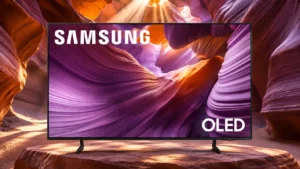
Samsung S85F OLED Feature Scores
Overall Scorata score: 3.9/5
Based on 14 analyzed reviews · View source samples
Explore all 124 feature scores for Samsung S85F OLED, organized into pros and cons.
Scores by Feature
Summary
124 reviewed features-
Very positive 4.5-5.057 (46%)
-
Positive 3.5-4.428 (23%)
-
Neutral 2.5-3.424 (19%)
-
Negative 1.5-2.413 (10%)
-
Very negative below 1.52 (2%)
Pros
Sort
-
Individual OLED pixels produce genuinely deep blacks, making night scenes look striking rather than gray. This is a defining advantage in controlled lighting.
-
Fast response, low input lag and VRR make games feel exceptionally responsive. The 120Hz cap and firmware-specific HDR calibration caveat temper the praise.
-
Self-emissive OLED contrast puts bright details alongside near-perfect blacks without backlight interference. Dark-room movies are particularly convincing.
-
The 55- and 65-inch QD-OLED versions excel with saturated colors, including rich dark shades and vivid highlights. WOLED sizes are attractive but less capable with the brightest colors.
-
Roughly 9ms-class gaming delay feels immediate and makes turns, jumps and aiming highly responsive.
-
The OLED image earns praise for vivid color, punchy contrast and fine detail. Strong picture quality is the most dependable selling point.
-
Most assessments are favorable, led by the picture quality and responsive gaming. The best fit depends on room lighting, panel variant and price.
-
Most praise the OLED features and gaming performance for the money, but some find older discounted OLEDs or small upgrades to higher models more compelling.
-
Dim rooms bring out the S85F’s best attributes: convincing blacks, rich color and deep shadow detail.
-
All four full-bandwidth HDMI 2.1 ports can accommodate gaming devices and other high-bandwidth sources.
-
Ultra-thin borders focus attention on the image and contribute to its modern look.
-
HDR combines perfect blacks and vivid colors for strong impact. Higher-tier OLEDs pull ahead with larger and brighter highlights.
-
Support for 4K at 120Hz is an excellent practical fit for modern consoles and delivers noticeably smoother gameplay than older 60Hz TVs.
-
Most major streaming services are available directly on Tizen, reducing reliance on external devices.
-
Fine textures look crisp without becoming excessively processed, whether in films or colorful games.
-
The rechargeable remote can top up via solar power or USB-C, avoiding frequent battery replacements.
-
Color and contrast stay unusually consistent off-center, so seats across a couch can share a strong picture.
-
Smart TV platform is a genuine strength of the S85F, especially in the supported viewing or gaming conditions.
-
Game Mode keeps input delay tiny and retains OLED contrast, making controls snappy without a major picture sacrifice.
-
High-bandwidth HDMI connectivity supports the key modern gaming features without relying on a single special input.
-
The U.S. QD-OLED versions offer especially wide color coverage, with superb DCI-P3 performance. Some BT.2020 hues are less complete.
-
An elegant, almost borderless screen gives the S85F premium styling despite its entry-tier positioning.
-
HD content and DVDs gain useful clarity and texture. Very low-resolution material can remain soft, especially fine lettering.
-
Sports and fast action can look crisp after suitable motion adjustments, though slow film pans can still stutter.
-
Several reports describe quick menus and app launching, while one tester encountered intermittent freezes needing a reboot.
-
The feet can use narrow or wide spacing, helping match furniture widths and soundbar placement.
-
A dedicated game hub and dashboard make gaming modes and connected devices easier to manage.
-
There is effectively no halo around small bright objects because each OLED pixel controls its own light.
-
Gaming Hub provides convenient access to cloud services and connected devices, adding flexibility beyond traditional consoles.
-
Smooth gradations are handled particularly well, with only small traces of banding in demanding HDR content.
-
Self-emissive OLED pixels avoid the halo or trailing associated with moving between backlight zones.
-
Object Tracking Sound Lite effectively links effects to movement onscreen and gives action scenes greater cohesion.
-
The glossy coating cuts reflected light impressively, although ambient illumination can introduce a pinkish gray appearance to blacks.
-
Near-instant OLED pixel transitions keep fast movement sharp and mostly free of ghosting.
-
Dark material retains fine room and object details without overwhelming black crush.
-
Speech is generally understandable, and the Amplify setting can improve clarity in challenging mixes.
-
Specular highlights pop convincingly against black backgrounds, but the biggest bright areas lose intensity.
-
The QD-OLED versions are admired for deeper color saturation, whereas the WOLED versions retain strong OLED blacks but less bright-color headroom.
-
SDR color is generally strong, though some HDR colors, luminance levels and white-balance targets are imperfect until carefully adjusted.
-
Banding is usually faint, but technical comparisons flag some troublesome gradients and changes from older Samsung models.
-
The very slim cabinet looks expensive and is attractive on a wall, although it should be handled carefully.
-
The television follows HDR luminance targets closely in its accurate modes, preserving details as scenes approach the brightness ceiling. Game HDR settings have had firmware-specific issues.
-
Foot height and the wide stand arrangement leave usable space for a soundbar under the screen.
-
A slim profile and standard mounting arrangements suit wall installations, provided the mount matches the exact size.
-
Compact highlights look reasonably bright for the price, especially compared with some entry-level alternatives. It does not approach the brightest OLED tiers.
-
Reflections are reduced well in some tests, but strong light can still expose raised QD-OLED blacks and wash out dark scenes.
-
Small HDR highlights have enough sparkle for engaging movies and games, but this entry-level OLED is much dimmer than midrange and flagship rivals in demanding scenes.
-
Detailed, colorful OLED games look excellent, and the HDMI inputs handle modern 4K consoles without sacrificing responsiveness.
-
Streaming apps can open much faster than on older Samsung sets.
-
ALLM automatically switches into responsive gaming settings when a compatible console starts.
-
Deep black screens stay exceptionally even with no backlight haloing, although very dark gray uniformity is a separate weakness.
-
OLED’s pixel-level lighting and the QD-OLED color advantages make this an appealing picture-focused set, especially in the smaller North American sizes.
-
Filmmaker Mode provides a preferred warmer, more cinematic presentation without overstating sharpness.
-
Upscaling is generally effective, but aggressive sharpening or compression cleanup can leave occasional artifacts.
-
People and objects take on a convincing dimensional look, especially when the processing adds subtle depth rather than harsh sharpening.
-
Each pixel dims independently, eliminating conventional zone compromises.
-
Fast color transitions avoid ghosting; some narrow cases of frame skipping or over-sharpened motion still crop up.
-
Fast-moving subjects stay remarkably distinct thanks to quick pixel transitions.
-
The wide stand arrangement provides welcome stability, particularly for busy shared spaces.
-
Broad VRR compatibility limits tearing even as frame rates fluctuate.
-
Low-frame-rate compensation extends smooth play when game frame rates dip.
-
Ordinary TV material is comfortable in moderate lighting, although broad bright scenes can appear less punchy than on higher-end sets.
-
Dual-position feet help adapt the TV to furniture, though the thin screen makes careful installation important.
-
A 120Hz ceiling represents a welcome jump from 60Hz sets while falling short of the faster refresh options now available.
-
Adjustable feet suit varied furniture, but the plastic construction can feel less substantial than ideal.
-
The TV accepts 1440p high-refresh signals and other common console resolutions effectively.
-
Apple AirPlay adds useful casting flexibility within the Tizen system.
-
Audio settings is a genuine strength of the S85F, especially in the supported viewing or gaming conditions.
-
Sound placement adds a sense of movement, but the two-channel system cannot match a separate surround setup.
-
There is room for significant accuracy improvement through calibration, though some HDR color errors remain.
-
Multi-View is presented as an easy way to split the display between different sources.
-
Game Mode’s optional aim reticles and display controls can be useful in competitive play.
-
Compatible Samsung soundbars can combine their audio with the TV speakers for a richer presentation.
-
Its streamlined shape and helpful shortcuts are liked, though the compact footprint makes it easy to misplace.
-
Voice operation adds convenience alongside AirPlay, app access and smart-home functions.
-
Voice commands are described as responsive in one overview, although no rigorous recognition test is provided.
-
Picture-enhancement modes can improve depth and detail, but their usefulness varies by scene.
-
Tizen can suggest programming from watch history and gives personalized shortcuts.
-
Samsung TV Plus supplies an extensive selection of free channels without an external box.
-
Tone mapping is serviceable with some important tradeoffs, rather than a standout strength.
-
Navigation often feels fluid, but intermittent interface unresponsiveness is a potential annoyance.
-
The set offers useful modes and many controls, but deeper motion or color settings may take effort to locate and configure.
-
Without typical PWM backlight dimming, flicker is generally subtle, but the screen is not completely flicker-free.
-
HDR tone mapping is credible, but pre-calibration white balance and color-mapping errors remain.
-
The compact remote works well for everyday controls but can disappear between couch cushions.
Cons
Sort
-
Dolby Vision is absent, so Dolby Vision movies and compatible games must fall back to other supported HDR modes.
-
The S85F name does not guarantee the same panel: U.S. 55/65-inch versions can use QD-OLED, while larger and international versions use WOLED. Shoppers need to verify the exact model code.
-
The S85F is generally a 4K/120Hz display, not a 144Hz gaming TV; one overview claims otherwise, but multiple technical assessments describe a 120Hz ceiling.
-
No DTS pass-through is a drawback for disc enthusiasts using DTS-based soundtracks.
-
Large, bright scenes expose the OLED’s power limits, with noticeably reduced full-screen luminance. WOLED and QD-OLED versions also behave differently.
-
Some surround formats are limited: Dolby Digital Plus 7.1 falls back to 5.1 and DTS is unsupported.
-
Long-lasting static elements still pose OLED burn-in risk, so this is not a risk-free display for fixed graphics.
-
A firmware change reportedly broke proper HGiG behavior, making accurate HDR calibration difficult for some games and especially Switch 2 use.
-
The panel-code uncertainty was frustrating when early model information did not clearly distinguish OLED technology.
-
Built-in audio is serviceable for casual TV, but voices and effects lack the fullness of a more substantial setup.
-
The speakers can struggle to fill bigger spaces and become less balanced near their highest output.
-
Tizen includes interface ads that cannot be fully disabled, even if personalized ad targeting is switched off.
-
Recessed ports can be awkward to reach after the TV has been mounted close to a wall.
-
Very dark gray scenes can reveal a minor vertical band near the center, even while true black remains exceptionally uniform.
-
The integrated speakers keep effects close to the screen rather than producing a broad cinematic sound field.
-
Slow pans reveal juddery-looking stutter caused by exceptionally fast OLED transitions, and smoothing options only partly help.
-
HDR10+ is present, but the lack of Dolby Vision limits compatibility with some preferred movie and gaming formats.
-
Full-screen scenes and abrupt bright transitions expose stronger power limiting than small-window brightness numbers suggest.
-
Game motion interpolation is not especially effective at smoothing low-frame-rate pans.
-
Tuner support remains a noticeable limitation, so shoppers who prioritize it should consider alternatives.
-
The slender OLED panel requires careful handling during unpacking and positioning.
-
The thin cabinet is attractive, but reports of a flexible back panel and rather cheap-feeling feet temper confidence.
-
Motion smoothing can reduce some judder, but it is not especially effective at hiding OLED stutter and needs tuning to avoid an unnatural look.
-
Basic streaming and settings shortcuts are straightforward, although more advanced picture adjustments can be buried in submenus.
-
One test heard satisfying impact in action scenes, but others found the small 20W speakers lacking deep bass.
-
Daytime programs can look bright enough in moderate lighting, but very bright rooms reduce dark-scene visibility and black depth.
-
Normal listening is mostly clean, though the speaker balance deteriorates at very high volume.
-
Compression cleanup is only fair, sometimes leaving blocks in dark scenes or becoming too aggressive when enabled.
-
Optional black-frame insertion helps persistence blur but operates only at 60Hz.
-
Some gray backgrounds show mild central patchiness and uneven corners.
-
Larger WOLED versions can deliver impressive OLED size, but buyers should not expect the smaller QD-OLED color advantages.
-
PC text is usable, but QD-OLED subpixels can create green or purple fringing around high-contrast lettering.
-
Ad targeting can be disabled, but the interface still shows advertising.
-
Screen coating clarity is serviceable with some important tradeoffs, rather than a standout strength.
-
Overall gray uniformity is decent, with darker corners and a small amount of dirty-screen effect.
-
Typical 24p movie signals are handled well, while unusual 25p-over-60p sources and some pans can look jerky.
-
SDR white balance is good, but HDR can lean too blue and cool. Calibration improves it without eliminating every mapping error.
-
Old or heavily compressed sources are still watchable, but blocky dark gradients and occasional detail loss remain.
-
The 120Hz mode is quick and clear for consoles, though enthusiasts with powerful PCs may want 144Hz or 165Hz headroom.
Use Cases
Best for
Sort
-
The S85F is a strong match for PS5 and Xbox thanks to 4K/120Hz, VRR, ALLM and extremely low latency.
-
Streaming movies and shows benefit from vivid OLED color and attractive contrast. Heavy compression can still leave visible artifacts.
-
Movie lovers get excellent black depth, strong color and nuanced shadows. Dim lighting is best, particularly for darker films.
-
The slim design, full app selection and strong everyday image make the S85F a comfortable living-room centerpiece when lighting is reasonable.
-
A wide audience can see nearly the same colors and contrast from different seats, helping group viewing.
-
At a meaningful discount below step-up OLEDs, it supplies much of the premium picture and console gaming experience. Its value weakens when older or brighter models are similarly priced.
-
PS5 play is particularly responsive, with fluid 120Hz support and very clear motion in fast action.
-
Quick pixel response keeps action sharp, though brighter sports broadcasts can expose brightness limits and some motion tuning is helpful.
-
A soundbar is the sensible finishing touch for film sound and larger rooms, complementing the much stronger OLED image.
-
The picture excels in a dark theater-like setting, but sound and format limitations make a soundbar and careful source choice worthwhile.
-
Detailed disc movies showcase rich palettes and controlled shadows, though missing Dolby Vision and DTS can matter for serious collectors.
-
Four capable HDMI inputs make it easy to connect several modern consoles or a PC without constantly swapping cables.
-
A responsive game mode and strong OLED picture make occasional gaming an easy fit.
-
Full-HD material scales cleanly, keeping shapes and textures attractive on the 4K panel.
-
Old DVDs look clearer than expected after scaling, although genuinely fine detail remains limited.
-
Racing controls and turns feel notably more immediate than on an older 60Hz TV.
-
With a few room lights and no harsh direct glare, the S85F remains enjoyable for regular shows and games.
-
Exploratory games gain from richer colors and finer environmental detail.
-
Its OLED contrast and adequate brightness make it an appealing bedroom TV, especially with lights lowered.
-
HDR gaming is serviceable with some important tradeoffs, rather than a standout strength.
-
Samsung and SmartThings users benefit from familiar hubs and convenient device integration.
Conditional or not ideal for
Sort
-
Nintendo Switch 2 gamingThe hardware is capable, but the reported HGiG firmware issue makes accurate Switch 2 HDR setup a concern.
-
Long-term ownershipBurn-in exposure and potential gradual brightness loss are relevant considerations for long-term fixed-content use.
-
PC gamingPC games enjoy OLED response and VRR, but a 120Hz ceiling and some text color fringing make this less ideal than faster, monitor-friendly TVs.
-
Low-distraction useInterface advertising can interrupt a minimalist TV experience even when content playback looks pristine.
-
Bright-room viewingThis is a conditional choice for bright rooms: reflections are manageable, but sunlit spaces can lift the blacks and weaken contrast.
-
Photosensitive playersThe screen avoids conventional PWM dimming, but a subtle refresh-related flicker may still bother the most sensitive players.
-
TV speaker-only viewingSpeech and everyday shows are acceptable through the TV speakers alone; high-impact movie sound is less satisfying.