
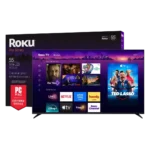
Roku Pro Series (2025) Feature Scores
Explore all 99 feature scores for Roku Pro Series (2025), organized into pros and cons.
Scores by Feature
Summary
99 reviewed features-
Very positive 4.5-5.053 (54%)
-
Positive 3.5-4.422 (22%)
-
Neutral 2.5-3.414 (14%)
-
Negative 1.5-2.49 (9%)
-
Very negative below 1.51 (1%)
Pros
Sort
-
Setup is overwhelmingly described as quick, intuitive, and painless. The main complication is physical handling because larger sizes are heavy and often need two people.
-
The rechargeable, backlit Voice Remote Pro is one of the most consistently loved features, especially its finder function and premium feel.
-
Built-in sound is one of the TV’s biggest advantages, frequently described as soundbar-like and unusually full for a flat-screen. A minority still prefers an external system.
-
Most owners and experts praise a bright, sharp, vibrant Mini-LED picture that looks excellent with 4K and HDR. A smaller group reports washed-out color, blur, or a less dramatic upgrade than expected.
-
Roku OS remains a major reason to buy: it is simple, intuitive, familiar, and tightly integrated with the TV. A few owners dislike live-TV navigation or isolated streaming problems.
-
Brightness is consistently praised, with experts measuring strong HDR peaks and customers calling the screen extremely bright. It is especially effective in rooms with substantial ambient light.
-
Value is widely praised, especially at sale prices, because the TV combines strong picture, unusually good sound, fast Roku software, and gaming features. At full price, competition becomes tougher.
-
The 2025 Pro Series is consistently described as extremely fast, with little to no interface lag and a clear performance jump over older Roku TVs.
-
Overall satisfaction is high, driven by picture, sound, simplicity, and value. The main reasons for low ratings are early failures, support problems, ads, and isolated motion or streaming issues.
-
Colors are repeatedly described as vibrant, rich, and lively, with strong measured gamut coverage. The set does not fully cover DCI-P3, but real-world color is a major strength.
-
Wall mounting is a major strength: the flat-backed design can sit nearly flush like a frame TV, with several owners reporting straightforward installation.
-
Black levels are one of the Mini-LED system’s strengths, often described as deep or nearly OLED-like. Isolated hardware faults can still create dark patches.
-
The shadowbox design is thicker than many TVs but looks premium and attractive, especially when flush-mounted like a picture frame.
-
Contrast is widely praised for combining bright highlights with convincing dark areas, giving movies and games strong depth without sacrificing shadow detail.
-
Bezels are consistently praised as very thin, giving the screen a clean, modern presentation.
-
Four HDMI ports provide plenty of room for consoles, streamers, and audio gear, and owners generally like the connection flexibility.
-
Menus, channel changes, and app switching feel immediate, with reviewers repeatedly praising seamless navigation and quick command execution.
-
Experts consistently praise the TV for preserving detail in dark scenes, often outperforming comparison sets in shadow-heavy material.
-
Streaming is generally effortless, with major services easy to access and existing Roku app setups often carrying over quickly.
-
Most major streaming apps are easy to find and use, though Twitch is missing and one owner could not install a desired karaoke app.
-
Bass is unusually strong for a TV and surprises many owners, but opinions vary: one expert wanted more true low-end extension while one customer found the bass excessive.
-
Dialogue is usually clear and intelligible, helped by a strong midrange and dedicated sound options. One owner found heavy bass could obscure speech.
-
HDR usually looks punchy and impressive, with strong highlights, deep contrast, and vivid color. Some reviewers still found HDR color less accurate than ideal.
-
4K/120 support is repeatedly praised and works on two HDMI inputs, making the TV a strong match for current consoles.
-
Gaming performance is a standout strength, combining responsive controls, strong HDR color, smooth high-refresh output, and very low lag.
-
Measured input lag is consistently excellent, landing below 10ms in several tests and producing highly responsive gameplay.
-
Response is excellent for gaming, with measured behavior under a frame and customers also describing the TV as exceptionally quick.
-
Stereo imaging and virtual surround are unusually convincing for built-in speakers, creating a wider and more immersive soundstage than typical TVs.
-
Most owners describe the metal-framed TV as solid, premium, or built like a tank. That positive impression is tempered by delicate screens and a few early hardware failures.
-
There are extensive picture and audio adjustments, including per-input controls and EQ. Some reviewers still find color management confusing or less complete than they would like.
-
Roku’s large tiles, straightforward navigation, and approachable design make the platform especially friendly for less tech-savvy viewers.
-
Roku’s art and Backdrops modes are a surprise hit, letting the TV resemble a more expensive frame-style display when idle.
-
Recessed routing and integrated straps keep cables controlled behind a flush-mounted TV, a small design detail reviewers repeatedly appreciate.
-
Remote commands register very quickly, with owners describing little to no delay compared with older TVs.
-
USB-A and USB-C connectivity is repeatedly appreciated, especially for powering accessories and keeping the rechargeable remote cable handy.
-
Off-axis viewing is better than many VA-style LCD TVs for several reviewers, with colors often staying true. Others still see noticeable degradation from the side, so seating position matters.
-
Antenna reception is usually strong, including reports of dozens of channels from small antennas. One owner had severe live-TV guide/reset problems despite the hardware connection.
-
Blooming is generally minimal and often barely noticeable even around bright objects on black backgrounds. A small number of users saw brief halo artifacts.
-
Color accuracy is mixed but mostly good: SDR and Dolby Vision can look very natural, while some testing found inaccurate HDR color and a few owners noticed pinkish skin tones.
-
Modern-console gaming is strongly supported, with customers and experts praising 4K gameplay, low lag, and smooth performance.
-
The tool-free feet are sturdy and thoughtfully designed, with integrated knobs and flexible placement making assembly easier.
-
High brightness makes the TV a strong daytime performer, even in rooms with large windows. Glare and a few reports of dim dark scenes keep it from being universally ideal.
-
The 120Hz refresh rate is a strong fit for gaming and feels like a major upgrade over older TVs. A few sports viewers still report motion lag despite the higher refresh rate.
-
Voice control is convenient for media tasks such as launching apps, changing inputs, and adjusting volume, but it is less capable as a whole-home assistant than Google or Alexa.
-
Bluetooth audio works well for private listening and compatible rear speakers, giving owners flexible alternatives to the built-in speakers.
-
Two high-bandwidth HDMI inputs support 120Hz gaming, which reviewers consider sufficient for most modern console setups.
-
HDR brightness is strong enough to make highlights pop and materially improve viewing in bright rooms.
-
Private headphone listening is convenient through Roku’s app or headphone mode and is valued by owners who watch without disturbing others.
-
Firmware support has successfully fixed at least one measured color issue, showing that Roku can correct picture problems after release.
-
Local dimming is usually excellent, producing deep blacks and strong highlight separation. A few owners encountered haloing or dark-zone failures, so the experience is not flawless.
-
The revised speaker system can play louder than the previous generation while remaining useful at lower volume settings in everyday rooms.
-
Roku’s Smart Picture processing can improve color, contrast, and scene-by-scene presentation, but automatic motion smoothing and low-light processing can become overly aggressive.
-
Programmable shortcuts and a guide button are useful, but live-TV viewers may miss traditional number buttons.
-
Recommendations stay relatively restrained and avoid overwhelming the home screen, which suits buyers who prefer Roku’s simpler presentation.
-
One long-time Roku owner specifically calls Bluetooth a major quality-of-life improvement.
-
Mini-LED/QLED is viewed as a meaningful step up from standard LED, delivering deeper blacks, stronger contrast, and more vivid color.
-
Dolby Vision content can look especially vibrant, with strong color and contrast according to owners who use it.
-
Connecting a soundbar through HDMI ARC/eARC is reported as straightforward, with easy integration into the Roku control experience.
-
One owner reports the TV uses about half the power of their previous set, making efficiency a pleasant bonus.
-
Automatic Game mode switches in with a console and produces highly responsive performance without requiring manual setup.
-
A customer successfully ran a PS5 at 4K/120, confirming that the high-bandwidth HDMI connection delivers the expected gaming benefit.
-
HDR and Dolby Vision content are praised for vivid, high-impact color, making the TV well suited to modern HDR sources.
-
4K/120 gaming works well and gives modern consoles a responsive, fluid presentation.
-
Fast sports can remain impressively clear, with players and movement easy to follow during NFL viewing.
-
4K presentation is a clear strength, with one gaming-focused owner praising the bright, crisp 4K visuals.
-
Full-screen brightness remains strong rather than collapsing, helping the TV keep a punchy image across large bright scenes.
-
Hands-free voice control is described as genuinely useful and convenient, especially because it works without pressing the microphone button.
-
The remote’s physical microphone mute switch is a useful privacy feature, though one owner raised concerns about the TV’s Wi-Fi broadcasting behavior.
-
Reflection handling is average to good for the class. The screen is somewhat reflective, but several reviewers found it manageable in normal bright-room use.
-
Movie mode can look natural and realistic once the automatic processing is dialed in, with no major rendering errors in normal viewing.
-
Uniformity is acceptable rather than perfect, with minor vignetting and one sample showing vertical banding.
-
Upscaling is mixed. One expert liked the restrained, non-oversharpened processing, while an owner found older low-resolution movies noticeably blurry in backgrounds.
-
Loud peaks can trigger audible compression, but the effect is considered acceptable for built-in TV speakers and helps prevent harsher distortion.
-
Tone mapping is competent but not perfectly calibrated: HDR can under-track the target curve unless brightness settings are pushed high.
-
Out-of-box white balance can lean slightly cool and blue. The error is visible but not severe, and the picture still looks natural in the better modes.
Cons
Sort
-
Customer support is a major weak point: several owners describe unanswered contacts, repeated runarounds, and troubleshooting that failed to resolve serious faults.
-
Reliability is the biggest customer concern. Many sets run flawlessly for months, but a meaningful number of owners report early screen, backlight, HDMI, power, or glitch failures.
-
Warranty experiences are inconsistent: one owner received a quick replacement, while several others describe slow, frustrating, or unhelpful repair and replacement support.
-
Large sizes are heavy and awkward to handle, with several owners and experts recommending two people for lifting, setup, or wall mounting.
-
Stutter is a recurring motion weakness, especially in slow pans and sports where some owners notice jitter or lag despite the 120Hz panel.
-
Live-TV and guide navigation can be cumbersome, with some owners complaining that finding channels requires too much scrolling.
-
The feet sit very far apart, and multiple owners warn that the TV can require a wider console than expected.
-
One owner reports random mid-stream audio sync failures across multiple apps, fixable only temporarily with a quick rewind.
-
The optical output caused an unusually difficult setup experience for one owner, who eventually found a working cable orientation only through trial and error.
-
The manual exists, but one owner found it unusually difficult to locate even after spending time with chat support.
-
Wi-Fi experiences vary widely, from fast initial connection to severe buffering and one complaint about interference or security concerns.
-
There is no dedicated gaming dashboard like some rivals provide, which makes quick game-specific adjustments less convenient.
-
Slow camera pans can show more judder than expected, making cinematic movement look less smooth than the rest of the picture.
-
Ads are a notable point of disagreement. Some reviewers find them restrained versus rival platforms, while others strongly dislike large, unavoidable ads in Roku menus.
-
Deep blacks and shadow detail can look excellent in dark scenes, but one owner reported severe low-light processing blur and another found daytime dark scenes too dim.
-
Ethernet performance is mixed: one owner reports trouble-free wired networking, while another still experienced constant buffering over a wired connection.
-
Glare is noticeable for some owners, especially from windows, though another reviewer found it unobtrusive during typical living-room viewing.
-
Smart-home support is intentionally limited: Roku devices integrate well, but third-party compatibility is much narrower than on Google, Amazon, LG, or Samsung platforms.
-
One expert sample showed visible vertical banding on test patterns, though it was not severe enough to justify replacing the unit.
-
Older and lower-resolution material produces mixed results, ranging from surprisingly visible detail to distracting background blur on some films.
-
Motion smoothing is divisive: some viewers grow to like the ultra-smooth look, while others find even the lowest setting too aggressive and soap-opera-like.
-
App performance is polarized: many reviewers praise instant launches and smooth streaming, while a few owners report Netflix glitches or severe buffering even on fast connections.
-
Over-the-air TV is convenient when it works, with useful guide integration and live pause. Several owners, however, found local-channel navigation or guide behavior frustrating.
-
Motion performance is inconsistent. Many viewers see smooth sports and action, while others report stutter, jitter, blur, or lag that persists even after adjusting motion settings.