
Dell Alienware AW2725QF Feature Scores
Explore all 89 feature scores for Dell Alienware AW2725QF, organized into pros and cons.
Scores by Feature
Summary
89 reviewed features-
Very positive 4.5-5.026 (29%)
-
Positive 3.5-4.437 (42%)
-
Neutral 2.5-3.410 (11%)
-
Negative 1.5-2.414 (16%)
-
Very negative below 1.52 (2%)
Pros
Sort
-
Native 4K at 27 inches delivers unusually sharp desktop and game detail; the trade is softer 1080p output when switching for maximum speed.
-
The 4K panel looks razor sharp for small text and fine game detail. Lowering it to 1080p makes edges and textures noticeably rougher.
-
High SDR brightness is a consistent strength, frequently measured near or above 450 nits. HDR brightness results vary by mode and test, and small highlights are not always punchy.
-
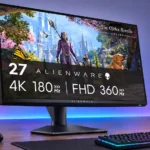
The advertised 4K/180Hz and FHD/360Hz modes are the headline strengths, though the top rates require overclock settings and 360Hz cannot always be fully resolved by the IPS pixels.
-
Height, tilt, swivel and pivot are broadly praised for smooth, flexible positioning, although desk clearance may constrain a full turn on some setups.
-
The clean black enclosure, slim bezels and understated RGB earn frequent praise. Some note it is bulkier than thin OLED designs, but it suits both gaming and workspaces.
-
The chassis, stand and assembly generally feel sturdy and well finished, with little flex and a reassuringly solid base.
-
The ability to switch between detailed 4K/180Hz and rapid 1080p/360Hz is the central attraction. It is most valuable to players who genuinely alternate between high-fidelity and competitive games.
-
The dense 27-inch 4K image makes small text and game details exceptionally crisp. The tradeoff is a much coarser-looking 1080p mode.
-
Both modes look smooth and impressively quick for IPS, with a visible benefit from higher refresh rates. Some testers say pixel response cannot fully exploit 360Hz and trails leading OLED displays.
-
Accurate, pleasing SDR colors are a major selling point, especially in sRGB or after calibration. Some testers still flag factory settings or slight deviations that matter for color-critical use.
-
Most find the centered joystick and logical menus fast to navigate. Dark menu text, tiny labels and a too-easy mode shortcut bother a few users.
-
The substantial base usually holds position without wobble and gives the panel a solid, secure feel.
-
The 1080p/360Hz mode gives fast, low-lag play without buying a separate esports screen. Its pixel response and softer fine details mean dedicated high-end 360Hz displays can still be better for the most demanding competitors.
-
Wide, vibrant color helps games and general work look appealing. Coverage is sufficient for many creators, but some competing OLEDs and professional displays reach further into demanding color spaces.
-
A fast 4K gaming experience and optional 360Hz FHD mode suit varied PC games, with adaptive sync helping smooth variable frame rates.
-
Impressions are broadly favorable among gamers who actively want both resolutions, while others question the extra cost and reduced HDR impact.
-
Tool-free or near-tool-free stand attachment is quick and straightforward, with the included cables helping users start gaming sooner.
-
The compact hexagonal stand leaves room for keyboards and accessories, making it friendlier to small desks than sprawling tripod bases.
-
Stand cutouts and rear routing help keep cables tidy, though a few users still find wires visible or awkward to route.
-
G-SYNC and variable refresh operation are generally praised for smooth, tear-free play across the monitor's resolution modes.
-
Low input lag is a consistent gaming advantage, especially in the higher-refresh 1080p mode. Testers report responsive aiming and little control delay.
-
The fit, finish and firm stand adjustments leave a distinctly premium impression, despite the thicker LCD enclosure compared with OLED.
-
Gamma tracking and the sRGB calibration earn praise for keeping tonal output predictable, with only minor corrections needed in some tests.
-
The pop-out hook is a clever convenience for keeping a headset off the desk, although its usefulness varies and one reviewer found a heavy headset could tilt the monitor arm.
-
Detailed 4K visuals and vivid color suit expansive single-player games, but flat blacks and modest HDR reduce their cinematic impact in dark scenes.
-
Convenient front-bottom ports make temporary device connections easier, even though some plugs hang visibly beneath the screen.
-
Pixel response is fast for IPS and helps make gaming smooth, but the most rigorous measurements show blur and overshoot that hold it back from the best 360Hz screens.
-
Dual HDMI 2.1 inputs are praised for carrying high refresh rates and modern-console 4K/120Hz signals without sacrificing the monitor's gaming flexibility.
-
Variable-refresh support works across PC gaming modes and modern consoles, helping keep play smooth without tearing.
-
Sharp, bright, colorful 4K output wins praise, especially for SDR and daytime use. Evaluation turns more negative when comparing HDR contrast and dark scenes with OLED competitors.
-
The 27-inch size strikes a sensible balance for 4K sharpness and 1080p esports play, even though some users would prefer 32 inches for cinematic games or a single large workspace.
-
Customizable rear lighting provides restrained gaming flair that can illuminate a wall without dominating the setup.
-
The IPS panel avoids the static-image burn-in concern that accompanies OLED alternatives, making long sessions with fixed desktop elements easier to justify.
-
Standard 100×100 mm VESA mounting makes it easy to replace the included stand with a compatible arm or wall mount.
-
Motion is generally clean in the better overdrive settings, but reviewers disagree about how much trailing remains. The fastest setting can create noticeable inverse ghosting.
-
Value depends heavily on using both modes: fans of the flexibility see a fair bargain, while several reviewers prefer cheaper 4K IPS or similarly priced OLED alternatives.
-
HDMI audio return and passthrough add a useful way to connect compatible soundbars and external audio gear, partly offsetting the missing analog headphone output.
-
Typical IPS viewing angles are usable for nearby viewers and broad desktop positioning, though very wide angles and dark scenes can wash out.
-
The center-mounted joystick is quick to reach and responsive, though its shortcut behavior can make accidental resolution changes frustrating.
-
On-screen timers, frame counters, aiming aids and picture controls provide a useful selection of gaming conveniences, though not every reviewer finds the extras essential.
-
HDMI 2.1, 4K/120Hz and VRR make it a capable match for modern consoles. Its missing onboard audio options are less convenient for certain console setups.
-
High resolution and natural color help photo editing and everyday visual work, though specialist proofing still calls for closer attention to gamut and uniformity.
-
Several USB-A ports plus a downstream USB-C socket make accessory connections practical, but the hub is not a substitute for full USB-C display docking.
-
Custom HDR color controls allow unusual freedom to adjust hue, saturation and contrast, although Smart HDR can lock standard brightness sliders.
-
Recyclable molded-cardboard packaging replaces the usual crumbly foam, a practical improvement in material choice.
-
The 27-inch chassis was easy for one tester to handle during setup and felt lighter than several comparable displays.
-
Slim borders make the monitor a neat fit for paired-screen arrangements and keep the gaming styling visually restrained.
-
The conventional IPS pixel layout keeps text crisp without the colored subpixel fringes seen on some older OLED monitors.
-
Mode switching is normally quick with the joystick and can be configured reliably. Some testers encounter application mismatches, brief freezes or a stuck on-screen overlay when changing modes.
-
A broad selection of presets and creator settings is useful, with several testers finding their preferred SDR picture quickly.
-
Creator, Custom Color and HDR tuning offer meaningful adjustment; some controls are restricted to particular modes. Calibration can improve already good color reproduction.
-
Dolby Vision's dynamic mapping and HDR tracking impress some testers, but results can still vary unexpectedly with picture modes and content.
-
Some reviewers praise the matte coating for cutting mirror reflections; others see distracting glare in front of windows. Room and light placement influence the result.
-
Night vision, aiming points and sniper-focused overlays add useful targeting aids for players who want on-screen assistance.
-
The dark stabilizer can brighten shadowed areas for play, offering a useful visibility adjustment.
-
DisplayPort 1.4 is regarded as adequate for this monitor's advertised resolution and refresh-rate combinations; a newer connector is not essential here.
-
Several HDR10 and Dolby Vision presets let users tailor the look, with Custom Color HDR singled out for its stronger image.
-
A built-in supply avoids an external power brick and keeps the desk and cable arrangement simpler.
-
Sniper and aiming overlays can help spot or target distant threats, although their value depends on whether the player uses visual assists.
-
The option to synchronize settings between resolution modes or maintain separate profiles makes switching more manageable.
-
Power draw is reasonably restrained for a bright 4K IPS screen, sitting between more and less efficient competing displays.
-
Sharp text, strong brightness and a burn-in-free IPS panel make this a good crossover screen for work and play.
Cons
Sort
-
The lack of a 3.5mm audio output is a recurring complaint, particularly for headsets, wired speakers and users swapping between sources.
-
The edge-lit zones offer little useful control over dark and bright elements. Several tests describe haloing, raised blacks or muted highlights, with limited ability to disable dimming in HDR.
-
Contrast remains a prominent weakness of the conventional IPS panel, particularly next to OLED or strong mini-LED alternatives. Some brighter-room use is less affected.
-
Most reviewers find blacks gray or washed out in darker scenes, particularly in unlit rooms. A few are satisfied with blacks when the surrounding room is illuminated.
-
Reviews are split: some find satisfying brightness and color, while others call HDR flat and unconvincing. Weak dark-scene contrast and crude edge dimming are the recurring caveats.
-
Small bright objects often lack impact or detail under edge-lit local dimming, even when larger bright scenes reach respectable luminance.
-
There are no integrated speakers. Many gamers consider that acceptable, but buyers will need separate audio hardware.
-
The coarse edge-lit dimming sometimes casts obvious halos around bright objects and subtitles, although one test found small highlights less prone to obvious blooming.
-
Darkening at edges and corners is a recurring weakness, especially on bright white backgrounds. Some samples look acceptable in games, but it can distract during precise visual work.
-
Limited USB-C charging wattage is useful for small peripherals but not convincing for powering a gaming laptop or serving as a docking connection.
-
The pixel-doubled 1080p mode remains playable and often looks better than on 32-inch dual-mode screens. Fine foliage, text and some game details can look noticeably rough or soft.
-
Unlike some larger dual-mode competitors, this screen cannot shrink its 1080p image into a 24-inch competitive viewport. That limits its appeal to players who prefer a tighter tournament-style view.
-
One owner voices frustration that OLED models were receiving updates while this IPS variant appeared overlooked; ongoing firmware support is a concern rather than an established failure.
-
An owner reports severe stuck-pixel issues with early revisions and fewer defects after replacement, making panel inspection and revision checking worthwhile.
-
Switching between separate SDR and HDR presets can be inconvenient because SDR color looks wrong in some HDR settings.
-
One tester could not get Alienware Command Center to recognize the screen despite installed drivers, turning instead to Dell Display Manager.
-
Dell Display Manager offered useful controls and window layouts after Alienware Command Center failed to detect the monitor for one user.
-
Light bleed and IPS glow weaken dark scenes, although one owner reports little visible bleed in a normally lit room. This is not an OLED-like black presentation.
-
The middle settings usually balance speed and overshoot; aggressive modes can produce inverse ghosting and often require retuning across refresh rates.
-
The HDMI, DisplayPort and downstream USB selection is useful, but a USB-C video input and analog audio jack are conspicuous omissions at this price.
-
The IPS panel delivers brightness, text clarity and immunity to OLED burn-in, while giving up OLED's deeper blacks and faster pixel transitions.
-
The matte-to-semi-gloss coating can reduce harsh reflections, though several testers notice graininess, haze or a less satisfying compromise than a truly clear glossy panel.
-
Driving 360 frames per second requires a suitably powerful PC and compatible games; the monitor's fastest mode has less benefit when hardware cannot sustain those frame rates.
-
One owner's experience suggests early panel revisions could have defects while a later replacement improved things; long-term reliability is not established across the broader sample.
-
A little flicker can occur when frame rates fluctuate, particularly in the 1080p mode, but it is described as less distracting than on many VA or OLED rivals.
-
Dolby Vision and its picture-mode options are welcome, but reviewers disagree about the practical improvement because the IPS backlight cannot deliver truly deep blacks.
Use Cases
Best for
Sort
-
Crisp 4K text, strong brightness and no OLED burn-in worry make it a convincing everyday work screen. Switching down to 1080p sacrifices that desktop sharpness.
-
One of the strongest use cases is combining sharp, reliable daily work in 4K with fast competitive gaming after hours. Its weaker HDR and lack of USB-C video still matter for particular workflows.
-
The 4K mode looks crisp and colorful for relaxed or story-driven play, with plenty of refresh-rate headroom even without switching to 360Hz.
-
High SDR brightness makes the screen practical in sunlit offices and bright rooms. Reflections can still be troublesome if a strong light or window faces the panel.
-
The fast mode aids aiming and responsiveness in shooters, but 1080p softness can complicate spotting smaller targets. Some esports-focused players may prefer a dedicated high-refresh display.
-
Stand pivot and VESA support create flexible portrait mounting possibilities, though actual clearance depends on desk height and mount position.
-
Accurate, colorful SDR output and high brightness make standard dynamic range a stronger fit than HDR, especially when local dimming artifacts are avoided.
-
Detailed 4K footage and accurate sRGB color make the panel appealing for editing, although its HDR and black-level limitations rule out demanding grading work.
-
The high-density 4K screen and accurate colors work well for everyday creative projects. Serious HDR finishing and the most demanding color tasks reveal the IPS contrast and uniformity limitations.
-
The fast FHD mode is praised for improving responsiveness and aiming precision in esports competition, although it is less specialized than a dedicated tournament display.
-
The rapid mode benefits shooters such as Apex Legends, but the reduced 1080p detail can make distant opponents more difficult to pick out. It is a speed-versus-visibility tradeoff.
-
The burn-in-resistant IPS design looks appealing for years of mixed desktop use, though scattered revision complaints mean no guarantee of defect-free ownership.
-
Compared with older TN, VA or IPS gaming screens, the bright 4K image and fast dual modes can feel like a substantial improvement.
-
Thin framing and the 27-inch size can work well in a multi-screen workspace, although edge darkening may stand out beside a more uniform display.
-
The restrained design and narrow bezels fit paired-monitor desks, but uneven white corners can be more noticeable next to a second IPS screen.
-
The sharp panel and accurate sRGB mode suit many graphic-design tasks, though its contrast and uniformity fall short of specialist displays.
-
The lower-resolution high-refresh mode is considered well suited to fast racing simulations where input speed matters more than maximum image detail.
-
The image generally remains usable for someone seated beside the primary viewer, though extreme off-axis angles lose brightness and color.
-
Bright, colorful 4K video can look appealing, but darker films expose the limitations of IPS blacks and local dimming. It is less compelling for HDR movie nights.
Conditional or not ideal for
Sort
-
Single-cable laptop dockingNo USB-C DisplayPort video input means the monitor cannot provide the simple single-cable docking that some laptop owners expect.
-
USB-C laptop dockingThe USB-C socket is for peripherals and modest power, not DisplayPort video, so laptop users will need a separate display cable and often a charger.
-
HDR gamingHDR titles can look colorful and bright, but limited dimming and gray blacks undercut cinematic highlights. More HDR-focused gamers are better served by OLED or capable mini-LED monitors.
-
Dark-room viewingDim-room use exposes elevated blacks, IPS glow and a lack of HDR depth. The screen is less immersive for dark games and movies than OLED alternatives.
-
24-inch competitive viewingPlayers who want a 24-inch tournament-style image cannot shrink the display to that size, making the fixed 27-inch viewport less appealing for that preference.
-
Budget-conscious buyersThe two-mode design can save enthusiasts from buying separate displays, but users who need only one mode can often find cheaper or better-suited alternatives.
-
Photosensitive playersOne comparison highlights IPS as a possible alternative for people bothered by OLED brightness-control flicker; individual sensitivity and settings still matter.
-
Color-critical workSharp 4K text and a well-calibrated sRGB mode support careful creative work. Uneven edges, gamut limitations and less convincing HDR keep it from being a full professional reference monitor.