
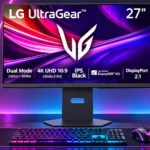
LG 27G850A-B Feature Scores
Explore all 84 feature scores for LG 27G850A-B, organized into pros and cons.
Scores by Feature
Summary
84 reviewed features-
Very positive 4.5-5.027 (32%)
-
Positive 3.5-4.420 (24%)
-
Neutral 2.5-3.413 (15%)
-
Negative 1.5-2.415 (18%)
-
Very negative below 1.59 (11%)
Pros
Sort
-
The display's powerful SDR brightness is among its most consistent strengths. It stays readable in well-lit rooms, even when set far below maximum.
-
Input processing is impressively quick at 60Hz, 120Hz, 240Hz and in the fast mode. Response-time blur, not control delay, is the bigger gaming concern.
-
Native 4K/240Hz and optional 1080p/480Hz are exceptionally ambitious for IPS. The extra refresh does improve smoothness, but slow pixel transitions limit its full benefit.
-
IPS Black avoids the persistent static-element burn-in concern associated with OLED desktops. That makes it appealing for all-day taskbars and work windows.
-
Moving between sharp 4K/240Hz and fast 1080p/480Hz is the signature attraction. Actual benefits vary with game frame rates and the panel's imperfect motion tuning.
-
The native 4K image is excellent for detail-rich games and small text. Switching to 1080p trades much of that clarity for speed.
-
The broad DCI-P3 coverage produces vibrant colors and supports wide-color work. The expansive gamut may look oversaturated in SDR unless an sRGB mode is used.
-
HDMI 2.1 and very low lag serve PS5 and Xbox gaming well, while retro signals also work unusually reliably. Consoles generally benefit more from native 4K than 480Hz mode.
-
This IPS panel responds well to calibration and can deliver very accurate, vibrant colors. A colorimeter is preferable to copying another unit's settings.
-
The joystick menu is responsive and relatively easy to navigate. Its controls compare well with pricier gaming displays.
-
The monitor works with major adaptive-sync formats, including FreeSync and G-SYNC Compatible modes. This provides flexibility across gaming PCs and consoles.
-
Height, tilt, swivel and pivot controls provide good ergonomic flexibility. Even at its lowest setting, the panel can sit slightly higher than expected.
-
Native 4K at 27 inches delivers extremely fine text and crisp details. The pixel-density advantage largely disappears in the 1080p high-speed mode.
-
Gameplay benefits from smooth, tear-free variable refresh over a broad frame-rate range. Brightness stability is generally good, with some higher-mode flicker caveats.
-
The sturdy stand keeps the display firmly in place with minimal wobble. Its flat metal base is especially well received.
-
Modern inputs, variable refresh and two speed modes make this a flexible gaming PC display. High frame-rate performance is limited by graphics hardware and visible motion blur.
-
The monitor keeps input lag impressively low even at 60Hz. That makes slower or capped games feel responsive instead of sluggish.
-
Two full-bandwidth HDMI 2.1 inputs make it easy to connect high-refresh PCs and modern consoles. Low latency is retained across supported signals.
-
Tool-free stand assembly makes getting the monitor ready straightforward. The included cables also simplify first-time connection.
-
Native 4K text and images are exceptionally crisp, with moderate sharpening settings preferred. Extreme sharpness creates artifacts, and the 480Hz mode is noticeably softer.
-
Crosshairs, a refresh counter and shadow controls offer useful in-game tools. The selection is practical, though not especially extensive for a premium gaming screen.
-
The 480Hz option and extremely low lag suit esports on powerful PCs, but motion trails hold it back against the sharpest competitive displays. The experience is especially frame-rate dependent.
-
DisplayPort 2.1 is a welcome advantage over some rivals, but bandwidth limits still require compression at 4K/240Hz. Certain graphics-card and driver combinations may need attention.
-
Dedicated sRGB and DCI-P3 options help rein in oversaturation or work in a wider gamut. Some presets still need white-balance adjustment.
-
Nano IPS Black brings better contrast and bright, crisp text without OLED burn-in worries. Its slower pixel response and limited black depth still matter for dedicated gaming.
-
IPS Black is a welcome improvement over ordinary IPS, with roughly doubled native contrast in some testing. It still falls far behind good OLED or Mini LED dark-scene performance.
-
Rich 4K detail suits visually elaborate single-player games, though weak HDR contrast limits cinematic impact. If those games run well below 240fps, the extra high-refresh hardware offers less value.
-
The casing feels solid and carefully assembled. Despite some plastic surfaces, the monitor comes across as well built.
-
The panel's supported color-depth processing helps gradients appear smooth rather than visibly banded. It is a useful strength for images with subtle transitions.
-
Slim borders, restrained RGB and a simple gray housing make the monitor look sleek rather than overly flashy. The flat stand base is also attractive.
-
The flat metal stand base takes up relatively little desk space and can hold small items. It is a practical design for a crowded setup.
-
Fine tonal transitions look smooth thanks to the monitor's color-depth support. The absence of obvious banding helps subtle colors look clean.
-
The internal fan was effectively inaudible during ordinary use. Cooling noise should not be a distraction in a typical setup.
-
LG's Switch software lets you adjust on-screen settings with a mouse and keyboard. It is more convenient than reaching behind the monitor.
-
The monitor accepts commonly used PS5 signals with very low lag. Its sharp 4K mode is the sensible choice rather than the PC-focused 480Hz mode.
-
Typical IPS viewing angles remain wide and reliable despite the added contrast of IPS Black. The picture holds up well when viewed off center.
-
Windows 11 automatic color management successfully reins in wide-gamut oversaturation. Colors remain wide-ranging without looking excessively vivid in ordinary sRGB content.
-
Power draw is fairly reasonable for a bright, high-refresh IPS display and drops at lower rates. A comparable QD-OLED can use somewhat more energy under similar conditions.
-
Variable refresh is generally stable, particularly at 240Hz, but the 480Hz mode may flicker slightly during abrupt frame-rate changes. It is usually not very distracting.
-
Black Stabilizer helps reveal targets and details in dim scenes. It is a useful additional gaming control.
-
Subtle rear lighting adds a little gaming character without dominating the design. Its restrained treatment is more tasteful than many flashy gaming monitors.
-
Adjustable white balance and detailed color controls help fix factory inaccuracies. The flexibility is valuable when dialing in an accurate sRGB image.
-
The fastest 4K mode requires DSC, but normal use shows little or no visible quality penalty. The limitation matters more to buyers seeking an uncompressed signal.
-
The headphone output makes it simple to attach headphones or an inexpensive soundbar. This is helpful because the monitor has no built-in speakers.
-
Thin bezels on three sides keep the appearance relatively clean and modern. The small lower chin preserves a practical control area.
-
The panel looks fairly uniform across its center with slight edge darkening. Vignetting is generally subtle in real content.
-
Vibrant, sharp and bright SDR images are a real attraction. Weak HDR contrast and inconsistent local dimming keep it from delivering flagship all-round picture quality.
Cons
Sort
-
Just eight edge-lit zones are too coarse for convincing HDR. Enabling them often adds halos, delayed transitions or muted highlights instead of genuinely deeper scenes.
-
Its bright, wide-color HDR signal is much less impressive than the specification badge suggests. Eight edge-lit zones produce halos and disappointing scene contrast.
-
Small bright highlights can be dimmed rather than emphasized, while other details disappear in shadow. The limited dimming zones undermine HDR sparkle.
-
Bright objects can light up large vertical strips of the screen, creating pronounced halos. The eight-zone edge backlight is a poor fit for contrast-heavy content.
-
Coarse vertical dimming zones respond slowly to moving highlights and can alter brightness abruptly. Their behavior makes HDR more distracting than convincing in challenging scenes.
-
Native 4K is razor sharp, while the 1080p high-speed mode is conspicuously softer for text. Lower-resolution game signals can look decent with measured sharpening.
-
The specialty dual-mode combination can be defensible at a discount for buyers who use both modes. Slow pixel response and poor HDR make full premium pricing difficult to justify.
-
Slow transitions and aggressive overdrive can both produce visible trails. Some testers find the motion acceptable, while others consider ghosting a dealbreaker at 240Hz.
-
Integrated speakers are absent, which is frustrating for basic system sounds on an expensive screen. An external audio device is required.
-
Pushing 4K at 240fps or 1080p at 480fps requires a genuinely powerful gaming system. Less capable PCs may need lower settings or upscaling to realize the benefit.
-
The edge-lit backlight struggles to keep shadow detail alongside bright elements. Dark scenes can appear flatter or less legible than expected from a premium HDR display.
-
The fastest settings can produce inverse ghosting, while slower ones blur motion. Different refresh-rate modes need separate compromises that the monitor does not remember automatically.
-
The simulated 24-inch view is particularly blurry, with scaling that makes small text harder to read. It is better suited to occasional competitive gaming than desktop tasks.
-
The monitor lacks a hardware KVM switch, a disappointment at this price. LG's software sharing option is less seamless and requires networked computers.
-
Different speed modes benefit from different overdrive choices, but the monitor does not retain them separately. Repeated manual changes become tiresome.
-
Unlike some rivals, the USB-A ports do not provide independent power for charging accessories. A data connection to the computer is necessary.
-
Ordinary IPS use avoids the familiar OLED burn-in worry, but external BFI techniques can introduce temporary retention risks. Specialist settings deserve care.
-
DisplayPort 2.1 configurations with some RTX 50-series drivers have a documented black-screen caveat. Checking drivers or trying HDMI may help when connection issues arise.
-
The two downstream USB-A connections are useful once the upstream cable reaches a PC. They cannot function or charge devices independently from the monitor.
-
Fast HDMI 2.1 and DisplayPort 2.1 inputs are well suited to PCs and consoles. The absence of USB-C and hardware KVM support limits premium productivity appeal.
-
Local dimming can cause jarring shifts in brightness as windows and scenes change. Disabling that feature may produce a more stable image.
-
The flat 27-inch format disappointed a user who prefers curved monitors for immersion. There is no curved alternative in this version.
-
Aggressive HDR settings overbrighten scenes and deviate from the intended luminance curve. More restrained modes sacrifice some brightness or black-depth control.
-
The advertised 1ms response and DisplayHDR 600 branding can create unrealistic expectations. Real pixel response and dimming performance are less impressive than the headline specifications.
-
Rearward, downward-facing connections are awkward to reach after installation. Frequent cable swapping may be frustrating.
-
Factory gamma and white balance are generally reasonable but vary by mode and unit. Calibration can correct the remaining inaccuracies.
-
The matte surface limits glare effectively but adds a little grain. The tradeoff is usually mild compared with its reflection benefit.
-
Measured pixel transitions fall short of what many expect from a top-end 240Hz screen. Some testers are satisfied with the motion; others find it slow for the price.
-
IPS Black delivers noticeably deeper blacks than conventional IPS displays. Bright objects still expose grayish blacks and the substantial gap to OLED.
-
There is no built-in BFI option, but external processors can deliver surprisingly clear motion with careful setup. Flicker, dimming and potential image retention make this a specialist experiment.
-
Some IPS glow is visible in dark scenes and at oblique angles. It remains manageable in ordinary viewing, though dark-room users may notice it.
-
Switching from 4K to the 1080p high-speed mode works smoothly via a dedicated control. Different modes still need manual overdrive retuning.
-
Multiple dimming intensities are available, but each involves a compromise in brightness or tone mapping. None completely fixes weak local contrast.
-
The matte coating diffuses most ordinary glare well, at the price of slight grain. Direct sunlight across the screen can still impair visibility.
-
Opinions range from excellent for an IPS panel to deeply disappointing against other 240Hz models. Across that divide, OLED is consistently clearer during fast motion.
-
Color accuracy is generally good, with some calibration modes and panels showing imperfect gamma or white balance. Proper calibration can produce much better results.
-
The screen impresses for work, retro input compatibility and mixed gaming, but its speed tuning and price attract serious criticism. Satisfaction depends heavily on the intended use.
Use Cases
Best for
Sort
-
The sharp, bright IPS display handles static daytime work and fast evening games without OLED burn-in worries. It is strongest when both modes see regular use.
-
Sharp 4K text, high brightness and no OLED burn-in concern make this a comfortable work monitor. Missing USB-C docking features and soft text in 1080p mode are the notable limitations.
-
High SDR brightness makes daylight use a major strength, often without needing maximum brightness. A window shining directly into the screen can still overwhelm the matte finish.
-
The LG accepts older 240p, 480i and 480p sources as well as modern scalers with unusually low latency. That flexibility is especially attractive to retro enthusiasts.
-
Extremely fast shooters can make practical use of the optional 480Hz mode when the PC sustains high frame rates. Soft 1080p visuals and ghosting are the compromises.
-
The native 4K panel provides sharp workspace detail and ample brightness for editing. The picture is exceptionally clear in daily editing use.
-
Calibrated sRGB and DCI-P3 presets make it promising for color-sensitive tasks, with further refinement available. Print-focused work benefits from additional calibration.
-
Unusual classic-game signals worked reliably in hands-on testing, including low-latency modes. It is a more accommodating choice than some premium OLED rivals.
-
Vibrant color, strong brightness and improved IPS contrast make SDR games look excellent. HDR limitations are much less consequential when SDR is the priority.
-
The LG fits naturally into a dual-monitor desk as the primary screen beside another display. Its crisp IPS picture works well in a mixed-display workspace.
-
LG's software can share a mouse and keyboard between two networked PCs. It is helpful in compatible setups but not a hardware KVM replacement.
-
Good wide-gamut coverage provides a useful starting point for print-oriented work. Calibration is recommended for the most reliable color accuracy.
Conditional or not ideal for
Sort
-
HDR gamingBrightness alone cannot compensate for washed-out blacks and crude local dimming. HDR-first gamers are better served by strong Mini LED or OLED alternatives.
-
USB-C laptop dockingWithout USB-C video input or charging, this is not a one-cable laptop workstation solution. Buyers who rely on docking should consider another monitor.
-
Dark-room viewingIPS Black improves on ordinary IPS, but grayish blacks, glow and ineffective local dimming can spoil dark scenes. HDR enthusiasts will find stronger options elsewhere.
-
Photosensitive playersOptional externally generated BFI can introduce obvious flicker and reduced brightness. Those sensitive to flicker or headaches should avoid that setup.