
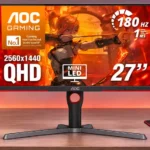
AOC Q27G3XMN Feature Scores
Explore all 74 feature scores for AOC Q27G3XMN, organized into pros and cons.
Scores by Feature
Summary
74 reviewed features-
Very positive 4.5-5.023 (31%)
-
Positive 3.5-4.424 (32%)
-
Neutral 2.5-3.48 (11%)
-
Negative 1.5-2.414 (19%)
-
Very negative below 1.55 (7%)
Pros
Sort
-
Delivering high-brightness Mini LED HDR, 1440p and 180Hz at a budget-level price is the most consistent compliment. A few newer alternatives may beat its feature set at similar prices.
-
High native VA contrast pairs with effective local dimming for much greater separation between bright highlights and dark backgrounds than typical budget IPS displays.
-
The VA panel produces notably deep blacks even without local dimming; switching on the Mini LED zones gives dark games and movies considerably more depth.
-
Unusually high SDR output and HDR peaks beyond 1,000 nits are recurring strengths. Small isolated highlights can dim to limit blooming, and the highest HDR level can feel uncomfortable at night.
-
Rich colors, exceptionally high contrast and striking HDR lift the image well above most monitors in the same price class. The image is strongest when viewed head-on.
-
Height, tilt, swivel and portrait pivot are generous for the price, although some users notice wobble or stiffness during adjustments.
-
Bright, convincing HDR is the standout reason to buy: Mini LED dimming adds depth and punch beyond most conventional monitors in this class. Blooming, restricted HDR controls and differing calibration experiences keep it short of premium OLED precision.
-
Most assessments are enthusiastic about the picture for the money, even while acknowledging more modest ergonomics, controls and motion behavior.
-
Low SDR latency makes input feel responsive at high refresh rates. HDR processing and 60Hz operation can introduce noticeably more delay, depending on settings.
-
1440p on 27 inches is a pleasing balance between crisp text and gaming performance, requiring less GPU power than 4K.
-
FreeSync and compatible G-SYNC generally provide smooth, tear-free play on PCs. The benefit can be undermined by noticeable flicker during large frame-rate swings.
-
Broad DCI-P3 coverage makes HDR games and videos rich and saturated. Default wide-gamut SDR modes can overcook reds and skin tones until clamped or calibrated.
-
Story-driven and atmospheric games benefit especially from the strong shadows and HDR highlights. The residual dark smearing is easier to forgive here than in top-level esports.
-
It is a particularly strong match for 1440p PC games where DisplayPort can unlock 180Hz, HDR and adaptive sync. Users prioritizing flawless competitive motion may want something faster.
-
Up to 180Hz over DisplayPort gives fluid gameplay and noticeably smoother desktop motion. HDMI tops out lower, and faster competitive displays remain available.
-
FreeSync and compatible G-SYNC generally work well on PCs, but the monitor lacks HDMI Forum VRR support needed for certain console setups.
-
Text and game detail look crisp at native 1440p, helped by standard RGB subpixels and a relatively clear screen coating.
-
Pixel transitions are comparatively quick for VA at high refresh rates, but results depend heavily on overdrive and can show dark trails or overshoot.
-
The 336-zone backlight delivers unusually strong contrast for its price, but opinions diverge on blooming, zone transitions and flicker. Several recommend Strong for video while others prefer Medium or disabling it for desktop work.
-
At high frame rates, motion looks fluid and reasonably clear for a VA panel. Fast esports detail and darker transitions are less crisp than on higher-refresh IPS alternatives.
-
DisplayPort 1.4 is the preferred route to the full 180Hz experience and the broadest combination of HDR and adaptive sync.
-
Units checked by several reviewers showed little or no troublesome corner bleed, helping black scenes retain a cleaner appearance.
-
Tool-free stand assembly and clear instructions make first-time installation straightforward.
-
The 27-inch QHD format serves gaming, browsing and occasional creative work well, provided local dimming and color settings are adjusted for the task.
-
The plastic shell generally feels adequately solid for the price, but a few units and stands have some wobble or minor fit-and-finish issues.
-
Standard 100×100mm mounting provides easy compatibility with a monitor arm when the included stand is too bulky.
-
The relatively light matte coating preserves a clearer, less grainy image than many heavier anti-glare surfaces, though reflections are more defined.
-
The VA panel is a clear advantage for dark blacks and HDR contrast, but its narrower angles and dark-transition smearing are real compromises.
-
The 27-inch screen is a comfortable compromise for a single-user desktop and 1440p gaming, without the GPU demands of a larger 4K display.
-
There are useful game, HDR and shadow adjustments, with the default DisplayHDR mode commonly preferred. Some alternatives oversharpen or oversaturate the image.
-
Automatic transitions between SDR and HDR can preserve separate preferred settings, reducing the need for repeat configuration.
-
Its light matte surface reduces most everyday glare without the grain of heavier coatings, though direct light remains noticeable and can wash out blacks.
-
A cutout through the stand helps route connections neatly and keeps cables from dangling across the desk.
-
Its mostly black, lightly red-accented styling avoids an overly flashy gamer look. The execution is simple rather than luxurious, and tastes differ on the red trim.
-
Medium provides a useful balance across varying refresh rates, while Strong can reduce smearing at 180Hz but introduces distracting inverse ghosting at lower rates.
-
Color reproduction can be good, particularly with retail firmware and the sRGB mode, but reports differ across units and regional firmware. Red or warm tints, oversaturation, and limited HDR adjustment complicate precision work.
-
Its LCD construction appeals to buyers wary of OLED burn-in, making everyday static desktop content less of a concern.
-
The box includes useful display cables and power connections, avoiding an immediate extra cable purchase for common setups.
-
Standard RGB subpixels give text a cleaner appearance than certain OLED subpixel layouts, avoiding some of their fringing or ClearType softness.
-
Despite being fairly substantial, the display is manageable to set up and reposition; it is not a lightweight travel screen.
-
Low-blue-light and high-frequency or flicker-free backlighting are welcome, though some sensitive users may still notice dimming fluctuations or experience discomfort.
-
High HDR brightness can be sustained during normal gaming, although unusually long full-white scenes may trigger temporary dimming as the panel manages heat.
-
Shadow Control can lift dark areas to make opponents easier to spot, though it is a fairly standard gaming adjustment.
-
It works well with PCs and can also be paired with a Mac using DisplayPort-over-USB-C, though the chosen connection affects maximum refresh rate and VRR.
-
It runs without a cooling fan and can throttle extreme sustained white HDR output to protect against heat, without disrupting typical gaming use.
-
The construction is described as durable and dependable for a budget model, although longer ownership reports also raise firmware and unit-variation concerns.
-
Setup materials and included guides are helpful, but factory calibration reporting has also been criticized as confusing or inaccurate.
Cons
Sort
-
The use of HDMI 2.0 prevents the full 180Hz link and limits some next-generation console features. It is one of the clearest hardware compromises.
-
No USB data hub is included, forcing peripherals to connect elsewhere even though some price rivals offer USB-A or USB-C.
-
The row of hard-to-identify buttons is a near-universal irritation: changing settings feels slow and accidental shutdowns are common.
-
The VA panel washes out noticeably away from center, including at the edges from close seating positions; it strongly favors one head-on viewer.
-
The absence of user-installable firmware updates is a significant drawback for owners who encounter a software or control bug.
-
The two HDMI 2.0 connections, one DisplayPort and audio output cover basic needs, but lack of USB-C and USB data ports feels sparse for a modern desk.
-
Initial setup is straightforward, but daily adjustments can be irritating because the control buttons and menu navigation require too many presses.
-
Stock and regional distribution have been inconsistent, so buyers may encounter shortages or substantially different prices.
-
Brightness flicker as frame rates fluctuate is one of its most significant recurring drawbacks. Some find it tolerable in active play, while others disable VRR in affected games.
-
AOC G-Menu offers some computer-based controls, but not the full OSD experience, and software or firmware limitations remain.
-
There is no integrated KVM function, making shared keyboard-and-mouse workflows across computers less convenient.
-
At least one detailed long-term account reports audible coil whine at certain brightness settings, with another tested unit behaving differently.
-
Third-party brightness-control tools are reported as unreliable over DisplayPort, with commands sometimes ignored and no easy software fix.
-
The advertised 1ms response figure is an idealized specification rather than representative behavior across all pixel transitions and settings.
-
Neither picture-in-picture nor picture-by-picture is offered, limiting simultaneous viewing of multiple sources.
-
The lack of speakers is a convenience tradeoff. Some find it acceptable with headphones or separate audio, while others would welcome built-in sound.
-
The wide stand gives the screen a steady base but reaches far back on the desk; shallower workspaces may feel cramped.
-
1440p at up to 120Hz and 4K-signal downsampling make console gaming viable. HDMI 2.0 means fewer VRR and bandwidth options than modern HDMI 2.1 console monitors.
-
Some HDMI users report difficulty getting full-height 4:3 output at certain legacy resolutions, with smaller windowboxed images instead.
-
Non-native resolutions appear softer than desired, and the limited sharpness controls make it hard to fine-tune older or lower-resolution sources.
-
Switching the screen off can disconnect it from Windows and rearrange open windows on another monitor, an annoyance in multi-display desks.
-
Faint horizontal banding can appear in particular colors at the highest refresh rate; lowering it toward 144Hz reduces the visibility.
-
The 180Hz refresh and low lag work well for casual competition, but finer detail in fast motion and dark smearing fall short of faster esports-focused IPS screens.
-
Sturdy enough in places, but simple plastics, the chunky panel and modest controls do not deliver a consistently premium impression.
-
Power use is typical rather than exceptional, and one comparative measurement finds it somewhat less efficient than rival Mini LED designs.
-
This is better than many older VA monitors for dark trails, yet smearing remains visible in shadowy motion, especially at lower refresh rates.
-
Findings vary by unit: some screens appear very even, while others show edge vignetting, dirty-screen patches or color-temperature shifts.
Use Cases
Best for
Sort
-
It brings convincing Mini LED HDR to a much lower price bracket than buyers might expect. Regional pricing and availability can change how compelling the deal is.
-
HDR titles benefit enormously from deep blacks and intense highlights, especially in cinematic scenes. Haloing around small objects and frame-rate-related flicker temper the impact.
-
Bright HDR highlights and strong blacks lend movies a lively, cinematic quality. Small subtitles and stars can trigger halos or reduced highlight brightness.
-
The substantial SDR brightness helps it remain clear in bright rooms, though strong direct reflections can still compromise the dark-scene advantage.
-
Mac users can reach the full refresh rate and HDR features through a suitable DisplayPort-to-USB-C connection. HDMI cuts the maximum refresh and disables VRR in the tested setup.
Conditional or not ideal for
Sort
-
Shared-screen viewingOff-center viewers see contrast and colors wash out quickly, so it is not ideal for co-op play or showing content to a group.
-
Color-critical workWide gamut is useful for hobbyist editing, but VA angle-related shifts, variable calibration and limited mode controls make it a poor substitute for a color-consistent professional display.
-
Low-distraction useOccasional dimming fluctuations, flicker and reported coil whine can be distracting for sensitive users, especially during quiet work or dark games.
-
Video editingWide gamut and usable sharpness support occasional editing, but viewing-angle shifts and calibration limitations make professional color grading a poor fit.
-
Long-term ownershipThe screen can remain compelling as a daily desktop and gaming upgrade, but the lack of user firmware updates may leave owners stuck with persistent bugs.
-
Multi-computer workflowsMultiple video inputs are available, but no KVM or USB-C dock means moving peripherals and switching workstations requires extra hardware.
-
Photosensitive playersVRR and local-dimming flicker can become particularly distracting in some scenes, so flicker-sensitive players should be cautious.
-
Desktop productivity1440p text and responsive scrolling make regular work enjoyable, but local dimming can create distracting halos around cursors and windows, so SDR without dimming is often more comfortable.