
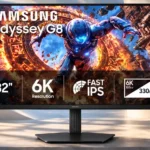
Samsung Odyssey G80HS S32HG80 Feature Scores
Explore all 92 feature scores for Samsung Odyssey G80HS S32HG80, organized into pros and cons.
Scores by Feature
Summary
92 reviewed features-
Very positive 4.5-5.028 (30%)
-
Positive 3.5-4.423 (25%)
-
Neutral 2.5-3.417 (18%)
-
Negative 1.5-2.414 (15%)
-
Very negative below 1.510 (11%)
Pros
Sort
-
Fine text, distant game geometry, and high-resolution photographs look exceptionally clean at 6K; switching to 3K sacrifices some of that crispness.
-
Its unusual 6144×3456 native resolution delivers a dramatic text-and-detail upgrade, especially for work; the performance cost makes full-res gaming less universally useful.
-
The exceptionally dense 32-inch 6K panel makes individual pixels nearly invisible at normal distance and noticeably improves fine type and imagery.
-
Its standout trick is pairing exceptionally clear 6K/165Hz work with useful 3K/330Hz gaming, a far less severe resolution cut than 4K-to-1080p dual-mode screens.
-
Height, swivel, tilt, and 90-degree pivot adjustments are repeatedly praised, even by reviewers disappointed with the chassis materials.
-
Combining 165Hz at 6K with 330Hz at 3K brings a fluidity rarely seen in high-density screens, even if actual gaming frames depend on the GPU.
-
Across the native and fast modes, input lag stays extremely low and controls feel responsive.
-
The 3K/330Hz mode gives high-frame-rate competitors a viable option, though slower IPS transitions and low-frame-rate ghosting keep it from leading dedicated esports displays.
-
A roomy 32-inch canvas suits high-DPI work and immersive play, although using 6K requires scaling and does not magically expand the physical viewing area.
-
Fine RGB controls and full calibration can produce excellent SDR color accuracy, even where factory white balance misses the mark.
-
Extensive white-balance, gamma, and color-space adjustments let owners correct factory inaccuracies rather than relying on an inflexible preset.
-
A 4K image can be viewed at native size with editing tools still visible, making detailed photo work easier than on a same-size 4K monitor.
-
The non-grainy matte coating keeps ordinary glare manageable, though some dedicated work monitors handle bright reflections better.
-
6K sharpness earns consistent admiration, while weaker contrast, HDR punch, and panel consistency stop the overall image from being an unquestioned class leader.
-
The broad, flat stand generally holds the screen securely; a small amount of wobble appears during some adjustments.
-
FreeSync Premium and G-SYNC compatibility make variable-refresh play practical, with no obvious VRR flicker in one detailed test.
-
Around 440–480 nits is ample for ordinary indoor work but falls short of the impact and flexibility of brighter premium HDR rivals.
-
The restrained, slim black shell suits both office and gaming desks, although reviewers differ on whether it feels polished enough for the price.
-
Testing generally finds good or excellent gamma behavior, which can improve further with the available calibration controls.
-
The light matte finish suppresses reflections without much grain, preserving the panel's unusually fine detail.
-
Tool-free assembly and manageable weight make the monitor reasonably straightforward to install.
-
Factory calibration impressions range from excellent to merely adequate, but the display can become very accurate after adjustment.
-
A restrained rear RGB ring adds ambient effects without dominating the design, and it can be switched off for a simpler workspace.
-
Compression is required for full 6K/165Hz operation, but technical testing found no meaningful practical downside to the selected DisplayPort bandwidth.
-
Two modern HDMI inputs provide high-bandwidth video, though achieving every mode still depends on the source and proper cabling.
-
A cutout in the stand lets cables pass cleanly behind the screen for a tidier setup.
-
HDR luminance tracking can be precise, with optional active tone mapping producing a slight brightness lift at the expense of some midtone detail.
-
High-bandwidth HDMI and DisplayPort cables arrive in the box, making initial connectivity easier even if the supplied DP cable is relatively short.
-
Narrow edges and a modest bottom chin keep the front clean and focused on the image.
-
The flat base doubles as a convenient place for accessories, but its broad, chunky shape is less ideal on a tight desk.
-
Pixel transitions are adequate for gaming but not fast enough for perfect 330Hz compliance; careful settings and high frame rates help avoid artifacts.
-
The rear joystick divides opinion: some find it fast and intuitive, while others dislike its feel, location, and accidental mode switching.
-
There are several genre-based and general presets; the useful all-around modes work well, while genre differences can be quite subtle.
-
The analog audio output is useful because the monitor has no internal speakers, though its placement is not always effortless to reach.
-
Adjustable shadow boosting helps uncover dark details in games and films without simply raising the entire black point.
-
The IPS panel avoids OLED-style long-term static-image burn-in worries, making it appealing for persistent desktop controls and documents.
-
Smooth grayscale and color transitions showed little obvious banding in technical inspection.
-
Startup appeared as quick as a normal monitor rather than adding the delay observed on some other 6K displays.
-
Remembered brightness settings for each signal mode make transitions between SDR work and HDR entertainment less tedious.
-
The IPS panel showed no perceptible VRR flicker even when frame rates changed rapidly.
-
Separate HDR settings and tone-mapping choices offer useful flexibility, even though the limited backlight constrains the result.
-
Windows' automatic color management can restrain oversaturated SDR colors, though it does not fix every grayscale calibration issue.
-
The fast mode looks distinctly clearer than 165Hz, but IPS pixel response and low-frame-rate overshoot prevent OLED-like motion clarity.
-
The 3K mode looks surprisingly good for a halved-resolution display, while desktop text and older games can expose softness or tiny interfaces.
-
Dynamic Brightness can boost perceived contrast, although its histogram-based behavior is not equivalent to a physical ambient-light sensor.
-
Low IPS glow is a welcome improvement over some competing LCD panels, especially when viewed from off-center.
-
Samsung provides downloadable firmware updates, but software-based monitor control does not necessarily handle the update process.
-
The external power adapter can be swapped without opening the display, a practical maintenance benefit of its design.
-
The backlight is flicker-free with local dimming off, while enabling dimming at reduced SDR brightness introduces PWM that may bother sensitive users.
-
Shadow and black-equalizer controls can reveal more near-black detail, although they cannot deliver true OLED-like black depth.
-
Experiences differ: the horizontal rear ports seem accessible to one user, while another struggled to attach cables by touch.
Cons
Sort
-
The minimal edge-lit dimming system seldom adds much real-scene contrast and is the clearest technical obstacle to convincing HDR.
-
Native 6K gaming can overwhelm even powerful GPUs, making high refresh at full resolution a costly and often unrealistic target in demanding titles.
-
Accurate tracking in some tests cannot fully compensate for limited peak brightness and weak real-scene separation of bright highlights.
-
A built-in KVM is missing, reducing convenience for buyers who alternate between multiple computers with shared peripherals.
-
Neither split-screen input mode is provided, a notable omission on a large high-resolution panel meant for flexible setups.
-
Black-frame insertion is missing, so motion tuning depends on the refresh modes and response behavior instead.
-
The unique 6K/330Hz combination can justify a discounted price for specialists, but many reviewers see much better HDR or gaming value in cheaper OLED alternatives.
-
Blacks generally look gray beside OLED and good Mini LED displays, although one test found better native IPS contrast than expected.
-
Opinions diverge sharply. Some praise accurate, attractive HDR, but the prevailing concern is that a basic edge-lit backlight delivers little of the contrast expected at this price.
-
Overdrive cannot be adjusted with VRR enabled, causing a frustrating tradeoff between transition speed, tearing avoidance, and inverse-ghosting artifacts.
-
The slim body has an understated look, but inexpensive plastic and the joystick prevent it from consistently feeling like a premium-priced display.
-
No Thunderbolt dock or USB-C video input is built in, so laptop users may need an external hub and additional cables.
-
There are no internal speakers. Most see that as an omission at this price, though one commentator would rather avoid low-quality monitor speakers.
-
Fast motion is generally serviceable, but inverse ghosting becomes visible at lower variable refresh rates in 3K mode.
-
Several tests found edge darkening or patchiness on plain backgrounds, while another owner praised the absence of the blue blotches seen on rivals.
-
There is no strobing blur-reduction option, a missed feature for players prioritizing maximum motion sharpness.
-
At full 6K on a taxed graphics card, blur made distant targets hard to identify while moving, undermining precise shooter play.
-
An owner describes intermittent half-screen corruption with certified DisplayPort cables, suggesting a frustrating signal issue on at least one unit.
-
One owner received a unit with dead pixels and returned it; that individual experience flags quality control without establishing a wider failure rate.
-
Fast IPS is a sensible choice for sharp text and burn-in-resistant work, but its blacks and motion are less striking than OLED alternatives.
-
Modern HDMI and DisplayPort connections handle the demanding signal, but missing USB-C and Thunderbolt and a small USB hub reduce workstation appeal.
-
A couple of USB-A data ports offer basic peripheral connectivity, but the hub feels limited for a premium productivity-capable monitor.
-
Low-blue-light modes are available, but locked brightness and other restrictions make them frustrating compared with manual color-temperature adjustment.
-
One owner reported static appearing mostly after cold starts and sometimes during normal work, temporarily cleared by changing refresh rates.
-
The traditional 16:9 shape disappoints someone who would prefer a wider, wraparound field for immersive games.
-
A customer seeking help with recurring image corruption felt Samsung had not clearly escalated detailed troubleshooting to engineers.
-
Mode changes can be awkward: the joystick cycles through an extra 24-inch option, and one MacBook connection required switching back to HDMI to escape a no-signal dual mode.
-
VRR provides smooth gameplay but locks the overdrive setting; the fixed tuning can become troublesome at lower frame rates.
-
Most testers find typical decent IPS angles, but edge dimming and brightness shifts drove one office-focused owner to return their sample.
-
Modern graphics hardware with the right HDMI or DisplayPort output can exploit both gaming modes; older cards can fall well short of the advertised refresh rate.
-
The simulated 24.5-inch view is usable for fast action, but scaling leaves lower resolutions visibly blurrier than the full panel.
-
The compact external power brick keeps power hardware outside the panel and can be replaced, though it adds another component to manage.
-
Samsung's desktop utility offers some settings, but important controls are still unavailable through the software.
-
Reports conflict: some praise a solid assembly and sturdy feel, while others criticize the basic plastic construction and flimsy-feeling rear joystick.
-
The menu itself can be intuitive, yet the rear joystick attracts complaints about location, cheap feel, and awkward quick-switch behavior.
-
Crosshairs, presets, and a shadow-control option cover the basics, but strobing, some overlays, and advanced multi-input features are absent.
-
The dense screen suits macOS integer scaling, but practical refresh ceilings, adapter requirements, and the lack of Thunderbolt depend heavily on the Mac and connection. One user could not establish DisplayPort video until turning off dual mode over HDMI.
-
Cinematic games look extremely detailed at native 6K when hardware can cope, but modest HDR and lower performance detract from the spectacle.
-
DisplayPort 2.1 supports the demanding native mode; older DP 1.4 devices and some Mac configurations encounter substantial refresh-rate limits.
-
Coverage is broad enough for vivid general use and some creative work, yet falls short of wider-gamut OLED and some competing 5K panels.
-
Its native contrast is good for IPS by some measurements, but cannot compete with OLED black depth; a few assessments rate its dynamic contrast much more favorably.
Use Cases
Best for
Sort
-
Six-kilopixel text, smooth 165Hz desktop motion, and abundant detail make this a serious office screen, although edge dimming distracted one demanding full-screen white-background user.
-
Unlike many other large monitors, the adjustable stand can rotate the entire 32-inch panel into portrait orientation for long documents.
-
This is most compelling when someone genuinely needs both the 6K desktop and 3K gaming modes; the weak HDR and limited laptop I/O remain important compromises.
-
Slower-paced games can showcase the 6K detail, while the 3K mode provides a smoother, more attainable option for everyday play.
-
Editing tools, high-resolution assets, and timelines benefit from the unusually crisp canvas, although color-critical workflows may need calibration and a different gamut.
-
Fast, detailed SDR gaming is an effective complement to productivity use, especially in the balanced 3K mode where frame rates are easier to sustain.
-
Detailed strategy games and city builders make strong use of the 6K panel for text, maps, and dense interfaces without excessively taxing graphics hardware.
-
The reasonably bright IPS panel is comfortable in ordinary indoor light and holds an advantage over some dimmer OLED alternatives; dedicated productivity displays can still get brighter.
-
The 6K canvas can show 4K footage at 100% scale while leaving room for timeline and editing controls.
Conditional or not ideal for
Sort
-
USB-C laptop dockingWithout a USB-C display input or power delivery, the monitor is poorly suited to true one-cable laptop workstations.
-
HDR gamingHDR presentation is disputed: one enthusiastic assessment praises it, while several tests fault dim highlights and poor local dimming compared with OLED or Mini LED.
-
Budget-conscious buyersGaming-focused alternatives cost substantially less while delivering better HDR or motion performance, making this an impractical budget choice.
-
Dark-room viewingRaised IPS blacks, modest HDR contrast, and a relatively high minimum brightness limit the experience in dim surroundings.
-
Native 6K AAA gamingNative 6K visuals can look spectacular but require severe graphics compromises in demanding modern games; 3K is usually the more practical setting.
-
Print photo editingInadequate Adobe RGB coverage makes this a questionable choice for color-managed print workflows requiring that gamut.
-
Retro and older PC gamingOlder PC games can run into scaling mismatches at 6K, leaving interface text tiny or assets looking muddy despite the high-resolution panel.
-
Color-critical workThe display can be made accurate for SDR and some P3 work, but restricted Adobe RGB or P3 coverage and unevenness make it less reassuring than a dedicated reference monitor.
-
Movies and streamingVideo looks acceptable, but most sources cannot exploit 6K and the IPS black level limits cinematic depth.
-
Programming and codingCode and dense windows look crisp at 6K, but one productivity-focused owner found the edge-darkening distracting enough to return the screen.
-
24-inch competitive viewingThe reduced-size emulation gives competitive players a smaller area to scan, though the softer image makes it a specialized gaming option rather than a desktop setting.