
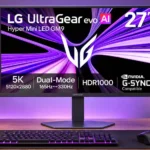
LG 27GM950B-B Feature Scores
Explore all 84 feature scores for LG 27GM950B-B, organized into pros and cons.
Scores by Feature
Summary
84 reviewed features-
Very positive 4.5-5.029 (35%)
-
Positive 3.5-4.432 (38%)
-
Neutral 2.5-3.411 (13%)
-
Negative 1.5-2.412 (14%)
Pros
Sort
-
At 27 inches, native 5K makes desktop text and high-resolution photos visibly sharper than 4K. The benefit is less dramatic in many 3D games and comes with a substantial graphics-performance cost.
-
The switch between sharp 5K/165Hz and faster QHD/330Hz is a standout strength. QHD sacrifices fine detail but is much more usable than the 1080p alternate modes on some 4K screens.
-
The exceptionally broad gamut produces rich, vivid HDR colors and appeals to photographers. SDR content needs proper gamut control to avoid oversaturation.
-
Height, tilt, swivel and pivot adjustments allow comfortable landscape or portrait placement without buying a separate monitor arm.
-
Switching between 165Hz at native 5K and 330Hz at QHD gives players a real speed-versus-detail choice. The top rate requires compatible hardware and the lower resolution.
-
The refreshed on-screen interface is fast, logically arranged and provides handy shortcuts. One tester found the physical joystick small or awkwardly placed.
-
Tiny text, high-resolution photos and game details look especially crisp at native 5K. QHD dual mode is softer and is best reserved for gaming rather than desktop work.
-
Up to 90W charging makes it convenient to run most compatible laptops from the monitor. Very power-hungry machines may still need a separate power adapter.
-
The 1440p/330Hz mode and low latency work well for shooters and racing. OLED competitors retain an edge in response speed, and overdrive tuning is less consistent across refresh rates.
-
Powerful Windows PCs can use the full native 5K/165Hz mode and high-speed QHD option. High GPU demands and some firmware quirks complicate an otherwise versatile setup.
-
Its semi-matte surface reduces distracting room reflections without severe blur for most users. Glossy-screen fans may still notice a slightly grainy finish.
-
PlayStation testing confirms 4K/120Hz video with HDR and VRR, while lower-resolution console sources can benefit from optional upscaling.
-
With local dimming enabled, this IPS display can produce remarkably deep blacks. The unassisted panel's native contrast is much weaker, and small highlights sometimes lose brightness.
-
The low-profile, flat metal base makes the desk easier to use than a sprawling tripod stand. It leaves space for a keyboard, mouse movement, or small items.
-
Most tests praise exceptionally restrained halos for an IPS Mini LED display. One owner still found obvious bloom around a cursor, while the aggressive dimming can suppress tiny lights.
-
Normal fast-overdrive settings keep inverse trails low, making motion respectable for an IPS panel. More aggressive tuning can introduce overshoot.
-
Action is smooth and sharp by LCD standards, especially in 330Hz mode. A little trailing blur remains, so top OLEDs are still clearer.
-
Full-bandwidth DisplayPort 2.1 can carry high-refresh 5K without display stream compression on compatible hardware, a useful advantage over lower-bandwidth connections.
-
The IPS panel holds color and contrast well from off-center positions, with less obvious haloing than many Mini LED alternatives.
-
Input response is very quick in SDR, helping fast games feel connected to controller or mouse movements. HDR backlight processing can add some delay.
-
Brilliant SDR output and large HDR highlights make daylight use easy. Small highlights are less forceful, and independent tests disagree over whether sustained HDR brightness falls after several minutes.
-
Subtle rear hexagon lighting adds atmosphere without making the front look flashy. Its positioning suits the compact 27-inch frame, and the effects are customizable.
-
An understated, slim-bezel front, flat metal base and optional rear RGB make for a tidy gaming setup. A few find the gray plastic less premium than expected.
-
The high-density, dual-refresh design makes a strong impression, but owners disagree about whether its HDR quirks and high price undermine the purchase.
-
There are usable sRGB presets and some very good calibrated results. Default SDR saturation or white balance can be inaccurate without color management.
-
The stand snaps together and the display is manageable for one person to unpack. Basic setup is much easier than fixing early firmware issues.
-
Fine 5K detail, vivid colors and high dynamic range create a striking overall image. Tone-mapping accuracy and consistency are less universally admired.
-
The box includes HDMI, DisplayPort and USB-C cables alongside the power supply and stand, reducing the need for immediate extra purchases.
-
Native 5K detail and vivid HDR can flatter richly rendered campaigns. Some dark scenes are over-dimmed, making OLED alternatives more dependable for cinematic HDR perfectionists.
-
Game profiles, black stabilization, frame counters and shortcut customization give players useful control without a sprawling, confusing menu.
-
On-display AI upscaling can sharpen a lower-resolution console or video feed. Gains on PCs are smaller and sometimes hard to activate, where native game upscalers tend to be better.
-
The backlight-strobing mode is unusually clear and retains substantial brightness. It is restricted to native-resolution mode, cannot be used with VRR, and is not ideal for every game.
-
HDMI 2.1 makes high-resolution console connections straightforward, including tested 4K/120Hz operation on PlayStation hardware.
-
A built-in cooling fan is present, but testing found it quiet or effectively inaudible at a normal seating distance.
-
DisplayPort 2.1, two HDMI 2.1 inputs and USB-C provide excellent modern video connectivity. Missing KVM and more extensive USB docking are the notable limitations.
-
The low, flat metal base offers good stability and an unobtrusive shape, with only modest wobble reported during use.
-
Variable refresh support works across common PC standards and also supports tested 4K/120Hz console gaming, helping prevent tearing.
-
The body feels generally solid and the metal stand inspires confidence, but the largely plastic housing and surface finish do not always feel worthy of the premium price.
-
There are configurable color profiles and LG Calibration Studio support. Professional accuracy benefits from calibration rather than relying solely on the default modes.
-
The combination of vivid colors, deep blacks and high peak brightness wins praise in favorable scenes. Owners disagree on consistency: muted dark scenes and reported brightness decay can interfere with immersion.
-
The dense Mini LED backlight brings powerful contrast and controlled bloom. Its conservative tuning can obscure tiny light sources, and not all testers observed stable sustained brightness.
-
FreeSync and G-SYNC-compatible variable refresh keep gameplay responsive with little tearing. The best overdrive setting differs by refresh rate in the faster mode.
-
Reading profiles and subdued bias lighting are welcome conveniences for long desk sessions, though they do not substitute for personal brightness adjustment.
-
The display uses active cooling but has not shown worrying external heat levels in hands-on checks.
-
Conventional RGB subpixels and high density make letters unusually clean, with little distracting color fringing for most users. The matte coating draws a few complaints.
-
The matte anti-glare layer generally retains impressive detail without the severe haze of some competitors. A few users dislike its subtle grain and shimmer versus glossy glass.
-
Exceptionally tight backlight control makes halos and LCD light spill hard to spot in many dark scenes.
-
One long-term owner found unusually clean gradients and natural transitions, contributing to an impressively polished image.
-
VESA mounting lets buyers replace the stock stand with an arm without sacrificing a pivot and height-adjustable stand option at purchase.
-
Mini LED dimming lifts the IPS panel to impressive real-scene contrast, especially in checkerboard and dark-object tests. Native contrast without dimming remains ordinary.
-
Most testers saw excellent or good uniformity, but others noticed darker edges or vignetting on plain white backgrounds.
-
Bass enhancement and AI sound adjustments can make dialogue clearer, but they do not turn the thin built-in speakers into a convincing audio system.
-
The 27-inch size balances high pixel density with a manageable desk footprint. Users wanting a large physical workspace may feel cramped even at 5K.
-
The Mini LED panel avoids the characteristic permanent image retention risk of OLED technology, an appealing consideration for desktop-heavy use.
-
Mac and Windows users report straightforward connections and sensible scaling. Whether maximum refresh rates are available depends on the connected computer.
-
Changing HDR mode preserves the color presentation on tested Mac systems, making everyday switching more convenient.
-
The appearance and image controls can feel distinctly high-end, although plain plastic surfaces and software rough edges undercut that impression for some.
-
Pixel transitions are sound for a modern IPS panel, especially with suitable overdrive. They remain slower than OLEDs and do not fully keep pace with the 330Hz ceiling.
-
The quick-access menus, shortcut buttons and preset modes make switching tasks straightforward after setup. Updating firmware can be much less pleasant.
-
The simulated audio processing can make dialogue easier to separate from background effects. Other testers would still use a dedicated headset for convincing game sound.
-
Text clarity and high resolution suit office and creative tasks, but the smaller physical screen and missing advanced docking features hold it back as an all-purpose workstation.
Cons
Sort
-
Despite USB connectivity, there is no built-in KVM switch. Anyone sharing a mouse and keyboard between computers needs another solution.
-
LG Switch offers monitor controls and firmware upgrades, but slow updates, connection detection failures and bloatware worries spoil an otherwise refined interface.
-
The external snap-on cable clip is a weak point: it feels inexpensive, has limited capacity, and can leave a USB-C cable hanging near the controls.
-
Native 5K gaming is substantially more demanding than 4K, with sizable frame-rate losses in demanding titles. The 1440p mode is a useful escape hatch for less powerful systems.
-
The original premium pricing draws repeated criticism when 4K OLED or Mini LED monitors cost much less. Deep discounts make its unusual 5K flexibility more compelling.
-
Neither picture-in-picture nor picture-by-picture is available, limiting simultaneous use of multiple video sources.
-
One test found that high HDR brightness dropped dramatically after several minutes and did not recover without restarting the display. Another independent tester did not reproduce that behavior, so the experience remains uncertain.
-
The LG Switch application has failed to recognize connected monitors during necessary updates, making maintenance needlessly frustrating.
-
Tone mapping is a divisive weakness: one test found broadly decent tracking with slightly dark output, while an owner found low- and medium-brightness HDR scenes seriously inaccurate.
-
Automatic scene-based changes are available, but dynamic color shifts can undermine accuracy. Leaving the feature off is preferable for faithful image reproduction.
-
This model lacks the streamlined display daisy-chaining available on some higher-end productivity monitors.
-
Early sharpness defects, intermittent slow wake-ups and occasional corrupted output raise concern despite several strong reports of daily operation.
-
The USB-C connection is convenient, but the absence of Thunderbolt limits advanced docking compared with some productivity-focused rivals.
-
One tester encountered unusually long blank screens when connecting a GPU, while a deep-sleep option deliberately wakes more slowly to save energy.
-
Two downstream USB-A ports are useful for basic accessories but form a limited hub. More demanding multi-device desks benefit from a proper docking station.
-
Assembly is straightforward, although the crumbly Styrofoam packaging feels less polished than the premium price suggests.
-
Integrated speakers are acceptable for everyday sounds and simple gaming. They are thin or metallic sounding in voices and do not replace proper speakers.
-
Sound is a little better than some monitor speakers and works for everyday alerts, but voices can sound thin and dedicated speakers are better for media.
-
Power draw is relatively high for a 27-inch LCD, especially during bright gaming. A deep-sleep option can reduce standby consumption at the cost of slower wake-up.
-
A single fast setting works well at native 165Hz. The QHD/330Hz mode needs different overdrive choices across the refresh range, with some overshoot at lower speeds.
-
Standard country-dependent warranty coverage is available, but at least one tester wishes premium monitors offered substantially longer protection.
-
The backlight produces powerful larger highlights while preserving dark blacks. Very small bright objects such as stars and lamps can be dimmed too heavily or disappear.
-
USB firmware updates are supported and can correct an early sharpness defect. The process may be slow or frustrating when the LG utility fails to recognize the screen.
Use Cases
Best for
Sort
-
One USB-C cable carries video, peripheral data and up to 90W charging for supported laptops. It is convenient but not as expansive as a dedicated Thunderbolt dock.
-
USB-C handles a supported laptop's display, data and charging in one connection. Hub capacity and bandwidth remain more limited than a full Thunderbolt dock.
-
Small text and fine desktop graphics look especially crisp at native 5K scaling. Some find 27 inches restrictive for a premium multitasking display despite the extra pixel density.
-
The unusually bright panel and anti-glare coating make the screen practical in daylight. One test found its image a little washed out under exceptionally intense lighting.
-
The fully pivoting stand supports vertical placement, especially useful for long documents and lines of code.
-
The wide gamut and fine 5K detail benefit image and design work, particularly with calibrated profiles. Its default color and white-point tuning do not replace a proper reference calibration.
-
Bright, colorful HDR games can look striking thanks to Mini LED contrast. Uneven tone mapping, small-highlight suppression, or possible brightness drops make dark HDR titles less predictable.
-
Dense 5K text and a pivoting portrait stand are well suited to code and lengthy reading sessions, particularly for users who prefer precise scaling.
-
Five-kilopixel desktop space makes it possible to view 4K material at native size with room for editing controls. Its broad gamut is attractive when properly calibrated.
-
The 5K density delivers sharp, Retina-like macOS scaling and USB-C connections work smoothly. Supported refresh rates depend on the Mac, and the matte finish may not appeal to Studio Display users.
-
HDR movies look unusually vibrant and bright when mastered content suits the dimming system. Built-in sound is modest, and a reported brightness dip or dark-scene handling may lessen the experience.
-
The rare 5K Mini LED and QHD/330Hz combination offers unusual flexibility to buyers who enjoy experimenting with premium display modes. Pricing and firmware quirks temper its appeal.
-
The integrated speakers are adequate for meetings and basic system audio, although they lack the fullness needed for richer entertainment sound.
Conditional or not ideal for
Sort
-
Budget-conscious buyersThe premium launch price is hard to justify for gamers who can accept 4K or QHD. Sales help, but cheaper OLED and Mini LED alternatives remain strong competition.
-
Multi-computer workflowsThere is no KVM to share keyboard and mouse peripherals across multiple computers. Users switching machines need a separate USB solution.
-
Casual gamingIt handles everyday gaming well, but its costly 5K-and-330Hz combination is difficult to justify if those advanced capabilities will rarely be used.
-
Long-term ownershipThe absence of OLED-style burn-in concerns is reassuring for frequent desktop use. Early firmware faults and uncertain software reliability make trouble-free ownership less assured.
-
Dark-room viewingDeep blacks and reduced blooming make dark gaming scenes impressive when the dimming behaves well. Some HDR content can look overly dim, particularly lower-brightness scenes.