
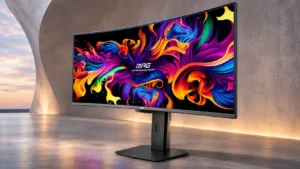
MSI MPG 341CQR QD-OLED X36 Feature Scores
Overall Scorata score: 4.4/5
Based on 36 analyzed reviews · View source samples
Explore all 88 feature scores for MSI MPG 341CQR QD-OLED X36, organized into pros and cons.
Scores by Feature
Summary
88 reviewed features-
Very positive 4.5-5.045 (51%)
-
Positive 3.5-4.426 (30%)
-
Neutral 2.5-3.412 (14%)
-
Negative 1.5-2.44 (5%)
-
Very negative below 1.51 (1%)
Pros
Sort
-
The 360Hz refresh delivers conspicuously smooth, crisp action and feels like a meaningful step up from older 120Hz and 240Hz displays, provided the PC can push high enough frame rates.
-
RGB-stripe subpixels sharply reduce the colored outlines previously noticeable around small text, making this a much better fit for mixed desktop use.
-
Colors retain vividness as brightness increases, giving QD-OLED images an unusually rich, saturated look.
-
Deep blacks, vivid QD-OLED color, and strong HDR punch produce a striking picture. Performance is especially convincing in games and dark scenes.
-
An enthusiast favorite for its big improvements to ultrawide OLED gaming: high speed, rich HDR, and improved panel refinement. Caveats concern premium cost and the relatively modest resolution.
-
Near-instant OLED pixel transitions help keep moving objects crisp, even during frantic action, with minimal smearing.
-
The joystick-driven menu is generally straightforward and feature-rich, with useful profile and brightness adjustments.
-
The flatter, smaller stand frees desk space compared with wide-legged designs, even though the ultrawide screen itself remains large.
-
The harder panel coating offers welcome extra resistance to scratches during handling and cleaning.
-
Per-pixel light control produces truly deep blacks in dim environments. Brighter rooms can still raise the perceived black floor despite the improved coating.
-
The layered OLED Care controls automate taskbar dimming, pixel shifts, and presence sensing; they ease worries about wear without guaranteeing immunity.
-
Most tests find strong factory accuracy, particularly after selecting the appropriate sRGB profile. Calibration can improve demanding color-sensitive work.
-
Color-space clamps, gamma adjustments, and user controls make it practical to tame oversaturation and tailor the display.
-
A three-year warranty that covers burn-in provides a reassuring ownership safeguard for a premium OLED.
-
The revised subpixel layout makes edges and text cleaner than previous QD-OLEDs, although the underlying 1440p pixel density still limits fine detail.
-
This is a standout strength: deep OLED blacks, brilliant small highlights, and effective EOTF Boost make HDR unusually convincing. Some modes have brightness and firmware quirks.
-
Motion stays impressively clear during rapid camera pans and fast-moving games; 360Hz makes fine moving details easier to follow.
-
Fast OLED transitions largely avoid ghosting and overshoot across a range of refresh rates, an advantage over LCD competitors.
-
Colors and black levels remain stable over broad viewing angles, even though the curve itself changes off-axis viewing geometry.
-
Small brilliant lights remain distinct against dark scenes, producing sparkling HDR highlights.
-
OLED contrast lends exceptional depth to night scenes and bright highlights without the backlight compromises common to LCD monitors.
-
MSI Gaming Intelligence provides software-based display adjustments, though app availability and usefulness varied in early testing.
-
Most testing found consistent color and good uniformity, though some measurements showed dimmer corners or minor dark-gray banding.
-
The compact metal base generally supports the curved panel securely, though occasional wobble appears at the tallest setting.
-
A metal stand base adds substance and a more refined feel, even if the outer design stays restrained.
-
At 34 inches the curved panel feels expansive for gaming and can hold wide workspaces without needing a second display.
-
Stand attachment and initial connection are generally straightforward, helped by a simple locking mechanism.
-
Expansive worlds, dramatic lighting, and rich colors make story-driven and cinematic games feel especially immersive.
-
Up to 98W power delivery turns the display connection into a convenient laptop charging link.
-
Unusually flexible HDR brightness and curve settings appeal to enthusiasts, although some controls are complex or have offered limited benefit on certain firmware.
-
Height, tilt, and swivel allow comfortable positioning; limited pivot range is not enough for portrait orientation.
-
VRR works smoothly with current graphics cards and helps avoid tearing, despite limited formal certification on some tests.
-
HDMI 2.1, DisplayPort 2.1, USB-C, and USB hub options make the monitor versatile across PCs and laptops.
-
One keyboard and mouse can control two connected computers, making shared desktop/laptop arrangements much simpler.
-
Full-screen SDR brightness has improved and works in ordinary indoor lighting, while HDR peaks can be brilliant. Strong direct sunlight remains a challenge.
-
The curved screen immersion draws praise for improving picture quality, convenience, or responsiveness.
-
The expansive 21:9 view makes supported games more absorbing and reveals more of the scene at once. Some games still show black side bars.
-
360Hz OLED speed delivers excellent responsiveness, but a 34-inch 21:9 format is not always the preferred tournament or esports setup.
-
Understated dark styling and a streamlined base make it more office-friendly than flashy gaming monitors, though not everyone finds it convincingly premium.
-
Solid materials, a stable stand, and a generally well-engineered chassis help the monitor feel durable.
-
The panel responds well to colorimeter calibration and can achieve high accuracy for demanding applications.
-
The 10-bit panel can render nuanced tones smoothly, useful for high-quality HDR and creative imagery.
-
The internal power board avoids an extra external brick beneath the desk.
-
The panel type draws praise for improving picture quality, convenience, or responsiveness.
-
The panel maintenance cycle runs less frequently than prior generations while supporting preventive OLED Care measures.
-
Presence sensing is processed locally without storing recordings, reducing privacy concerns about the built-in sensor.
-
Low measured latency makes inputs feel immediate, including fast aim adjustments and other timing-sensitive gameplay.
-
Gamma response is generally close to target, with profile selection available for fine adjustment.
-
Variable refresh works across common PC ecosystems, although some reviewers note the absence of branded certification.
-
The glossy, improved anti-reflective finish gives dark imagery extra punch and cuts the purple cast of earlier QD-OLED screens, without eliminating every reflection.
-
Premium pricing is a real hurdle, but many consider the feature set and panel upgrades good value within the OLED category.
-
True Black, Peak 1300, and EOTF Boost offer different balances between full-scene brightness and highlight intensity, with occasional firmware caveats.
-
There are many selectable profiles; the accurate sRGB modes generally perform better than some oversaturated genre presets.
-
The presence sensor can dim or wake the screen to reduce wear, with different testers experiencing anything from smooth operation to delayed wake-up.
-
The newer finish suppresses much of the distracting ambient-light haze, but strong lights and off-axis views can still reveal reflections.
-
Subtle lighting at the rear adds a small decorative accent without dominating the look.
-
The adaptive crosshair can remain visible against changing game backgrounds and is customizable for competitive play.
-
The wide screen offers useful extra horizontal space and strong immersion in compatible content, though ordinary 16:9 material does not fill the whole panel.
-
Self-emissive pixels keep bright details from spilling halos into adjacent dark areas, especially appealing for high-contrast HDR scenes.
-
The monochrome and flicker-control options can reduce visual strain for users who prefer gentler presentation.
-
Smooth transitions and 10-bit color help gradients avoid distracting banding.
-
The picture-in-picture and picture-by-picture draws praise for improving picture quality, convenience, or responsiveness.
-
Downstream USB ports help consolidate peripherals, although their throughput is modest for high-speed storage.
-
AI Vision can reveal shadow detail or adjust scene presentation, though its benefit depends on the setting and user preference.
-
Highlights and shadows can be finely managed, but results depend on the selected HDR mode and firmware behavior.
-
Useful display cables and setup accessories are included, though a short DisplayPort cable may limit positioning.
-
The very wide DCI-P3 and Adobe RGB coverage allows richly saturated games and broad creative color spaces, though unrestricted SDR modes can oversaturate.
-
VRR brightness fluctuations can appear in dark scenes or changing frame-rate conditions, but severity varies by testing setup.
-
Desktop control software and firmware support add versatility but were not equally ready across early units.
-
MSI provides monitor control software, though test timing and firmware behavior affected some experiences.
-
Ordinary screen use appears comfortable in some tests, while optional motion-strobing modes deliberately add flicker.
Cons
Sort
-
About 110 pixels per inch is the recurring compromise: attractive for gaming, but less crisp for fine text and detailed desktop work than a 4K monitor.
-
Early firmware could mishandle True Black 500 after switching modes, an issue that required an update rather than a practical workaround.
-
Static desktop elements still pose a long-term burn-in risk, so protection settings and varied usage matter.
-
Unusual console resolutions or aspect ratios can require compromises; not every requested source mode is accepted.
-
The product name resembles an older MSI model closely enough to cause potential confusion.
-
High brightness can raise power draw significantly above LCD monitors, a cost for the self-emissive OLED image.
-
The sensor-triggered wake-up can feel slower than desired, especially if using aggressive automatic power controls.
-
Sensor-driven brightness and color changes can be useful when lighting varies, but some find automatic adjustments distracting or slow.
-
The optional black-frame insertion mode can mimic higher-refresh motion clarity at lower frame rates, but limits brightness and cannot be used alongside VRR.
-
HDMI and dedicated console mode offer a useful connection path; console resolution or refresh behavior can vary.
-
Wake-on-approach adds convenience and protection, though some testers found the delay after returning to the desk noticeable.
-
HDR luminance can shift with scene brightness; customization exists, but reducing the fluctuation may sacrifice impact.
-
Basic rear routing helps tidy the setup, but the opening can be too tight for a fully populated set of cables.
-
The mac integration is useful in some situations but has noticeable limitations.
-
3440×1440 helps balance ultrawide gaming detail against attainable high frame rates, but is visibly less dense than modern 4K alternatives.
-
High refresh at ultrawide resolution requires a capable GPU; upscaling or frame generation may be needed in demanding games.
-
Firmware updates improved certain HDR behavior but also introduced a mode-switching issue in early samples.
Use Cases
Best for
Sort
-
The improved finish makes everyday bright-room use more viable, but glare and raised blacks remain possible in strong direct lighting.
-
Wide horizontal space fits spreadsheets, windows, and timelines, but static content needs OLED care and finer text is less crisp than on 4K.
-
A major strength is the ability to alternate smoothly between immersive gaming and practical work, with text density as the main compromise.
-
Bright effects, deep dark scenes, and excellent responsiveness make HDR games the monitor’s strongest showcase.
-
Protective care functions can run subtly, although some automatic light-sensing modes cause noticeable changes.
-
USB-C combines video, power, and peripherals for an easy laptop connection.
-
Quick transitions and high refresh help track targets, although the wider format is not every competitive player’s preference.
-
The broad canvas and rich color can help editing and design tasks, though the resolution is not maximally sharp.
-
The long horizontal canvas holds more timeline and tools, while wide color coverage supports post-production work.
-
Strong gamut coverage and calibration support make it workable for accurate color jobs, with better results after using the proper profile.
-
The curved ultrawide view enhances cockpit immersion, and fast motion stays exceptionally smooth.
-
The reduced stand footprint leaves more room for a keyboard and accessories despite the large panel.
-
OLED black depth and fine local contrast are especially appealing in dark rooms.
-
Three-year burn-in coverage and extensive protection measures add confidence, although permanent retention remains a consideration.
-
Cinema-width content takes advantage of the wider canvas and perfect blacks, while ordinary 16:9 video leaves side bars.
-
The adjustable stand and compact base make it possible to fit alongside another display.
-
For handheld gaming, this monitor is a strong option thanks to its OLED image and flexible ultrawide presentation.
-
Adobe RGB support gives photographers useful coverage for print-oriented color spaces.
-
For technology enthusiasts, this monitor is a strong option thanks to its OLED image and flexible ultrawide presentation.
-
For upgrading from a basic monitor, this monitor is a strong option thanks to its OLED image and flexible ultrawide presentation.
Conditional or not ideal for
-
Budget-conscious buyersThe high OLED price makes this a poor fit for anyone prioritizing low upfront cost.
-
USB-C laptop dockinguSB-C laptop docking is workable but subject to a tradeoff in brightness, compatibility, resolution, or screen format.