Overall: 4.0/5
The onboard sound system gets unusually loud without adding much compression or audible strain.
Pros: overall satisfaction, picture quality
Cons: size options, value for money

Overall: 4.0/5
The onboard sound system gets unusually loud without adding much compression or audible strain.
Pros: overall satisfaction, picture quality
Cons: size options, value for money
Overall: 4.3/5
The speakers can get impressively loud while keeping dialogue intelligible.
Pros: picture quality, color accuracy
Cons: bass performance, HDMI 2.1 port count

Overall: 4.2/5
The integrated audio can play fairly loud with reasonable clarity, although its tonal balance deteriorates toward maximum output.
Pros: picture quality, glare resistance
Cons: value for money, bass performance

Overall: 4.0/5
The built-in system gets loud enough for typical rooms without sacrificing easy-to-hear dialogue.
Pros: picture quality, black levels
Cons: HDR brightness, value for money

Overall: 3.9/5
The internal speakers can fill a room at useful volume without immediately needing external amplification.
Pros: peak brightness, overall satisfaction
Cons: value for money, shadow detail
Overall: 3.3/5
The built-in speakers reach a good volume for their size, even when their tonal balance is not ideal.
Pros: picture quality, motion handling
Cons: HDR performance, HDR brightness
Overall: 3.7/5
Loudness earns very different reactions by size and listening setup: owners are impressed, but the 55-inch model is limited and tonal balance degrades when turned up.
Pros: picture quality, maximum volume
Cons: sound quality, bass performance

Overall: 4.2/5
The speakers carry many action scenes convincingly, but maximum loudness is not especially high in every assessment.
Pros: high-refresh-rate gaming, gaming performance
Cons: value for money, bass performance

Overall: 3.0/5
The speakers can get reasonably loud, although high-volume compression and pumping reduce sound quality.
Pros: viewing angles, smart TV platform
Cons: overall satisfaction, refresh rate

Overall: 3.9/5
Built-in audio can reach room-filling levels and sounds more dynamic than most thin TVs, making it viable without a soundbar in many rooms.
Pros: gaming performance, peak brightness
Cons: HDMI 2.1 support, HDMI 2.1 port count
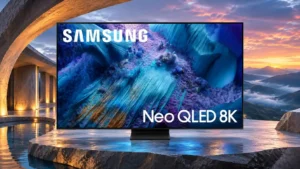
Overall: 3.8/5
The speakers can play loudly enough to fill a typical room without straining ordinary viewing.
Pros: glare resistance, overall satisfaction
Cons: input lag, value for money

Overall: 3.0/5
The speakers have sufficient volume for ordinary rooms, provided ambient noise is not excessive.
Pros: picture quality, smart TV platform
Cons: value for money, refresh rate

Overall: 4.0/5
The internal speakers are suitable for normal listening but lack the ultimate output and scale of an external system.
Pros: reflection handling, overall satisfaction
Cons: Dolby Vision support, bass performance
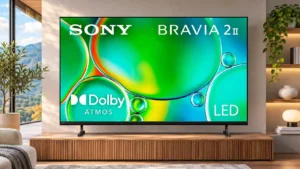
Overall: 3.6/5
The speakers are adequate in ordinary rooms according to some assessments, but others find maximum output limited and less balanced.
Pros: picture quality, overall satisfaction
Cons: sound quality, reliability

Overall: 3.6/5
Some screen sizes play fairly loudly, but the overall volume headroom is not consistently impressive.
Pros: black levels, picture quality
Cons: HDR performance, blooming control
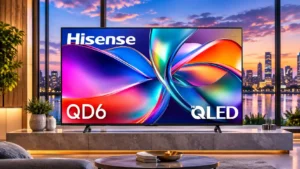
Overall: 3.0/5
Maximum speaker loudness is adequate on most checked sizes, though the 55-inch version is notably restricted.
Pros: color accuracy, Picture detail
Cons: HDR performance, motion clarity

Overall: 4.1/5
Some smaller sets play satisfyingly loudly, but the tested 100-inch speaker system reached its limits early.
Pros: peak brightness, HDR brightness
Cons: sound quality, viewing angles

Overall: 4.2/5
Volume is adequate to room-filling in normal use, but high levels can introduce metallic harshness in one demanding audio test.
Pros: overall satisfaction, value for money
Cons: smart TV platform, blooming control
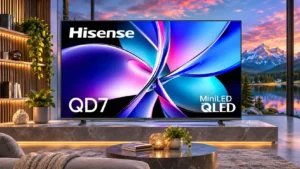
Overall: 3.9/5
Speaker output varies by size: some versions fill a room easily, while others are limited to smaller, quieter spaces.
Pros: picture quality, contrast ratio
Cons: HDR performance, motion handling

Overall: 4.0/5
Volume is adequate for some rooms but fails to impress everyone, and louder settings can compromise clarity.
Pros: peak brightness, picture quality
Cons: HDMI 2.1 port count, reflection handling

Overall: 3.9/5
Volume opinions are split: one owner found it extraordinarily loud, while lab testing says the speakers cannot get very loud.
Pros: overall satisfaction, picture quality
Cons: Weight and handling, black levels

Overall: 3.3/5
Speaker volume suits many everyday rooms, but reviewers disagree about its headroom and several find it too quiet for large or noisy spaces.
Pros: color accuracy, upscaling quality
Cons: picture quality, sound quality

Overall: 4.0/5
The built-in speakers may run out of volume or clarity when asked to fill a large room.
Pros: value for money, overall satisfaction
Cons: Remote control usability, sound quality
Overall: 3.9/5
Speakers can grow strained or unbalanced when turned up, limiting their suitability for loud movie nights.
Pros: value for money, overall satisfaction
Cons: Dolby Vision support, sound quality

Overall: 3.4/5
Loudness varies by size and source: the 55-inch test struggled in larger spaces, while the 65-inch unit and one video evaluation sounded adequate.
Pros: picture quality, value for money
Cons: viewing angles, HDR performance

Overall: 3.9/5
The speakers can struggle to fill bigger spaces and become less balanced near their highest output.
Pros: color volume, black levels
Cons: Inconsistent panel and coating by size, sound quality

Overall: 4.0/5
The stock speakers do not get especially loud and can compress or distort when pushed.
Pros: color accuracy, picture quality
Cons: HDR brightness, peak brightness
Overall: 3.8/5
Maximum volume is a recurring audio limitation: several customers wanted more output or found the sound less clear when pushed. Noisy settings such as a running bath can easily overwhelm...
Pros: overall satisfaction, portability and versatility
Cons: value for money, menu responsiveness

Overall: 4.2/5
The speakers provide enough volume for casual listening but lack scale and exhibit compression when pushed hard.
Pros: value for money, color accuracy
Cons: HDR brightness, reflection handling
Overall: 3.0/5
The speakers cannot get very loud, and at their loudest the frequency balance can become unfavorable to speech.
Pros: color gamut, smart TV platform
Cons: value for money, overall satisfaction

Overall: 3.9/5
The built-in speakers cannot play especially loudly without sounding strained.
Pros: gaming performance, overall satisfaction
Cons: sound quality, value for money

Overall: 3.8/5
Sound remains balanced at moderate levels but compresses noticeably when pushed to the top.
Pros: Wireless One Connect compatibility, art display mode
Cons: value for money, input lag

Overall: 3.9/5
Built-in speakers may be too quiet for a noisy room, although other testers find loudness sufficient for normal viewing.
Pros: peak brightness, value for money
Cons: reflection handling, glare resistance

Overall: 4.0/5
The built-in system can get loud easily, though sheer volume does not always translate into the most refined balance.
Pros: overall satisfaction, picture quality
Cons: reliability, build quality