If you want better stand width
Choose Hisense U7SG. It scores 5.0 vs 2.0 for stand width, with a 4.2 overall score.

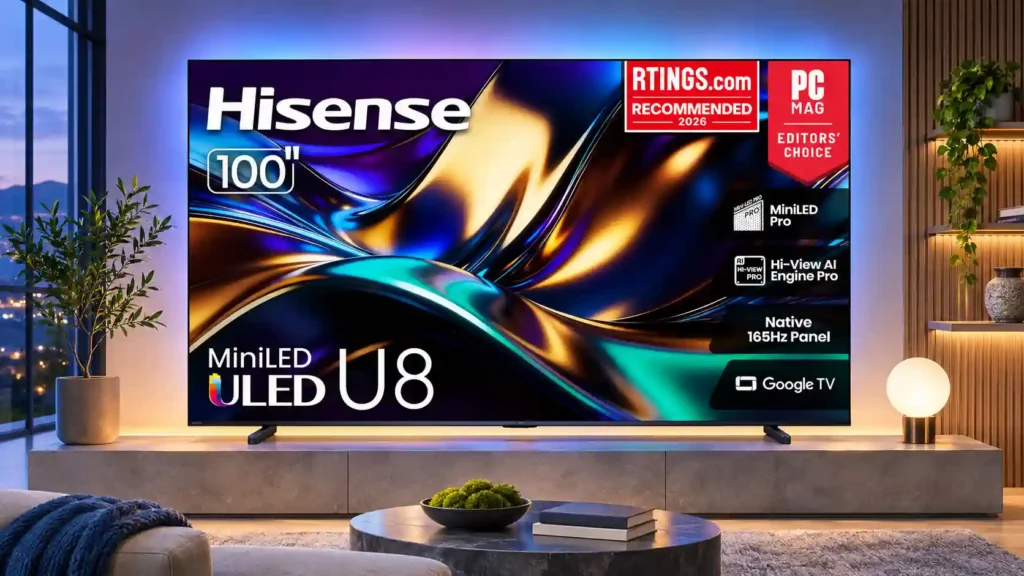
The U8QG brings premium-level brightness, contrast and responsive 4K gaming to more affordable sizes. Its limited HDMI ports, variable motion quality and weaker 100-inch panel make the exact model and seating arrangement important.
Centered-seating living rooms, bright-room sports and movies, and console or PC gamers who want dramatic HDR and low lag at a discounted price.
Wide seating arrangements, motion-sensitive competitive gamers, or households needing four direct HDMI connections. The 100-inch model also warrants size-specific checks for color and screen uniformity.
The Hisense U8QG makes a strong case for premium-looking Mini-LED performance without the premium price, especially when discounted. Its great trick is dazzling HDR brightness paired with deep blacks and restrained blooming; high-refresh HDMI gaming and Google TV add everyday appeal. Yet this family cannot be judged as one identical panel. The tested 65-inch unit often delivers vibrant color and impressive contrast, while the 100-inch model showed notably weaker color, uniformity and off-center performance in separate testing. Across sizes, some assessments find HDR processing too bright and motion too blurry for demanding gamers or sensitive film watchers. The ambitious speakers can sound unusually expansive, but the subwoofer may rattle on explosive soundtracks. With only three HDMI ports, an eARC soundbar also limits room for consoles. For centered seating, daylight viewing and spectacular value, it is easy to appreciate; for wide groups or motion purists, shop more carefully.
Compared with other TVs, this product is above average in HDMI port accessibility, warranty, HDR brightness, near average in motion handling, input lag, below average in cloud gaming support, HDMI port count, stand width.
| Attribute | This product | Category average | Difference |
|---|---|---|---|
| cloud gaming support | 2.0 | 4.3 | -2.3 |
| HDMI port count | 2.2 | 4.1 | -1.9 |
| HDMI port accessibility | 4.8 | 2.7 | +2.1 |
| warranty | 5.0 | 3.0 | +2.0 |
| HDR brightness | 5.0 | 3.4 | +1.6 |
| peak brightness | 5.0 | 3.6 | +1.4 |
| dark-room performance | 5.0 | 3.2 | +1.8 |
| voice control accuracy | 5.0 | 3.3 | +1.7 |
Choose Hisense U7SG. It scores 5.0 vs 2.0 for stand width, with a 4.2 overall score.
Choose TCL QM9K. It scores 4.5 vs 2.2 for HDMI port count, with a 3.9 overall score.
Choose Hisense UR8SG. It scores 4.4 vs 3.9 for reflection handling, with a 4.0 overall score.
Choose LG QNED92A. It scores 4.5 vs 3.4 for motion handling, with a 3.9 overall score.
Products reviewers directly compared with this model, grouped into quick takeaways.
Yes. Its very high brightness cuts through ambient light, though direct windows or lamps can still cause reflections.
No. The 100-inch model has separately tested weaknesses in color, uniformity and off-axis viewing that should not be assumed to describe the 65-inch model. Other sizes may also use different panel technologies.
It handles console-friendly 4K/120Hz, VRR and low-lag gaming well, and supports even faster 4K PC signals. Extremely fast motion can still show blur or ghosting.
Three HDMI 2.1 ports. Using eARC for a soundbar takes one of them, while the USB-C video input cannot fully replace HDMI for VRR gaming.
Not necessarily for everyday TV: the built-in surround system can be spacious and clear. However, bass-heavy movies can expose subwoofer rattle and external audio provides better refinement.
It depends on screen size. The 55- and 75-inch versions have received more favorable angle assessments, while the separately tested 100-inch unit degrades conspicuously off-center.
It looks impressive out of the box, but picture mode and brightness adjustments can improve naturalness. Professional calibration is worthwhile for viewers who prioritize accurate colors and HDR tone mapping.
These are a few of the reviews included in our analysis.



The best mini-LED TVs from Sony, Samsung, TCL, and Hisense deliver excellent brightness, deep blacks, and responsive gaming performance.
Hisense U8QG review covering 55, 65, 75, 85, and 100 inches. See brightness, HDR, gaming, viewing angles, HDMI limits, and why size matters.
Hisense U8QG review covering 55, 65, 75, 85, and 100-inch models, brightness, HDR, gaming, viewing angles, ports, mounting, and size differences.
Tech Steve’s Hisense U8QG Calman calibration settings for SDR and HDR, including picture controls, white balance, brightness observations and...
Tech Steve examines the 2025 Hisense U8QG's Mini-LED picture, HDR brightness, motion, upscaling, PS5 gaming, sound and size differences.
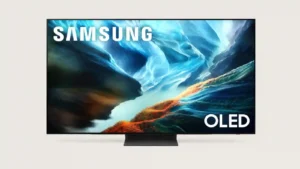
Choose the S90H for bright-room OLED viewing, deep blacks and top-tier gaming without flagship pricing. Skip it if you want Dolby Vision, a glossy screen or the simplest smart-TV software.
Pros: glare resistance, black levels
Cons: Dolby Vision support, color gamut
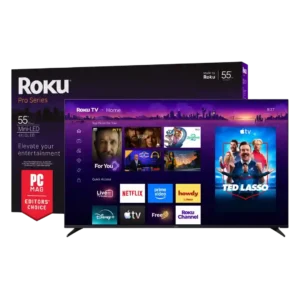
Best for bright Mini-LED picture, excellent built-in audio, easy Roku navigation, and responsive 4K/120 gaming. Skip it if you want ad-free menus, premium motion consistency, or stronger confidence in long-term...
Pros: overall satisfaction, picture quality
Cons: reliability, portability and versatility
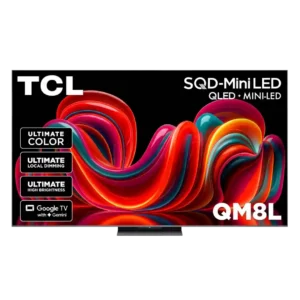
Choose the QM8L for a big, brilliantly bright TV with vivid HDR, deep mini-LED blacks, low input lag, and four HDMI 2.1 ports. Skip it if you need OLED-clean motion,...
Pros: picture quality, value for money
Cons: stand quality, judder handling

Choose the G6 for class-leading bright-room OLED picture, rich color, deep blacks and elite gaming. Skip it if you want strong built-in audio, polished launch firmware, no account sign-in, or...
Pros: picture quality, peak brightness
Cons: value for money, sound quality