
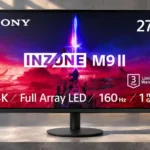
Sony INZONE M9 II Feature Scores
Explore all 71 feature scores for Sony INZONE M9 II, organized into pros and cons.
Scores by Feature
Summary
71 reviewed features-
Very positive 4.5-5.032 (45%)
-
Positive 3.5-4.418 (25%)
-
Neutral 2.5-3.411 (15%)
-
Negative 1.5-2.49 (13%)
-
Very negative below 1.51 (1%)
Pros
Sort
-
The subdued black finish is widely liked as a more versatile, premium-looking follow-up to the PlayStation-inspired original.
-
Rich and lively colors are a near-universal strength, with especially pleasing color in games. The best competing Mini LED and OLED panels can nevertheless offer stronger color performance.
-
The slim stand combines height, tilt and easy swivel, earning nearly universal praise for fast repositioning and cable access. It does not support portrait pivot.
-
Sony’s console-focused tuning, automatic HDR setup and strong 4K/120Hz support make PS5 gaming a standout strength. Not every tester likes the underlying dimming and black-level performance.
-
Across positive and negative assessments alike, high brightness is a standout quality. HDR highlights can be exceptionally intense and colors hold up in illuminated rooms.
-
The compact circular base is a universal highlight, freeing desk space for larger mousepads and other equipment compared with the old tripod stand.
-
The snap-on stand assembles quickly without tools, and rotation makes the ports easy to reach during initial connection.
-
Most impressions celebrate bright, vivid HDR and visible shadow detail; the strongest dissent concerns large dimming zones, clouding and weaker contrast than better Mini LED or OLED rivals.
-
Modern PlayStation and Xbox consoles connect with 4K HDR, VRR and high-frame-rate support. PS5 brings the closest integration, though 160Hz itself exceeds consoles’ 120Hz output.
-
Fast 4K play feels responsive and looks colorful on capable PC hardware, with 160Hz especially welcome in action games. Its refresh and dimming performance are less compelling than the strongest competing PC-focused displays.
-
160Hz makes PC play exceptionally fluid and is an upgrade over the original M9. Competitive specialists may want even higher speeds, while PS5 tops out at 120Hz.
-
PS5 and PS5 Pro integration automatically adjusts HDR during setup, making it easier to get convincing contrast without manually tweaking the console.
-
Luminous reds, blues and other bright colors give games impressive punch, complementing the screen’s high overall brightness.
-
HDR games and videos show saturated, lively color that can look almost three-dimensional, especially in brightly lit scenes.
-
Inzone Hub provides a convenient, often faster way to adjust settings and update firmware from Windows. One early test could not access the latest app version yet.
-
The 4K resolution looks richly detailed in games and video, delivering a sharp image on the 27-inch screen when the source is strong.
-
With PlayStation connected, the screen changes between gaming and video-focused profiles automatically. The convenience is welcome, even if some would prefer smarter game-by-game preset selection.
-
The rear joystick makes menus and common settings simple to reach, while Windows software offers a convenient second way to tune the screen.
-
Modern HDMI and DisplayPort connectivity plus ordinary USB ports make connecting consoles and a PC straightforward; USB-C docking is conspicuously absent.
-
G-Sync and adaptive synchronization help keep motion smooth and prevent tearing as rendering speed changes.
-
Low delay gives games an immediate, responsive feel, with no perceptible lag in tested PlayStation play.
-
Swiveling the entire display brings underside and rear connectors into easy reach, though the missing USB-C input is a limitation.
-
The IPS panel stays readable and colorful from the side, making shared viewing and off-center play easier.
-
Adaptive refresh works well with modern consoles and PCs and can make fluctuating frame rates look noticeably smoother.
-
Fine details remain visible in dark parts of games, an appreciable strength. That visibility sometimes comes at the cost of deeper blacks and more apparent dimming zones.
-
4K fine detail and text often look crisp, yet one tester consistently found the matte image unusually soft beside clearer OLED and Mini LED competitors.
-
Crosshair overlays, counters and specialized options broaden the toolkit beyond basic image adjustment. These extras appeal most to players who use competitive assists.
-
The 27-inch frame is a comfortable fit for close-up 4K gaming on both PCs and consoles without dominating the desktop.
-
The small round base is steadier than it looks; hands-on wobble testing found it remarkably well balanced.
-
FPS, RPG and other profiles make adjustment convenient, although their automatic choices are not always ideal and some players prefer manual DisplayHDR settings.
-
A majority of hands-on impressions recommend the bright, feature-rich gaming picture. One in-depth test was strongly negative about dimming and clarity, making the overall response divided.
-
Most tests find games fluid and sharp at 160Hz, but a demanding side-by-side assessment reports substantial blur and slow visual transitions.
-
Colorful 4K games look stunning to several testers. A sharply negative comparison found blurring, haloing and cloudiness serious enough to overshadow those strengths.
-
The black enclosure and compact stand feel more premium than several cheaper gaming displays, giving the design a solid high-end impression.
-
Bright highlights can be strikingly intense, particularly when compared with some OLED screens, even though that brightness can worsen visible halos.
-
The local-dimming system showed no noticeable flicker in testing, a welcome result for anyone sensitive to changes in backlight output.
-
The display, base and stand arrive packed separately and securely, keeping the quick assembly process straightforward.
-
The matte surface suppresses distracting room reflections effectively, helping colors and details remain visible under bright lighting.
-
Variable-refresh flicker is exceptionally well controlled in testing, with no noticeable flicker during the tested game scenarios.
-
Sony’s reduced-size mode is an inventive esports extra, though it leaves unused black space around the image and may go untouched by casual players.
-
Traditional 16:9 framing suits PS5 and most PC games, while the smaller workspace can feel restrictive for ultrawide-style multitasking.
-
Many impressions find input and pixel response sufficiently fast for smooth gaming, but an isolated motion-focused test finds visible blur, especially in fighting games.
-
Scanning the backlight is presented as a helpful way to reduce blur through fast game scenes, complementing the monitor’s rapid refresh.
-
Fast response and scanning are praised for limiting visible ghosting in action-heavy games, although not all assessments find motion equally clear.
-
Modern HDMI inputs make it versatile for contemporary consoles and other sources, pairing well with the monitor’s 4K gaming focus.
-
A standard 3.5mm audio output is helpful for replacing the modest built-in speakers with wired headphones or external sound.
-
The FPS picture preset lifts brightness and contrast to help distant opponents stand out against game environments.
-
The dark bezels are not record-thin but fade into the background, keeping attention on the game.
-
USB-A ports accommodate commonplace peripherals, although the missing USB-C connection makes the hub less useful for modern laptop docking.
-
HDR can look excellent, but certain Windows games may require manually disabling it for correct color. SDR remains a usable alternative on consoles.
Cons
Sort
-
Basic audio playback works but lacks the fullness expected from a premium gaming setup, sounding particularly tinny or muffled at elevated levels.
-
Bass is consistently the weak spot of the included audio: some hear a modest improvement over the original M9, but it remains thin, muffled or prone to clipping.
-
The coarse local-dimming zones can throw obvious halos around bright objects on dark scenes. Clouding is one of the most divisive and repeatedly criticized parts of the picture.
-
The local-dimming system is a major weak point: limited, slow-moving zones can leave conspicuous blotches, particularly around small highlights on dark images.
-
Dark-scene uniformity is a persistent concern, with clouding, corner shading and uneven brightness appearing in several assessments.
-
The speakers are convenient for basic playback but generally lack bass and fullness. Some find them serviceable at moderate volume; others hear muddy or tinny audio.
-
One side-by-side test found the Sony’s matte screen notably hazier than a competing OLED, diminishing the expected crispness of 4K.
-
Black Equalizer can help reveal hidden opponents in SDR, but the control is unavailable in HDR, reducing its usefulness with high-dynamic-range gaming.
-
Adjusting dark-scene visibility is less flexible in HDR because Black Equalizer is available only in SDR.
-
The factory power-saving preset makes the first picture look too dim. Turning it off and enabling a stronger image mode improves the experience dramatically.
-
The 24.5-inch mode and 160Hz refresh work for many competitive titles, but very demanding esports players may prefer substantially faster and clearer displays.
-
Value inspires the widest split: several see a worthwhile premium 4K gaming package, while others point to more capable, cheaper Mini LED and OLED alternatives.
-
One assessment found inky blacks without obvious bleed, while another encountered pervasive cloudy halos. Dark-scene cleanliness is far from consistently praised.
-
The included flexible cable strap is handy, but the back lacks more substantial built-in organization for a completely tidy desk.
-
To benefit from both native 4K and 160Hz, a capable gaming PC is important; less powerful systems will not exploit the full refresh capability.
-
Firmware can be updated through Windows Inzone Hub, but a USB-stick update attempt was unreliable and required switching to the software method.
-
High pixel density and window sharing are helpful, but the standard 16:9 shape is less spacious than an ultrawide for intensive multitasking.
-
Black depth attracts opposing impressions: some see impressively inky shadows for IPS, while others find persistent clouding and insufficient local-dimming darkness.
-
The IPS LCD panel offers a familiar burn-in-resistant option with broad viewing angles, though several comparisons favor OLED for deeper blacks, contrast and perceived clarity.
-
Large, richly detailed game worlds can look captivating, but blooming and clouding in slow, dark scenes may break immersion.
-
Some games show satisfying depth and vivid light-dark separation, yet the coarse dimming zones can flatten blacks and introduce gray haze compared with OLED and stronger Mini LED rivals.
Use Cases
Best for
Sort
-
Colorful PS5 and PC titles can look bright, lively and cinematic. The weak dimming precision and washed-out darker areas noted by some testers stop HDR from being an unqualified win.
-
4K video can look gorgeous, and automatic Cinema Mode helps PS5 playback. Weak speakers and obvious dimming artifacts in one assessment make it less convincing as an all-in-one entertainment screen.
-
The 24.5-inch screen mode concentrates more of the action in a smaller field of view, useful when sitting close for shooters. Its appeal is specialized rather than universal.
-
The M9 II is especially appealing as one shared screen for PlayStation and a capable PC. Its picture quality and fast refresh help both, though rivals offer stronger USB-C productivity extras.
-
4K detail, smooth scrolling and readable small text make routine office work pleasant. However, occasional corner dimming, limited 16:9 workspace and severe blotching in one test temper the recommendation.
-
The bright panel remains colorful with plenty of visible detail even in a well-lit room, while reflections rarely spoil visibility.
-
The small circular stand fits on tight desks and allows considerable freedom to position the screen without sacrificing mouse or keyboard space.
-
The small power light sits out of the direct viewing area, so it does not catch your eye while playing or working.
-
Strategy game scenes and detailed models benefit from crisp 4K images, with miniature elements remaining especially easy to make out.
-
At 160Hz, fast PC shooters such as Counter-Strike 2 feel particularly smooth, and the compact display mode is designed with close-range competitive play in mind.
-
Variable-refresh operation showed little to no visible flicker in testing, which is encouraging for people troubled by flickering displays.
-
Even without HDR, console games can remain colorful and pleasant to play; switching to HDR mainly brings a bigger brightness punch.
Conditional or not ideal for
Sort
-
Portrait orientationThe included stand has excellent swivel and tilt, but it cannot turn the panel into a vertical portrait orientation.
-
USB-C laptop dockingWithout USB-C video input and laptop power delivery, it is a poor fit for one-cable docking compared with more work-oriented rivals.
-
Dark-room viewingIn darker scenes and on dark desktop backgrounds, one detailed test found obvious halos, cloudy blacks and corner shading that made viewing distracting.
-
Budget-conscious buyersAt its original premium price, the M9 II is a difficult fit for shoppers prioritizing cost; less-expensive 4K models are available.
-
Smart TV replacementThe 4K HDR picture has enough impact for entertainment viewing, but the disappointing built-in speakers prevent it from being a convincing stand-alone TV substitute.
-
Upgrading from a basic monitorA buyer moving from a very basic or dim display may enjoy the large leap in brightness and color, but discerning upgraders could notice the uneven dimming.