
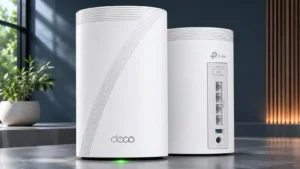
TP-Link Deco 7 Pro BE63 Feature Scores
Overall Scorata score: 4.2/5
Based on 28 analyzed reviews · View source samples
Explore all 115 feature scores for TP-Link Deco 7 Pro BE63, organized into pros and cons.
Scores by Feature
Summary
115 reviewed features-
Very positive 4.5-5.055 (48%)
-
Positive 3.5-4.433 (29%)
-
Neutral 2.5-3.415 (13%)
-
Negative 1.5-2.412 (10%)
Pros
Sort
-
Competitive pricing is a recurring strength: the system offers fast Wi-Fi 7 and generous wired connectivity for less than many premium rivals. The optional subscriptions deserve consideration.
-
Four fast Ethernet ports per unit provide unusual wired flexibility for a mesh kit. Using one for WAN leaves three for other devices on the main node.
-
The generous 2.5 GbE connectivity is one of the strongest reasons to buy this system.
-
Near the main node, tests repeatedly deliver impressive speeds, often around or above 2 Gbps with capable clients and local test equipment.
-
Multi-gig ports make Ethernet backhaul straightforward and help maintain performance across rooms or separate buildings.
-
Pre-paired or automatically detected satellite units make expanding the initial mesh remarkably easy.
-
The mesh generally stays stable through normal household use and simultaneous streams, with several tests reporting no dropouts.
-
Close and medium-range Wi-Fi speeds are a major strength, with compatible clients sometimes approaching the 2.5 Gbps wired ceiling. Speed drops with distance and obstacles.
-
Most installations are quick and straightforward, with nodes joining automatically. Some users needed repeated modem resets before the first unit connected.
-
The polished Deco app makes everyday monitoring and configuration approachable. It has useful options without offering the depth of a full desktop administration interface.
-
Installation is generally quick with an app-guided process and automatic satellite pairing, although modem resets sometimes delay the first connection.
-
The clean white cylindrical design blends into shelves and living spaces without the conspicuous antennas of conventional routers.
-
Wi-Fi 7 delivers impressive performance with compatible devices without requiring flagship pricing.
-
The clean dashboard puts network status and common settings within easy reach without burying them in complex menus.
-
The Deco app guides setup well and usually discovers hardware quickly, although initial modem or node detection can require troubleshooting.
-
A well-placed three-pack can blanket a house and even the garden. Two units may leave gaps in larger layouts.
-
Checking a client's node, renaming devices and pausing connections are easy from the app.
-
Downloads can approach the internet service or wired-port limit, and several tests show strong sustained throughput under load.
-
Multi-gig ports on every node make fast wired clients and Ethernet backhaul practical without immediately adding a switch.
-
Multiple active devices can share the network smoothly, with strong aggregate throughput during demanding tests.
-
Simultaneous downloads, streaming and file transfers generally cause little disruption, especially on the faster bands.
-
USB connectivity is a welcome extra that is uncommon in some competing mesh kits.
-
Cross-model Deco compatibility makes gradual upgrades and reuse of existing mesh equipment particularly appealing.
-
Wireless throughput is competitive with far pricier mesh kits, especially near the main router. Premium models still have the edge in some demanding tests.
-
Free parental controls cover useful basics such as profiles, filters and schedules. More detailed rules and reports require a subscription.
-
Separate IoT network options make it easy to segregate low-bandwidth smart devices and reserve faster bands for other clients.
-
Network maps, client information, speed tests and traffic visibility make it easy to check how the mesh is performing.
-
6 GHz offers particularly strong nearby throughput, but its signal weakens quickly through obstacles and at longer distances.
-
Wired throughput can approach the 2.5 GbE port limit, making the system useful for fast local transfers.
-
Built-in QoS offers useful device prioritization without requiring a subscription for basic operation.
-
The units are compact relative to many premium mesh towers, although one tester found their size and outlet needs inconvenient.
-
Mesh coverage is a strong selling point, especially with three well-positioned nodes. Two nodes may struggle in large or difficult floor plans.
-
Medium-range throughput remains fast in most layouts, although some rivals pull ahead as the distance increases.
-
Connections are generally dependable, including during active multi-device testing and movement between nodes.
-
Replacing extenders with a unified mesh can eliminate persistent weak spots and reduce the need for repeated network fixes.
-
Thoughtful packaging, organized accessories and easy-lift nodes make unboxing unusually pleasant.
-
A USB drive can provide convenient basic shared storage without requiring separate network storage hardware.
-
Backhaul can be fast and flexible, with particularly strong results when wired links or well-positioned wireless nodes are used.
-
Everyday operation is approachable and the app is intuitive, though its richer feature list may feel more involved than simpler alternatives.
-
Uploads can be impressively fast near a node and hold up under traffic, but tend to decline more sharply at longer distances.
-
The app offers useful device, band and network settings, but granular desktop-style administration remains limited.
-
The stated 200-client capacity is appealing for heavily connected homes, with strong results in smaller simultaneous-client tests.
-
The option to turn off the indicator at night is particularly welcome in bedrooms and home theaters.
-
The mesh offers a worthwhile performance upgrade from older wireless systems, particularly when newer clients can use its capabilities.
-
MLO can boost speeds significantly with compatible clients, particularly close to a node. Its implementation and benefits vary by client and configuration, and it is not always the best option at long range.
-
Automatic network detection and configuration reduce the amount of manual setup needed.
-
5 GHz performance is fast and generally remains competitive under traffic.
-
Interchangeable auto-sensing WAN/LAN jacks make installation easier because the modem can connect to any of the four ports.
-
Upstairs and downstairs coverage can be excellent with appropriately positioned nodes, though throughput can fall on another floor under heavy load.
-
The Deco app can conveniently manage compatible smart-home gear, although the router lacks the built-in hub capabilities of some rivals.
-
Wireless backhaul can deliver exceptional speed for the price, but distance, obstacles and shared airtime can impair it.
-
Reach is good in many homes but varies with layout; distant rooms and separate buildings may need extra nodes or Ethernet.
-
Garden and outdoor reach can be useful, but a detached building may need a wired connection for full speeds.
-
The cylindrical housings feel sturdy and well built.
-
The 6 GHz and 5 GHz bands hold up particularly well when several devices generate traffic.
-
Compatible Deco units can easily be added as coverage needs grow.
-
Visual placement tips help avoid interference and make satellite positioning less intimidating.
-
Movement between rooms and floors can be seamless, with no buffering or dropouts in one three-node demonstration.
-
Device-level priority settings help allocate bandwidth to important clients such as a gaming PC or console.
-
The included essentials cover ordinary installation, and the reset pin is a thoughtful extra.
-
Separate guest, IoT and MLO networks provide useful ways to organize connected devices.
-
Free age-appropriate and device-specific filtering is useful for managing children's internet access.
-
Automatic roaming can be smooth, although one TV chose a distant node until its preferred node was set manually.
-
Basic bedtime and device schedules are included without an extra charge.
-
Throughput can remain strong through a wall, although the 6 GHz signal weakens noticeably through obstacles.
-
Wide 320 MHz channels contribute to high throughput on compatible 6 GHz clients when conditions permit.
-
Ventilation and passive cooling keep the hardware reasonably cool during intense use.
-
The app makes pausing an individual device's internet access straightforward.
-
Visual setup directions are clear and approachable, but technical jargon and advanced configuration help could be improved.
-
The network optimization routine adjusts settings to improve connections in response to usage and interference.
-
HomeShield adds welcome baseline protection, but the free security tier is limited and more advanced protection costs extra.
-
Pre-synchronized nodes reduce setup work and can join the mesh automatically.
-
The reporting interface offers useful visual breakdowns of connected-device types.
-
Smart devices can work well, but one reported firmware update disrupted their connectivity.
-
Guest networking provides useful flexibility over which wireless bands visitors can access.
-
Adaptive network optimization is appealing for households that want less manual troubleshooting.
-
Traffic priority settings help important devices receive bandwidth when they need it.
-
The third, 6 GHz band gives this mesh a speed advantage over some dual-band Wi-Fi 7 systems.
-
A convenient support-center link provides an easy route to assistance from within the app.
-
Manual band preferences are useful, but flexibility over separating the primary 2.4 GHz and 5 GHz networks is limited or varies by software.
-
Included vulnerability scans provide some welcome baseline network protection.
-
Device-level priority can help gaming computers or consoles receive bandwidth, though it does not eliminate satellite latency.
-
Operating power costs are modestly lower than those of a higher-end Deco system in one comparison.
-
Lifetime support is attractive, but one reported firmware-related problem was accompanied by slow assistance.
-
The two-year warranty is reasonable, though some rival brands offer three years.
-
Manual node selection is valuable when automatic steering picks a distant node instead of the closest one.
-
The app can identify many connected devices, although doing so may require third-party data sharing.
-
The bottom-mounted indicator is subtle but can be harder to see directly.
Cons
Sort
-
Buyers who need an integrated Matter controller should not assume this system can replace a dedicated smart-home hub.
-
Initial configuration is app-centric rather than browser-based, which can frustrate users who prefer desktop router management.
-
Browser access is limited compared with the app, so desktop-first administrators may find it frustrating.
-
The 2.4 GHz band is a weak spot compared with competing mesh systems, particularly at a distance.
-
Regional variants, model aliases and similar product names can make it difficult to tell which hardware configuration is being sold.
-
There are no 10 GbE ports, a limitation for high-speed wired networks even though many ordinary homes will not need them.
-
Advanced HomeShield pricing can be difficult to establish from product pages before purchase.
-
The lack of 5 GbE ports limits flexibility for buyers planning faster wired networks.
-
Jitter can rise substantially when connected through a satellite, making latency-sensitive activity less predictable.
-
The system is not an attractive choice for users who need two independent WAN connections with automatic failover.
-
The short manual covers basic installation but provides little guidance on more involved tasks such as storage sharing and MLO optimization.
-
A built-in Thread border router is not a strength of this model, so Thread-focused households may prefer another system.
-
Automatic dual-connection failover is not supported according to the supplied technical discussion, making it a poor fit for redundant WAN needs.
-
Mandatory mobile-app and cloud-account management simplifies the consumer experience but is restrictive for people who prefer local, browser-based administration.
-
There is no separate permanent backhaul radio, so wireless inter-node traffic can compete with clients for airtime.
-
Initial modem communication can be troublesome, requiring multiple resets before the first node connects.
-
Cloud-account management and third-party device identification raise privacy concerns for buyers who prefer local control.
-
A reported firmware update disrupted smart-home connectivity, so update reliability is a concern for device-heavy homes.
-
Each node needs a mains outlet, which adds a placement constraint when trying to cover the whole house.
-
A 2.5 Gbps WAN connection is sufficient for many fiber plans but bottlenecks faster internet services.
-
Satellite throughput is often good, but it can trail the main router and introduce higher latency or jitter.
-
The BE10000 label describes combined theoretical radio rates, not the speed a single device should expect. Actual throughput depends on client capabilities and network conditions.
-
The 2.5 Gbps port ceiling is plenty for many homes, but limits the fastest local transfers.
-
WPA3-only operation on the MLO network can prevent older Wi-Fi clients from joining that particular network.
-
Main-router latency is adequate for routine use, but wireless satellites can introduce noticeable gaming lag and jitter.
-
Core networking and basic controls are available without payment, but advanced parental controls and security can add recurring subscription costs.
-
Long-distance results vary considerably with the building and node placement. Some tests show sharp speed losses, while well-positioned three-node systems keep distant rooms fast.
Use Cases
Best for
Sort
-
Multiple 2.5 GbE connections per node are especially helpful for wired PCs, storage and wired backhaul without an immediate need for a switch.
-
Three well-placed nodes can work very well in large or multi-story homes. Two units may leave gaps, and dense walls or floors can make wired backhaul important.
-
Households with roughly gigabit to 2.5 Gbps internet can benefit from the fast radios and multi-gig Ethernet ports without paying flagship prices.
-
Modern Wi-Fi 7 phones and laptops can make particularly good use of 6 GHz and compatible MLO features.
-
Separate IoT networking and compatible smart-device control are useful for smart homes. Weak 2.4 GHz performance, a reported firmware issue and the lack of an integrated hub are caveats.
-
The app and free core controls cover ordinary household needs, although a cheaper system may suffice for modest connections.
-
Strong simultaneous-client performance and high aggregate throughput make the mesh well suited to busy connected households.
-
Free profiles, content filters and schedules make this useful for families, while advanced parental controls require a paid plan.
-
Gigabit service is comfortably within the system's capabilities, but cheaper routers may provide the same internet experience on slower plans when coverage is already adequate.
-
A single unit can suit many smaller homes, but a full Wi-Fi 7 mesh kit may be unnecessary if an affordable router already covers the space.
-
Adding compatible Deco units or retaining older nodes makes staged mesh expansion easy.
-
USB sharing and multiple fast Ethernet connections make this a useful mesh for basic shared drives and wired NAS devices.
-
There is ample bandwidth for multiple 4K streams, though selecting a nearer node may be necessary if a TV connects to the wrong satellite. Basic streaming alone does not require such a fast mesh.
-
Clear visual guidance and automatic node pairing make this approachable for beginners, although jargon and occasional modem hiccups can complicate initial setup.
-
Fast local connections and usable upstairs throughput are helpful for working from home and transferring large files.
-
The available bandwidth and main-router latency are suitable for everyday video calls.
-
Access-point operation is useful for extending an existing router's network, including when another router must provide features such as failover.
-
Scheduling the indicator to turn off makes the nodes less distracting at night.
-
Fast internal networking makes the mesh appealing for teams that regularly transfer large media files between computers.
-
Ordinary web browsing remains comfortable even when satellite latency is less suited to gaming.
-
Casual gaming is reasonable when connected to the main router, although satellite latency can be less consistent.
Conditional or not ideal for
Sort
-
Online gamingGaming bandwidth is strong, but wireless satellite jitter and lag make wired connections or direct access to the main router preferable for competitive play.
-
Internet plans above 2.5 GbpsInternet plans faster than 2.5 Gbps cannot be fully utilized through the WAN port, making a faster-port model a better fit.
-
Advanced network administrationThe system has useful consumer-level controls but lacks the extensive tuning and controller-level visibility sought by network power users.
-
Legacy-device householdsOlder devices can use ordinary networks, but they miss the full Wi-Fi 7 benefits and may not join WPA3-only MLO networks. Distant 2.4 GHz clients are another caveat.
-
Budget-conscious buyersIt is good value among Wi-Fi 7 kits, but a cheaper Wi-Fi 6 system may be a smarter purchase for modest needs.
-
PC gamingPC gaming can lag over wireless satellite connections, so a direct router connection or Ethernet backhaul is preferable.