
If you want better Instruction readability
Choose TP-Link Archer BE550. It scores 5.0 vs 2.0 for Instruction readability, with a 4.3 overall score.

The Deco BE63 combines fast Wi-Fi 7, generous 2.5 GbE connectivity and easy mesh setup at a competitive price. Its main compromises are weaker distant and 2.4 GHz throughput, satellite gaming latency and paid advanced controls.
Households with gigabit-to-2.5 Gbps internet, newer Wi-Fi 7 devices and several wired clients benefit most from its fast radios and generous Ethernet ports. Busy or multi-story homes can get excellent results with sufficient, well-positioned nodes or wired backhaul.
Buyers who need to fully utilize internet plans above 2.5 Gbps, advanced browser-based administration or consistently low competitive-gaming latency through wireless satellites should consider alternatives. Homes already well covered by a cheaper router may not need a Wi-Fi 7 mesh.
The Deco BE63 is a compelling midrange Wi-Fi 7 mesh system for homes that need reliable coverage and several fast wired connections without paying flagship prices. Its four 2.5 GbE ports per node make Ethernet backhaul and wired devices unusually easy to accommodate. Tests consistently praise close-range throughput, the approachable Deco app and automatic satellite pairing. Multi-device performance is generally strong. Coverage depends heavily on layout and pack size: three well-placed units can work beautifully, but two nodes may leave gaps, and 6 GHz performance falls through obstacles. The 2.4 GHz band is comparatively weak, while wireless satellites can introduce gaming lag. Advanced HomeShield features require subscriptions, and browser administration is limited. The BE63 makes the most sense for gigabit-to-2.5 Gbps networks; faster internet plans or demanding wired cores deserve higher-speed hardware.
Compared with other Routers, this product is above average in seamless handoff, 6 GHz performance, Wi-Fi 7 support, near average in mobile app quality, Ethernet port count, below average in web interface setup, WAN failover, web interface quality.
| Attribute | This product | Category average | Difference |
|---|---|---|---|
| web interface setup | 2.0 | 4.8 | -2.8 |
| WAN failover | 2.0 | 4.7 | -2.7 |
| web interface quality | 2.4 | 4.5 | -2.1 |
| latency consistency | 2.3 | 4.3 | -2.0 |
| dual-WAN support | 2.0 | 4.0 | -2.0 |
| privacy controls | 2.5 | 4.1 | -1.6 |
| latency | 3.1 | 4.7 | -1.6 |
| WPA3 support | 3.0 | 4.6 | -1.6 |
Choose TP-Link Archer BE550. It scores 5.0 vs 2.0 for Instruction readability, with a 4.3 overall score.
Choose TP-Link Archer AX55. It scores 4.3 vs 2.0 for web interface setup, with a 4.0 overall score.
Choose GL.iNet GL-BE3600 Slate 7. It scores 5.0 vs 2.0 for dual-WAN support, with a 4.5 overall score.
Choose D-Link Aquila Pro AI R95. It scores 5.0 vs 2.3 for latency consistency, with a 4.8 overall score.
Compared with TP-Link Deco 7 Pro BE63
Yes. It offers fast close-range performance, four 2.5 GbE ports per node and an easy management app at prices that generally undercut flagship systems.
It depends on the layout and obstacles. Some two-node tests left gaps, while appropriately placed three-node kits achieved strong coverage; Ethernet backhaul can improve difficult locations.
No. The WAN port is limited to 2.5 Gbps, so a single faster internet connection cannot be fully utilized.
No for ordinary networking and basic parental controls. Advanced security, filtering and detailed parental-control features can require separate paid plans.
The main router offers ample throughput, but wireless satellites can introduce jitter and lag. A direct connection to the main unit or Ethernet backhaul is preferable for latency-sensitive gaming.
Yes. Compatible Deco units can be added to an existing mesh, although older nodes retain their original radio and Ethernet limitations.
Yes. The 2.5 GbE ports are useful for wired backhaul, and a USB 3.0 port supports basic drive sharing.
These are a few of the reviews included in our analysis.


TP-Link Deco BE63 (Deco 7 Pro BE10000) review from TP-Link's spec sheet and three lab reviews: per-band speeds, four 2.5 GbE ports, weak 2.4...
I replaced my eero system with the TP-Link Deco BE63 and found it faster, with more network adjustment options in the app.
BE63 provides four equal 2.5GbE ports per node, while BE67 provides one 10GbE, one 2.5GbE, and one 1GbE port. BE63 is often easier for...
TP-Link Deco BE63 review: tri-band Wi-Fi 7 mesh with four 2.5 Gbps ports per unit. See what experts praise, what they criticise and who it suits.
Tri-band BE10000 Wi-Fi 7 mesh with four 2.5 GbE ports per unit and the lowest 2-pack price in this group, read from the spec sheet

Choose the R95 for a busy home that needs fast Wi-Fi 7, strong range, multi-gig ports, and low-lag gaming. Skip it for a small, lightly connected space or if advanced...
Pros: Wi-Fi 7 support, Wi-Fi speed

Best for frequent travel, fast VPNs, dual 2.5GbE and resilient multi-WAN. Skip it if you need full 6GHz/320MHz Wi‑Fi 7, mesh, or desktop-class USB storage and long-range indoor coverage.
Pros: VPN client support, value for money
Cons: 6 GHz performance, USB storage sharing

Exceptional VPN speeds, strong Wi-Fi 6 coverage and extensive OpenWrt controls make the Flint 2 a compelling value. Its advanced setup, missing 6GHz band and firmware-specific caveats matter if you...
Pros: setup ease, configuration flexibility
Cons: Wi-Fi 7 support, USB storage sharing
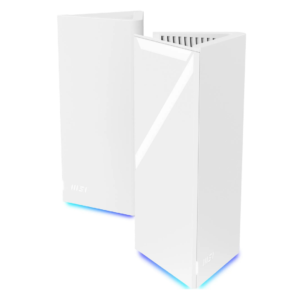
Best for affordable tri-band Wi-Fi 7, abundant 2.5GbE ports, and deep free controls. Skip it if you need consistently strong garden coverage, foolproof app setup, or proven top-tier speeds across...
Pros: value for money, design and appearance
Cons: node pairing ease, outdoor coverage