
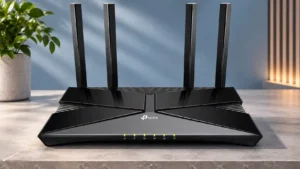
TP-Link Archer AX10 Feature Scores
Overall Scorata score: 3.7/5
Based on 15 analyzed reviews · View source samples
Explore all 109 feature scores for TP-Link Archer AX10, organized into pros and cons.
Scores by Feature
Summary
109 reviewed features-
Very positive 4.5-5.032 (29%)
-
Positive 3.5-4.439 (36%)
-
Neutral 2.5-3.421 (19%)
-
Negative 1.5-2.415 (14%)
-
Very negative below 1.52 (2%)
Pros
Sort
-
Affordability is a major strength, with solid everyday performance for considerably less than many better-equipped routers.
-
The straightforward interfaces and simple setup make everyday management approachable.
-
Setup is consistently straightforward, whether performed through the Tether app or a browser.
-
The web interface is clear, intuitive and rich in standard network controls.
-
The 5 GHz band is a standout, achieving strong near-router speeds and often competing with pricier models.
-
Overall, this is a well-liked budget Wi-Fi 6 router for modest homes, with clear compromises in reach and advanced features.
-
Good 5 GHz throughput makes this a capable budget wireless router, although the slower 2.4 GHz band and distance-related drop-offs limit its versatility.
-
Gigabit Ethernet performs well and is suitable for broadband connections within its speed ceiling.
-
Wi-Fi 6 is an affordable upgrade with strong 5 GHz speeds, although compatible clients are needed and some optional features are missing.
-
Several tests produced impressive speeds near the router, with much more variable results farther away.
-
Installation is generally quick and uncomplicated.
-
Wired connections are a strength, delivering full plan speeds and dependable Ethernet performance.
-
Standard wireless, DNS and network settings are flexible and accessible, while more specialized controls remain limited.
-
Tether simplifies setup, although reconnecting after changing network credentials can be briefly awkward.
-
Short-range Wi-Fi 6 tests reached roughly 730–841 Mbps in several tests, competitive with more expensive models.
-
Multiple everyday clients usually work well, although two simultaneous VR headsets caused severe problems in one account.
-
Tether makes everyday monitoring and configuration easy, but the web interface offers more advanced settings.
-
Basic and advanced options are clearly organized, so common settings are easy to find.
-
Four gigabit LAN ports provide useful wired flexibility, with convenient spacing.
-
Wi-Fi 6 is a useful step up from older hardware, though the router lacks some newer premium capabilities.
-
The slim, compact case fits easily into tight household spaces.
-
Screw slots make wall or ceiling mounting convenient on the units that were evaluated.
-
The router passed a three-day stress test without problems, and ordinary household connections are often stable.
-
The familiar browser setup process is intuitive and allows more detailed configuration.
-
Several experiences point to dependable everyday connections, although some devices may need to be closer to connect initially.
-
Ordinary concurrent streaming and gaming can run smoothly, but heavier simultaneous demands such as dual wireless VR are more challenging.
-
The router can handle a typical collection of home devices, but is not intended for exceptionally device-heavy networks.
-
Range is generally adequate for modest homes, but reports vary from good coverage to very poor long-distance reception.
-
Beamforming directs signal toward active devices and helps improve usable coverage.
-
Guest access is conveniently enabled and managed separately from the main network.
-
Ventilation is reasonably generous, and one comparison found the AX10 ran cooler than its pricier sibling.
-
The angular design is generally unobtrusive and appealing, although glossy plastic can be distracting and look inexpensive.
-
Compatible extenders can expand coverage, but firmware availability, proprietary mesh support and missing repeater mode limit flexibility.
-
Central placement can cover a modest house effectively; larger layouts and adjacent rooms may require an extender.
-
The protective cardboard frame and organized accessory compartments keep the contents secure.
-
A wired test delivered the full 300 Mbps upload speed of the broadband connection.
-
The built-in VPN server is a welcome extra on a budget router.
-
OFDMA is praised for managing simultaneous connections, though its benefit on this budget hardware may be modest.
-
Scheduling is useful for basic access restrictions, though the depth of daily time limits differs across accounts.
-
Smart Connect and automatic band allocation simplify choosing a suitable wireless band.
-
The wired connection delivered the full 600 Mbps download speed in one test, but premium routers offer more wireless read throughput.
-
Firmware updates can be applied during setup or through the management interfaces without much difficulty.
-
Throughput remains useful in nearby rooms or at around 30 feet, although it falls below same-room speeds.
-
Individual devices can be prioritized, but application-specific controls are limited or absent.
-
Latency is adequate for ordinary browsing and gaming in many setups, but demanding concurrent wireless VR can become unusable.
-
Older Wi-Fi clients can still connect and perform well, while newer features require compatible devices.
-
Concurrent Wi-Fi 6 connections benefit from more efficient scheduling and reduced contention.
-
Alexa integration is described as convenient for voice-controlled routines and device groups.
-
Connected devices can be monitored easily through Tether.
-
DNS settings can be customized with just a few clicks in the web interface.
-
Integrated dynamic DNS conveniently complements remote VPN access.
-
One apartment installation maintained a usable signal even two stories below the router.
-
Typical smart-home devices and hubs are handled reliably, although dense setups may need stronger hardware.
-
An IPv6 broadband connection worked well in one test.
-
The app provides a convenient way to view network status and connected clients.
-
One apartment user maintained connectivity outdoors on the street two floors below the router.
-
Low power draw makes the router practical for always-on home networking.
-
Low energy consumption is useful for a router that stays on continuously.
-
Ordinary smart-home hubs can connect reliably without placing excessive strain on the network.
-
Status LEDs can be scheduled to turn off at night.
-
Basic website and app filtering can be used without a paid subscription.
-
Alexa voice integration provides convenient control for supported devices and routines.
-
The AX10 offers good upgrade value for buyers who want faster Wi-Fi, although the benefit depends on existing equipment and plan speed.
-
The antennas can be positioned and hold their angle, but cannot be replaced with stronger ones.
-
Basic traffic and access restrictions can be configured without unnecessary complexity.
-
Automatic updating provides a convenient way to keep firmware current where supported.
-
Beamforming helps reduce dead spots, although it cannot overcome every obstruction.
-
Dual-band operation accommodates older devices alongside faster modern clients.
-
The chassis is described as sturdy enough for typical home use.
-
Compatible mesh extenders offer a way to improve coverage when a single router is insufficient.
-
Routine firmware updates are useful for maintaining security, subject to the specific hardware revision.
Cons
Sort
-
The lack of USB is a repeated drawback, especially for attached printers, drives or media servers.
-
USB-attached storage cannot be shared through the router, limiting built-in file-server functionality.
-
Whole-network antivirus and advanced malware protection are missing compared with better-equipped routers.
-
A lengthy support interaction over missing MU-MIMO controls was especially frustrating and involved conflicting answers.
-
Manufacturer support was inconsistent and time-consuming when a user needed help with missing MU-MIMO controls.
-
Firmware changes and delays have affected advertised features, particularly OneMesh and MU-MIMO controls.
-
WPA3 availability is inconsistent across tested units and versions; verify the exact hardware revision before relying on it.
-
Security is a notable compromise: basic protection is available, but advanced malware safeguards and WPA3 support vary.
-
OneMesh favors compatible TP-Link extenders, making cross-brand mesh expansion less flexible.
-
The router lacks wireless repeater mode, limiting the ability to reuse it as a wireless range extender.
-
Glossy plastic readily collects fingerprints, though this matters less on a router that is rarely handled.
-
The 2.4 GHz band is a recurring weak point, with mediocre throughput compared with faster alternatives.
-
Long-distance results vary substantially: some tests retained respectable throughput, while others found distant-room performance very poor.
-
Limited channel width reduces peak throughput potential, although gigabit Ethernet already imposes a ceiling.
-
There is no 160 MHz mode, which limits peak wireless speeds but matters less for ordinary broadband plans.
-
Advanced reporting is limited, so households seeking detailed activity insights may need more capable controls.
-
The firewall is basic and lacks detailed configuration.
-
A USB printer cannot be attached directly for network sharing.
-
The glossy plastic surface scratches relatively easily.
-
Lack of OpenWRT and DD-WRT compatibility limits more advanced software-based network management.
-
A long interval without firmware updates raised concern about the router's update cadence.
-
The available 5 GHz channels are restricted, limiting options for avoiding interference and optimizing performance.
-
Link aggregation is missing, a compromise for users who need higher wired bandwidth.
-
Multi-gigabit Ethernet is absent, preventing the router from fully exploiting faster-than-gigabit connections.
-
Traffic prioritization is available by client rather than by application, limiting flexibility.
-
Wireless latency fluctuates more than on some competing routers, making wired connections preferable for latency-sensitive tasks.
-
Guest isolation is useful, but advanced VLAN-based segmentation is limited.
-
Occasional firmware hiccups and changes to MU-MIMO settings have caused frustration.
-
MU-MIMO availability and effectiveness are inconsistent across accounts; some praise its efficiency while others report missing controls or poor concurrent VR performance.
-
The front LEDs communicate status, but cryptic icons, inexpensive styling and a shared Ethernet indicator reduce their usefulness.
-
Website and keyword blocking provide elementary filtering; sophisticated age-based categories are not consistently available.
-
QoS offers basic device priority, but lacks finer application-level options and may require manual bandwidth entry.
-
Basic profiles, schedules and website blocking are useful, but advanced parental controls are limited.
-
Basic bandwidth allocation is useful, but manual configuration and limited granularity make it less flexible.
-
The AX1500 label describes combined theoretical bandwidth rather than guaranteed device or internet speed; real-world results can be substantially lower.
-
Wi-Fi 6 scheduling can reduce contention, but limited channels and no DFS make congested wireless environments challenging.
-
A single wall can still allow good 5 GHz speeds, but dense materials and additional walls limit reach.
-
Build quality is serviceable for the price, but glossy plastic and budget construction divide opinions.
Use Cases
Best for
Sort
-
A strong budget choice for households seeking modern wireless speeds without paying for premium hardware or features.
-
Basic home networking is its strongest use: good everyday speeds and simple management without costly extras.
-
App-based and browser setup make this a friendly choice for first-time router owners.
-
Apartments and modest single-story homes are a particularly good fit thanks to adequate coverage and strong nearby speeds.
-
Several tests show good performance for broadband plans in the hundreds of megabits; gigabit Ethernet defines the upper limit.
-
Online gaming can be smooth, but Ethernet is preferable when consistent latency is important.
-
4K streaming is generally smooth in modest homes, including simultaneous streams when coverage is good.
-
Older Wi-Fi 5 devices remain usable and achieved respectable speeds in several tests.
-
Typical multi-device households can use the router comfortably, but unusually demanding or crowded networks may exceed its capabilities.
-
Ordinary video calls generally run smoothly, although wireless jitter can be higher than on competing models.
-
Ordinary small-office networks can benefit from affordable multi-device connectivity, but heavy enterprise traffic is beyond its intended scope.
-
Everyday browsing is generally smooth and not noticeably affected by moderate wireless jitter.
-
The VPN server is a useful bonus for remotely accessing a home network.
-
Casual gaming is a good fit when clients have a strong connection and household demand is moderate.
-
An iPhone XR reached nearly its expected Wi-Fi 5 speed in one test.
-
Typical smart-home networks are a good fit, with reliable hub connections and convenient Alexa integration.
-
Access-point mode provides a useful way to extend coverage from a wired connection.
-
Ordinary daily tasks are generally unaffected by the router's minor latency fluctuations.
-
Scheduled LED shutdown makes the router less distracting at night.
-
Wireless file transfers compare favorably with some budget models but trail higher-end equipment.
Conditional or not ideal for
Sort
-
Advanced network administrationThe browser exposes many standard settings and VPN access, but advanced QoS, security and configuration options are limited.
-
Mesh network expansionOneMesh can expand coverage with compatible extenders, but availability depends on firmware and hardware version.
-
Households with childrenFamilies needing basic web blocking and schedules are served reasonably well, but more sophisticated supervision requires another solution.
-
Large or multi-story homesLarger or multi-story homes are a conditional fit: placement and compatible mesh extenders may help, but long-range results vary widely.
-
Home network storageThis is a poor choice for a router-hosted USB file server because it has no USB port.
-
Multi-gigabit internetMulti-gigabit plans exceed the router's gigabit wired ceiling, so faster hardware is preferable.
-
Internet plans above 2.5 GbpsPlans above 2.5 Gbps cannot be fully exploited because the router is capped by gigabit Ethernet.
-
Wireless VR gamingDual wireless VR headsets became unusable in one account, making demanding simultaneous wireless VR a poor fit.
-
Wired multi-gigabit networkingThe lack of multi-gigabit ports makes it unsuitable for faster-than-gigabit wired networking.
-
Alternative operating systemsThird-party router firmware support is limited, making this a poor choice for alternative firmware enthusiasts.
-
Competitive wireless gamingCompetitive wireless gaming is a conditional fit at best because of latency fluctuations; Ethernet is preferable.