
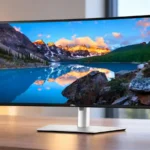
Dell Ultrasharp U3425WE Feature Scores
Explore all 53 feature scores for Dell Ultrasharp U3425WE, organized into pros and cons.
Scores by Feature
Summary
53 reviewed features-
Very positive 4.5-5.017 (32%)
-
Positive 3.5-4.420 (38%)
-
Neutral 2.5-3.47 (13%)
-
Negative 1.5-2.47 (13%)
-
Very negative below 1.52 (4%)
Pros
Sort
-
Productivity is the clearest strength: the 34-inch ultrawide comfortably holds multiple apps, spreadsheets, editors, and research windows at once. KVM, hub, and layout tools make it especially effective for work-from-home and multi-computer desks.
-
Port selection is a standout strength, with abundant USB-A, USB-C, Thunderbolt, video, Ethernet, and audio connectivity. The monitor can realistically serve as the connection center of a desk setup.
-
Picture quality is broadly praised as crisp, colorful, and excellent for office use, with strong IPS Black contrast. It is less convincing against OLED or higher-resolution alternatives when brightness, HDR, or maximum sharpness are the priority.
-
Eye comfort is a recurring strength, with praise for ComfortView Plus, the matte finish, and comfortable long-session use. Several owners specifically report less strain or squinting than with their previous displays.
-
The built-in KVM is one of the most consistently praised features, making it easy to share a keyboard and mouse across two computers. Responsiveness is strong, and multi-device desk setups become far simpler.
-
The 34-inch size lands in a sweet spot for many owners: wide enough for several windows without becoming as overwhelming as larger ultrawides. Multiple buyers specifically praise the usable workspace and comfortable scale.
-
Overall satisfaction is high among productivity-focused owners, with many calling it an excellent upgrade or favorite monitor. The strongest negative experiences center on defective panels, PBP problems, and difficult post-purchase support.
-
Text and everyday imagery generally look crisp and clear, and many owners praise the sharpness for office work. The main caveats are lower pixel density than 4K screens and somewhat softer scaling on macOS.
-
The integrated USB/Thunderbolt hub is one of the strongest reasons to buy this monitor. Owners repeatedly praise being able to keep peripherals connected through the display and reduce dependence on a separate dock.
-
The gentle curve is widely liked because it adds immersion without feeling aggressive. Owners describe it as comfortable for scanning the full ultrawide workspace.
-
Physical setup is usually quick, tool-free, and straightforward. The major exception is multi-computer split-screen configuration, which one buyer found difficult enough to abandon and return the monitor.
-
Color accuracy ranges from excellent after calibration to merely decent out of the box. Many users are happy with the colors, but serious creative work may benefit from calibration, and a few units look less convincing at default settings.
-
Cable management is usually a strength thanks to the stand routing, single-cable laptop setups, and daisy-chaining. With a fully populated KVM and hub setup, however, the large number of cables can still become messy.
-
The design is clean, understated, and office-friendly, with several buyers liking its professional look. Others find the silver finish and thick, basic styling underwhelming for such an expensive monitor.
-
Dell Display Manager is well liked for window layouts, display adjustments, and easier KVM-related control. Mac-oriented buyers also appreciate Dell’s more mature software and multi-device ecosystem.
-
USB-C/Thunderbolt power delivery is highly useful for laptop users, combining video, peripheral access, and charging through one cable. Owners especially like being able to leave the laptop power brick out of the desk setup.
-
Color gamut is consistently strong, with broad sRGB coverage and roughly mid-90% DCI-P3 results in several tests. Coverage is good for productivity and light creative work, though it can fall short of Dell’s advertised P3 figure.
-
The 120Hz refresh rate makes motion and cursor movement noticeably smoother and is a welcome upgrade over 60Hz. For office-only users, the benefit can feel modest relative to the added cost.
-
The 3440×1440 resolution is widely liked for productivity and looks crisp to many users, but it is not 4K. At 34 inches, some testers find the pixel density less sharp than higher-resolution 27- or 32-inch alternatives.
-
Black levels are a meaningful improvement over older and conventional IPS displays, and owners upgrading from older Dell panels notice the difference. Newer QD-OLED screens still produce deeper blacks.
-
Build quality is generally praised as sturdy, solid, and professional. The monitor feels made for long-term office use rather than for flashy gaming aesthetics.
-
The matte antiglare finish is effective in ambient light and can be especially helpful for glare-sensitive users. The tradeoff is that one tester felt the coating softened some of the extra contrast compared with a glossy surface.
-
IPS Black delivers noticeably stronger contrast than ordinary IPS, with several testers praising its depth and pop. It remains a step below OLED and can fall short of Dell’s idealized 2,000:1 target depending on settings.
-
Brightness is generally sufficient for office use and even bright rooms, though measurements from some testers are modest compared with premium rivals. A few owners actually find the display brighter than they need.
-
The built-in speakers are better than the typical monitor speakers and plenty usable for calls, YouTube, and everyday audio. They still do not replace good dedicated speakers for buyers who care about sound quality.
-
IPS Black is a strong fit for productivity, with excellent panel quality and better contrast than conventional IPS. It still cannot match OLED-class blacks and contrast, but avoids making OLED the only route to a premium work display.
-
The monitor works well for casual PC gaming and mixed work-and-play setups, especially with 120Hz. It is better viewed as a productivity monitor that can game on the side than as a gaming-first display.
-
VESA support makes it straightforward to move the large display onto a monitor arm. That is especially useful for reclaiming desk space from the substantial stock stand.
-
The monitor feels premium in capability more than in styling: its integrated dock, KVM, and polished productivity features impress, while the physical design can look fairly plain for the price.
-
The 21:9 ultrawide format is excellent for keeping several apps visible at once. One owner notes that some websites can look awkward when stretched across the full width.
-
The jump to 120Hz substantially reduces visible motion blur, making scrolling and cursor movement feel smoother. That improvement is especially noticeable when coming from a 60Hz display.
-
For slower single-player and story-driven games, the ultrawide image can look gorgeous. One owner specifically praises RPG and story-game visuals despite the monitor’s broader gaming limitations.
-
Viewing angles are excellent, maintaining comfortable visibility and color consistency even when the viewer is not centered. This is one of the practical advantages of the IPS-based panel.
-
Some backlight bleed is visible around the edges on dark screens, but it is described as mild and hard to notice during normal use. It is mainly a concern when viewing near-black content.
-
Variable refresh rate over HDMI adds useful flexibility for occasional gaming. The support is limited by connection path rather than being a broad gaming-focused implementation.
-
HDMI is the only path called out for 120Hz variable-refresh-rate gaming, giving the monitor useful casual-gaming flexibility. The benefit is practical, though the gaming feature set remains limited overall.
-
The ultrawide shape and 120Hz make occasional gaming enjoyable, but the experience is held back by missing FreeSync and other gaming-first features. It works better as a bonus than a core reason to buy.
Cons
Sort
-
Several dissatisfied owners report serious panel defects, including dead pixels, horizontal lines, black bars, and partially failed screen areas. These are not universal experiences, but the failures are severe when they occur.
-
HDR is one of the least consistent strengths: several hands-on testers say true HDR is missing or unimpressive, while another source presents DisplayHDR 600 capability positively. Buyers focused on impactful HDR should be cautious.
-
Competitive gaming is not this monitor’s strength. Its response time, lack of FreeSync/G-Sync, limited HDR, and productivity-first tuning make dedicated gaming monitors the better fit for serious players.
-
The lack of FreeSync and G-Sync is a clear gaming limitation. Casual play is still possible, but buyers wanting robust adaptive-sync support have better options.
-
One buyer found the product listing misleading because it referenced 5K even though this model is a 3440×1440 ultrawide. The complaint is about the listing language rather than the panel’s everyday image quality.
-
Picture-in-picture and split-screen modes can replace a two-monitor workflow when they work well. Two owners report severe PBP usability or pixelation problems, making this feature a meaningful risk if it is central to the purchase.
-
The three-year warranty is a selling point on paper and is praised by one expert, but customer experiences with actual support are much harsher. Dead-pixel thresholds, slow responses, and denied or difficult remedies are recurring complaints.
-
This is a large, heavy display with a substantial base, so it is not especially portable. Its size also makes returns and desk placement more cumbersome than with a smaller monitor.
-
The included setup documentation is a weak point for at least one owner, who wanted clearer English instructions instead of mostly symbolic drawings. The monitor can still be installed without technical help.
-
Value depends heavily on price and whether the dock, KVM, and connectivity will be used. Full MSRP draws criticism, while buyers at lower street prices often call it worth the money for an all-in-one productivity setup.
-
Fast-moving visuals can show modest ghosting even at 120Hz. That keeps motion performance behind monitors tuned specifically for gaming.
-
The 5ms-class response time is acceptable for everyday work and casual gaming, but it is not competitive with dedicated gaming displays. Gaming-focused alternatives can deliver much faster pixel response.
-
Many owners report flawless operation and long periods of trouble-free use, but a smaller group experienced dead pixels or catastrophic panel failure. Reliability therefore looks strong for most units but uneven enough to matter at this price.
-
Most reported deliveries were well packed and arrived intact, but there are isolated cases of damaged packaging or units that appeared previously used. Delivery condition can therefore depend heavily on the seller and shipment.
-
The stand offers useful height, tilt, and swivel adjustment, though portrait rotation is not practical on this ultrawide. A few owners report hinge weakness or shakiness, so a monitor arm may be preferable for some desks.
-
The OSD is functional and the single-joystick menu can be very good, but not everyone finds settings convenient to adjust. Dell Display Manager often provides an easier way to handle layouts and display controls.