
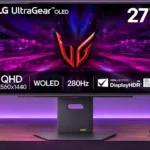
LG 27GX700A-B Feature Scores
Explore all 65 feature scores for LG 27GX700A-B, organized into pros and cons.
Scores by Feature
Summary
65 reviewed features-
Very positive 4.5-5.017 (26%)
-
Positive 3.5-4.424 (37%)
-
Neutral 2.5-3.413 (20%)
-
Negative 1.5-2.410 (15%)
-
Very negative below 1.51 (2%)
Pros
Sort
-
The matte treatment significantly reduces mirror-like reflections and preserves black depth in bright rooms. The tradeoff is occasional diffuse haze or grain.
-
Near-instantaneous OLED pixel changes are consistently praised for clear, immediate gameplay.
-
The fourth-generation Tandem OLED panel often looks brighter than older WOLED monitors, especially in SDR and very small HDR highlights. Not every tested game or HDR setting delivers the expected peak.
-
The expanded gamut brings richly saturated colors and strong HDR color coverage, representing a clear improvement over older WOLED generations.
-
The 280Hz refresh, exceptionally quick pixel response, and low lag make competitive games feel immediate and clear. Even faster esports models exist for players prioritizing refresh above image quality.
-
Fast movement stays sharp and readable at high refresh rates, with the near-instantaneous OLED response a consistent gaming highlight.
-
At 280Hz, gaming feels notably smoother and motion is clearer than at mainstream refresh rates. A few premium alternatives go even faster.
-
Low input lag makes both PC and console controls feel highly responsive, matching the quick OLED pixel transitions.
-
High-refresh PC play is a clear strength, combining GPU-variable-refresh support with low lag and crisp motion.
-
True OLED blacks deliver striking image depth and contrast without blooming. Some inaccurate presets alter perceived black detail despite that panel strength.
-
At around the strongest sale prices, fast Tandem OLED performance looks compelling. At launch-like pricing, the omitted docking features and picture compromises are much harder to forgive.
-
Deep blacks and bold light effects make atmospheric adventures immersive, but lower-frame-rate games do not exploit the 280Hz ceiling and HDR can be inaccurate.
-
Judgments vary sharply: several testers call it a favorite gaming OLED or an excellent sale purchase, while one strongly rejects its HDR tuning and grainy coating.
-
Bright objects appear against deep blacks without the glowing halos commonly seen around LCD backlight zones.
-
Per-pixel OLED blacks make dark environments exceptionally deep, including under ambient lighting. Some picture modes lift or crush near-black tones.
-
Rich color, perfect blacks, and unusually sharp motion make games visually impressive. Grading inaccuracies, gray bands, and a grainy matte finish can take away some of that impact.
-
FreeSync and G-SYNC compatibility keep motion fluid across supported PCs. Large frame-rate swings can still produce visible flicker in dark scenes.
-
Brightness behavior varies by scene and setting. Some gaming tests found little distracting dimming, though switching bright windows and larger HDR highlights can expose limits.
-
There is strong HDR impact and deep contrast, but major disagreement about real-game brightness and accuracy. Very bright settings sometimes overexpose the image or crush dark detail.
-
Rear accent lighting adds some flair and was reported working correctly during hands-on testing.
-
The UltraGear styling is smart and premium-looking, with restrained lines and accent lighting; the substantial base may look oversized to some.
-
One take appreciates the compact flat base for small desks, while another finds the heavy stand disproportionate. Placement depends on available space.
-
The OSD remains familiar and reasonably approachable, with accessible brightness, picture, and OLED-care settings.
-
PlayStation support is generally strong, including high-refresh operation from accepted 4K signals. Xbox Dolby Vision is absent, and some console setups require changing HDMI compatibility settings.
-
Tandem OLED makes bright, saturated colors more convincing than older WOLEDs, but QD-OLED alternatives can still deliver stronger color luminance.
-
The chassis feels sturdy and thoughtfully built, with substantial support behind the display.
-
Near-instant OLED response leaves fast motion unusually free of trailing and ghosting in action games.
-
The clean UltraGear styling and stable stand help it look and feel like a high-end gaming display.
-
The heavy metal stand keeps the screen firmly planted even during competitive play, despite its somewhat bulky appearance.
-
Black Stabilizer can lift visibility or help adjust shadow tones in dark games, although it cannot completely repair underlying HDR tracking errors.
-
Game imagery looks crisp, although fine desktop print and the matte coating can reduce perceived detail versus 4K or glossy alternatives.
-
Height, tilt, and swivel flexibility are praised; one comparison finds a glossy LG sibling slightly more ergonomic.
-
DTS Headphone:X processing is appreciated as a useful option for headphones connected to the display.
-
Pixel-shifting protection is useful, but long periods of static taskbars and editing interfaces still warrant care with OLED ownership.
-
The coating, improved text presentation, and stable white appearance make longer reading and office sessions less tiring than on some earlier OLED designs.
-
The 1440p resolution is easier to drive at high frame rates than 4K, though taking full advantage of 280Hz still calls for a capable gaming PC.
-
The headphone jack with DTS processing earned a positive listening impression; a separate headset is still needed for sound.
-
The 1440p picture looks sharp for gaming while remaining easier to run than 4K, though it is not the best match for ultra-fine text.
-
Menus and current firmware seem functional, though a critical tester felt substantial updates were needed to improve the picture.
-
Gaming picture modes offer useful flexibility, but their gamma, saturation, and HDR accuracy vary substantially. Choosing the wrong preset can compromise shadow detail.
-
HDMI 2.1 supports modern console and high-refresh connections, but one hands-on setup needed an input compatibility change before 120Hz worked.
Cons
Sort
-
Gamma is a recurring weakness: brighter-than-intended midtones and some poorly matched presets can require full calibration to correct.
-
HDR tracking is among the biggest drawbacks: modes often brighten the whole image or crush shadows, and adjustments can trade accuracy against spectacular highlights.
-
Some modes lift shadows to improve visibility while others crush them and lose detail. Calibrating the monitor does not always fully solve the issue.
-
There is no integrated KVM to share keyboard and mouse between computers. Hybrid desk setups need external hardware or a different monitor.
-
Gray bands and dirty-screen patterns can be visible, particularly in dim scenes and on dark-mode backgrounds; experiences differ notably across panels.
-
No combined USB-C video-and-power laptop solution means extra cables and separate charging.
-
The lack of Dolby Vision limits Xbox HDR flexibility compared with monitors that support that format.
-
Several testers noticed brightness flicker when frame rates fluctuated, particularly in dark games. One sample had little obvious flicker, so severity varies.
-
There are no integrated speakers, so audio needs to come from a headset or separate speakers.
-
Tweaking HDR settings can improve tracking, yet even after adjustments some dark details and highlights remain inaccurate.
-
Some tested modes under-track highlights or sacrifice detail for brightness, so HDR precision does not always match the panel’s impressive peak capability.
-
The shorter two-year warranty is a disadvantage beside commonly available three-year OLED alternatives.
-
It can handle routine photos after appropriate adjustments, but serious editing is less certain because of gamma, white-balance, and color-accuracy concerns.
-
DisplayPort 1.4 handles the native high-refresh mode but lacks the newer 2.1 connectivity found on some premium alternatives.
-
Two HDMI 2.1 inputs, DisplayPort, USB-A hub ports, and headphones cover straightforward gaming. USB-C and a KVM are missing for more elaborate desks.
-
Off-axis quality is generally decent, though one direct comparison found colors wash out faster than on an older LG OLED.
-
Accessing 120Hz over HDMI can require manually selecting the proper AV compatibility mode before the option appears.
-
Most menus are familiar, but console users may need a less-than-obvious HDMI input-mode adjustment to unlock 120Hz.
-
1440p is practical at 27 inches and less taxing for games than 4K, but fine text is visibly softer than on similarly sized 4K monitors.
-
Running pixel-clean cycles may soften gray-band artifacts on some Tandem OLED panels, but they are not a guaranteed cure.
-
Near-black banding can change after the first weeks of ownership, with some panels improving and others still showing it. Unit variation is an important uncertainty.
-
The matte coating is divisive: some see a surprisingly clean image with low glare, while others find its grain and softened highlights highly distracting.
-
The new subpixel arrangement reduces intrusive color edges around text, but small type can still look softer than on a high-resolution LCD.
-
SDR sRGB accuracy earns praise from some testers, while others report substantial white-balance and gamma errors. HDR accuracy is especially contentious without careful adjustments.
Use Cases
Best for
Sort
-
Unlike many OLED alternatives, the panel keeps blacks convincing in well-lit rooms and its matte coating reduces reflections. Sunlight can still create diffuse glare.
-
Some testing and hands-on use found regular video editing comfortable, especially with the expanded gamut. Static timelines, dark-mode banding, and imperfect accuracy require consideration.
-
Dark-room contrast is gorgeous, but visible gray banding, shadow crush, and occasional VRR flicker can be especially noticeable with dark material.
-
HDR game lighting can look spectacular against OLED blacks, with bright highlights in cinematic titles. The uneven tone mapping and weak results in some games leave the experience less reliable than it could be.
-
A deep discount can make this a compelling entry to fast Tandem OLED gaming; at higher asking prices, similarly equipped alternatives deserve close comparison.
-
It handles both gaming and lighter creative or office work, with some owners using it for video editing. Missing USB-C docking and KVM, plus text softness, make it less convenient for demanding hybrid desks.
-
Older games and less demanding play still benefit from the striking contrast and image quality; the very high refresh ceiling is not essential for them.
Conditional or not ideal for
Sort
-
HDR color gradingThe wide color gamut is attractive, but inconsistent HDR tone mapping and lost shadow detail make exact grading a risky fit.
-
Single-cable laptop dockingIt cannot combine laptop video, peripherals, and power through one USB-C cable, so a separate docking arrangement is necessary.
-
USB-C laptop dockingWithout USB-C video and data input, the monitor is a poor match for simple work-laptop docking.
-
Multi-computer workflowsUsing two computers is possible, but sharing peripherals requires external switching because there is no built-in KVM.
-
Movies and streamingOLED contrast brings depth to movies and HDR video, but inaccurate HDR picture modes can alter dark scenes and highlights.
-
Programming and codingCoding with small fonts is possible but not ideal, as text can be softer and fringed compared with a 4K IPS monitor.
-
Desktop productivityDocuments, browsing, and light office work are quite usable, helped by brightness and improved fringing. Small-font sharpness and matte haze make work-first 4K displays more appealing.
-
Long-term ownershipOLED burn-in remains a consideration with repeated static interfaces, and banding can vary from unit to unit. Gaming-heavy use is less demanding than a permanent office desktop.
-
Color-critical workThe broad gamut is useful, but precise work needs calibration and careful selection of modes; some units show large enough inaccuracies to deter demanding editing.
-
Shared-screen viewingSharing the picture with someone next to you is acceptable, but colors shift sooner at an angle than on some competing OLED monitors.