Best for KVM switch performance
ASUS ROG Strix OLED XG32UCWMG
5.0 attribute score
Highest scored product for this attribute based on supporting review evidence.

Highest scored product for this attribute based on supporting review evidence.
Balances the attribute score, supporting reviews, and overall product strength.
Has the broadest review evidence for this attribute.
Strongest overall product among items with scored evidence for this attribute.
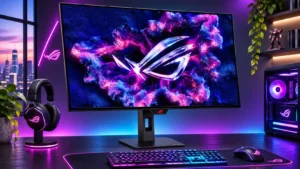
Overall: 4.2/5
The KVM makes sharing a keyboard and mouse between machines much more convenient, particularly alongside the USB hub.
Pros: overall satisfaction, black levels
Cons: reflection handling, Color brightness
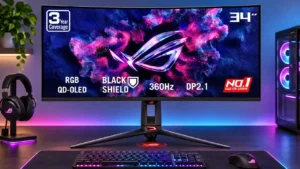
Overall: 4.5/5
The integrated KVM lets one keyboard and mouse follow a change between connected computers, avoiding extra desktop switching hardware.
Pros: color gamut, contrast
Cons: value for money, Resolution
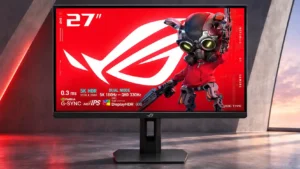
Overall: 4.1/5
The integrated KVM is useful for sharing peripherals between a gaming desktop and another computer without constantly reconnecting devices.
Pros: Pixel density, Resolution
Cons: GPU demands, HDR performance
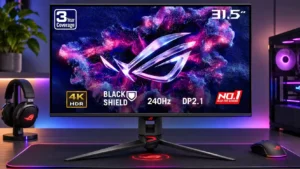
Overall: 4.2/5
The integrated KVM can switch mouse and keyboard control between connected systems without a separate box. One dual-computer user reports smooth automatic handoff and no peripheral lag.
Pros: overall satisfaction, black levels
Cons: value for money, stand adjustability
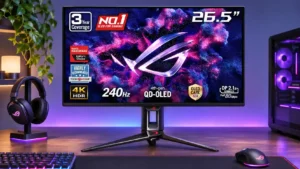
Overall: 4.4/5
An integrated KVM lets a keyboard and mouse move between a desktop and laptop without constant cable swapping. It's one of the more practical extras.
Pros: sharpness, overall satisfaction
Cons: value for money, VRR flicker
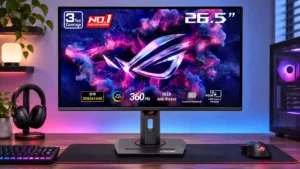
Overall: 4.4/5
The integrated KVM is a practical benefit for using one keyboard and mouse with a desktop and laptop, even if initial configuration is needed.
Pros: color gamut, overall satisfaction
Cons: reflection handling, VRR flicker
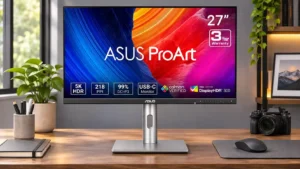
Overall: 4.1/5
Automatic keyboard-and-mouse switching between two systems is one of the more practical extras. Setup and switching smoothness vary by workflow.
Pros: color accuracy, overall picture quality
Cons: HDR performance, refresh rate
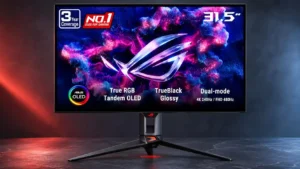
Overall: 4.3/5
The built-in KVM adds flexibility for connecting devices and using the monitor with more than one computer.
Pros: black levels, sharpness
Cons: value for money, brightness
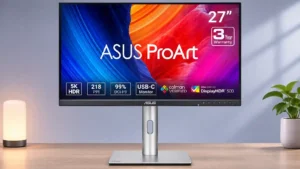
Overall: 4.1/5
The built-in KVM is handy for sharing input devices across two machines and often works smoothly. One hands-on account describes troublesome wake switching and too few usable peripheral ports.
Pros: value for money, Resolution
Cons: HDR performance, refresh rate
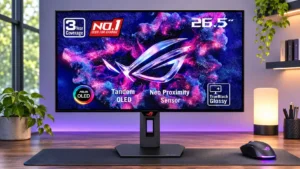
Overall: 4.4/5
There is no integrated KVM, a drawback for anyone switching one set of peripherals between two computers.
Pros: overall satisfaction, response time
Cons: reflection handling, VRR flicker
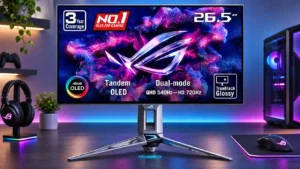
Overall: 4.3/5
There is no built-in KVM switch, limiting convenient sharing between two connected computers.
Pros: black levels, motion clarity
Cons: value for money, Dual-mode versatility
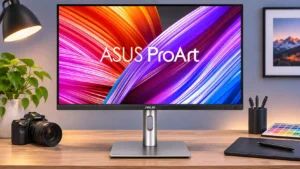
Overall: 4.3/5
There is no integrated KVM for sharing peripherals between computers. Models with a KVM are more convenient when swapping between two host systems.
Pros: USB-C power delivery, port selection
Cons: HDR performance, refresh rate
Overall: 3.8/5
A missing USB hub means it cannot serve as a KVM for sharing keyboard and mouse peripherals between computers.
Pros: value for money, Resolution
Cons: HDR performance, port selection
Overall: 3.9/5
There is no integrated KVM, reducing convenience for people sharing peripherals between computers.
Pros: motion clarity, Backlight strobing
Cons: contrast, HDR performance