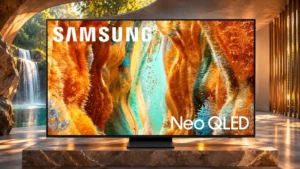
Overall: 3.8/5
Compatible gaming PCs can feed 4K at 144Hz, giving the QN70F more input flexibility than ordinary 60Hz televisions.
Pros: picture quality, 4K at 144 Hz support
Cons: sound quality, value for money

Overall: 3.8/5
Compatible gaming PCs can feed 4K at 144Hz, giving the QN70F more input flexibility than ordinary 60Hz televisions.
Pros: picture quality, 4K at 144 Hz support
Cons: sound quality, value for money
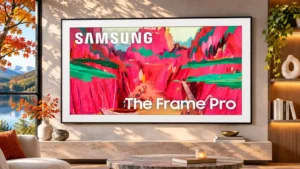
Overall: 3.8/5
The 144Hz ceiling is attractive for high-frame-rate sources, although slow pixel response and wireless lag can undermine the benefit.
Pros: Wireless One Connect compatibility, art display mode
Cons: value for money, input lag
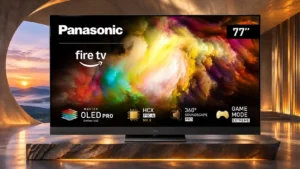
Overall: 4.0/5
At 144Hz, motion stays exceptionally sharp, making the higher ceiling especially worthwhile for PC gaming.
Pros: overall satisfaction, picture quality
Cons: size options, value for money
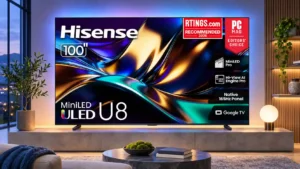
Overall: 4.1/5
A high-refresh 4K input is part of the strong PC gaming package, with the HDMI connection offering the fullest set of gaming options.
Pros: peak brightness, HDR brightness
Cons: sound quality, viewing angles
Overall: 3.4/5
Two high-bandwidth ports on the tested 75-inch set enable 4K/144Hz, making high-frame-rate PC play a major attraction.
Pros: picture quality, value for money
Cons: viewing angles, HDR performance
Overall: 4.3/5
PC gaming up to 4K/144Hz is fast and crisp, though LG and Samsung flagships can reach 165Hz.
Pros: picture quality, color accuracy
Cons: bass performance, HDMI 2.1 port count
Overall: 3.9/5
High-end PCs can use up to 4K at 144Hz, providing headroom beyond the 120Hz modes used by consoles.
Pros: gaming performance, overall satisfaction
Cons: sound quality, value for money
Overall: 3.8/5
A genuine attraction for a compatible gaming PC, this high-refresh mode is available through HDMI 2.1 and goes beyond what current consoles normally output.
Pros: overall satisfaction, picture quality
Cons: value for money, local dimming performance

Overall: 4.0/5
4K/144Hz PC gaming looks sharp and responsive in favorable tests, and separate eARC helps preserve both fast inputs.
Pros: color accuracy, picture quality
Cons: HDR brightness, peak brightness
Overall: 3.9/5
The 75-, 85-, and 100-inch models bring unusually fast native refresh rates to this budget series, enhancing their appeal for compatible gaming devices.
Pros: picture quality, contrast ratio
Cons: HDR performance, motion handling
Overall: 3.9/5
PC players get a genuine 4K/144Hz option, an unusual capability at this size and price.
Pros: overall satisfaction, picture quality
Cons: Weight and handling, black levels

Overall: 4.0/5
PC-focused testing praises the ability to push 4K up to 144Hz, adding useful headroom beyond console frame rates.
Pros: overall satisfaction, picture quality
Cons: reliability, build quality
Overall: 4.2/5
144Hz support is widely praised as exceptional at this price, particularly for PC gaming. One conflicting source describes a 60Hz limit, making the coverage unusually inconsistent across the supplied material.
Pros: overall satisfaction, value for money
Cons: smart TV platform, blooming control
Overall: 3.9/5
Two HDMI 2.1 inputs allow smooth 4K/144 gaming from capable PCs, with some limitations if several high-bandwidth devices are connected.
Pros: peak brightness, value for money
Cons: reflection handling, glare resistance

Overall: 4.0/5
PC players can enjoy very smooth 4K play at up to 144 Hz, an advantage over many 120 Hz alternatives.
Pros: value for money, overall satisfaction
Cons: Remote control usability, sound quality
Overall: 3.9/5
4K/144 Hz capability offers extra headroom for demanding PC gamers over standard 120 Hz displays.
Pros: value for money, overall satisfaction
Cons: Dolby Vision support, sound quality
Overall: 3.9/5
High-bandwidth inputs enable 4K at 144Hz gaming, but at least one PC tester could not make the mode work reliably with their graphics hardware.
Pros: peak brightness, overall satisfaction
Cons: value for money, shadow detail

Overall: 4.0/5
The panel tops out at 120Hz, so it is less attractive than 144Hz or faster rivals for high-refresh PC gaming.
Pros: picture quality, black levels
Cons: HDR brightness, value for money

Overall: 4.2/5
The B5 is limited to 120Hz rather than the 144Hz available on select step-up OLED televisions.
Pros: value for money, color accuracy
Cons: HDR brightness, reflection handling

Overall: 3.9/5
The S85F is generally a 4K/120Hz display, not a 144Hz gaming TV; one overview claims otherwise, but multiple technical assessments describe a 120Hz ceiling.
Pros: color volume, black levels
Cons: Inconsistent panel and coating by size, sound quality

Overall: 3.9/5
There is no 144Hz or 165Hz mode, a clear limitation for PC players comparing the Sony with faster premium rivals.
Pros: gaming performance, peak brightness
Cons: HDMI 2.1 support, HDMI 2.1 port count