If you want better cable management
Choose Samsung QN80H. It scores 4.3 vs 1.5 for cable management, with a 3.8 overall score.

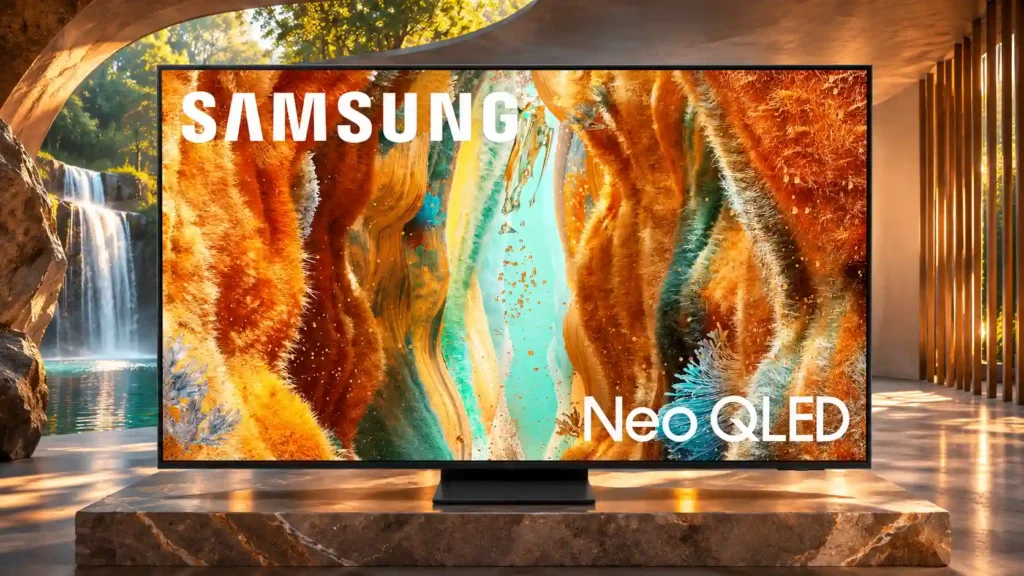
The QN70F excels at bright-room TV and flexible 4K gaming, with four capable HDMI inputs and low lag. Its weak edge-lit dimming, dark-scene contrast and motion blur make it harder to recommend at full price.
Daytime living-room viewers and casual console or PC gamers who want bright SDR pictures, low lag, four 4K/144Hz-capable HDMI inputs and Samsung smart features—ideally on a substantial discount.
Dark-room home-theater enthusiasts, motion-sensitive competitive gamers and widely spread seating groups; gray blacks, slow pixel response and narrow viewing angles undermine these uses.
The Samsung QN70F makes a convincing case as a daytime living-room TV and a flexible gaming display. Its bright SDR picture, four full-bandwidth HDMI 2.1 inputs, low input lag, 4K/120Hz console compatibility and up-to-4K/144Hz PC input are real strengths. Tizen, smart-home controls and a compact center stand add everyday convenience. The trouble is the picture after dark: coarse edge-lit dimming can produce gray blacks, halos and underwhelming HDR highlights. Measured response times also raise concerns about blur, even though several hands-on testers liked its sports and gaming motion. Built-in bass is weak, Dolby Vision and DTS are missing, and glossy reflections complicate rooms with direct windows. Some reviewers still find the image surprisingly pleasing, but stronger-contrast TCL, Hisense or higher-tier Samsung models may deliver better value near the QN70F’s usual price. A substantial discount makes it easier to recommend.
Compared with other TVs, this product is above average in wall flushness, stand width, Vision AI companion usefulness, near average in value for money, dialogue clarity, below average in local dimming zone transitions, cable management, Large-screen value.
| Attribute | This product | Category average | Difference |
|---|---|---|---|
| local dimming zone transitions | 1.0 | 3.4 | -2.4 |
| cable management | 1.5 | 3.7 | -2.2 |
| Large-screen value | 2.0 | 4.1 | -2.1 |
| reliability | 1.0 | 2.8 | -1.8 |
| HDR format support | 2.0 | 3.8 | -1.8 |
| Black uniformity | 2.0 | 3.8 | -1.8 |
| voice control accuracy | 1.5 | 3.2 | -1.7 |
| low-resolution content handling | 2.4 | 3.9 | -1.5 |
Choose Samsung QN80H. It scores 4.3 vs 1.5 for cable management, with a 3.8 overall score.
Choose Hisense UR8SG. It scores 5.0 vs 1.5 for voice control accuracy, with a 4.0 overall score.
Choose Hisense U7SG. It scores 5.0 vs 1.0 for reliability, with a 4.2 overall score.
Choose Samsung R95H. It scores 4.4 vs 1.8 for reflection handling, with a 3.7 overall score.
Products reviewers directly compared with this model, grouped into quick takeaways.
Yes for responsive console and PC play: it has four high-bandwidth HDMI ports, VRR, low lag, 4K/120Hz console compatibility and up to 4K/144Hz PC input. Slow pixel response can still make fast action look blurry.
Opinions vary, but detailed testing found poor local dimming, uneven blacks and weak HDR highlight separation. It is more convincing in a moderately lit or bright room.
No. It supports HDR10+ formats, but viewers relying on Dolby Vision films and streaming content will not get that format.
They are generally clear enough for speech and ordinary TV, but deep bass and dramatic movie effects are limited. A soundbar is a worthwhile addition for home theater.
1080p content often looks good, but very low-resolution material can remain blurry or blocky, and smoothing can strip away details.
It becomes more attractive with a large discount if you value Samsung software and four fast HDMI inputs. At similar prices, several reviewers prefer the contrast and HDR performance of alternatives from TCL, Hisense or higher Samsung ranges.
These are a few of the reviews included in our analysis.

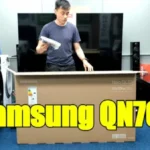
Samsung QN70F review covering picture quality, Mini LED dimming, 144Hz gaming, motion, HDR, sizes, prices, and alternatives including TCL...
Samsung QN70F review covering picture quality, Mini LED local dimming, HDR, gaming, motion, sizes, prices, and alternatives including TCL...
Explore the Samsung QN70F Neo QLED TV’s SDR and HDR capabilities, 4K 144Hz gaming features, Mini LED backlight, smart platform, sizes and key...
Samsung QN70F review covering Mini LED picture quality, HDR10+, 4K 144Hz gaming, motion, sound, Tizen features and 55- to 85-inch differences.
Samsung has a wide range of models to choose from in its extensive TV range, and among these, the QN70F sits in the centre of the pack: this...
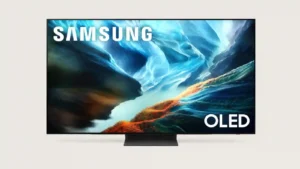
Choose the S90H for bright-room OLED viewing, deep blacks and top-tier gaming without flagship pricing. Skip it if you want Dolby Vision, a glossy screen or the simplest smart-TV software.
Pros: glare resistance, black levels
Cons: Dolby Vision support, color gamut
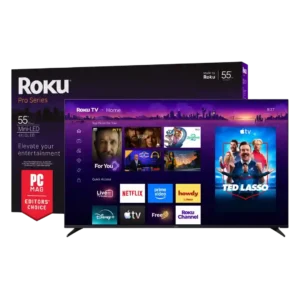
Best for bright Mini-LED picture, excellent built-in audio, easy Roku navigation, and responsive 4K/120 gaming. Skip it if you want ad-free menus, premium motion consistency, or stronger confidence in long-term...
Pros: overall satisfaction, picture quality
Cons: reliability, portability and versatility
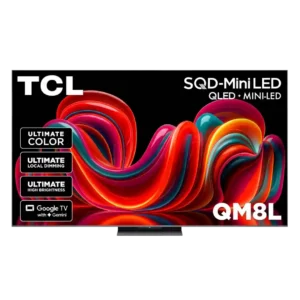
Choose the QM8L for a big, brilliantly bright TV with vivid HDR, deep mini-LED blacks, low input lag, and four HDMI 2.1 ports. Skip it if you need OLED-clean motion,...
Pros: picture quality, value for money
Cons: stand quality, judder handling

Choose the G6 for class-leading bright-room OLED picture, rich color, deep blacks and elite gaming. Skip it if you want strong built-in audio, polished launch firmware, no account sign-in, or...
Pros: picture quality, peak brightness
Cons: value for money, sound quality