Best for Image scaling
ASUS ProArt Display PA27JCV
5.0 attribute score
Highest scored product for this attribute based on supporting review evidence.

Highest scored product for this attribute based on supporting review evidence.
Balances the attribute score, supporting reviews, and overall product strength.
Has the broadest review evidence for this attribute.
Strongest overall product among items with scored evidence for this attribute.
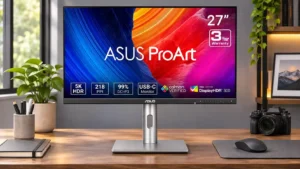
At the Mac-friendly 5K density, interface text can stay crisp at convenient sizes, avoiding many of the compromises associated with 27-inch 4K scaling.
Pros: color accuracy, overall picture quality
Cons: HDR performance, refresh rate
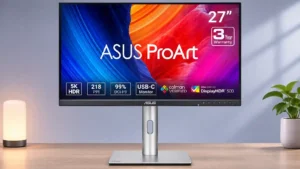
The native 6K resolution maps neatly to macOS's 2× scaling, retaining sharp UI elements. Windows scaling also works well with suitable hardware.
Pros: value for money, Resolution
Cons: HDR performance, refresh rate
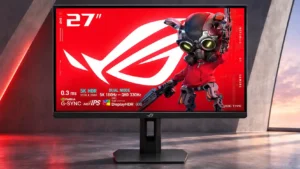
Non-native content generally upscales cleanly, but the 1440p high-speed mode can look softer or more pixelated than true native QHD to some eyes.
Pros: Pixel density, Resolution
Cons: GPU demands, HDR performance

Downscaling to 1080p is comparatively smooth for a dual-mode 4K screen, but smaller emulated windows and operating-system scaling reduce sharpness or complicate text sizing.
Pros: black levels, sharpness
Cons: value for money, brightness
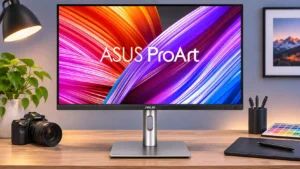
One assessment praises crisp macOS fonts and flexible scaling, while others find 27-inch 4K awkward on Macs without third-party software. Windows scaling receives a more consistent endorsement.
Pros: USB-C power delivery, port selection
Cons: HDR performance, refresh rate
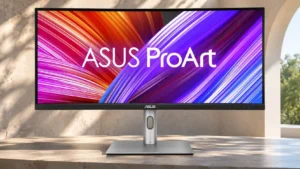
The larger workspace may make interface elements appear small, so some users will need to experiment with display scaling.
Pros: color accuracy, value for money
Cons: color gamut, black levels

Screen-size emulation is flexible, but a tested 27-inch mode looked softer than expected pending a proposed firmware correction.
Pros: color gamut, contrast
Cons: value for money, Resolution

4K at 27 inches benefits from careful Windows or application scaling; small text and inconsistent software rendering can complicate otherwise crisp desktop use.
Pros: sharpness, overall satisfaction
Cons: value for money, VRR flicker
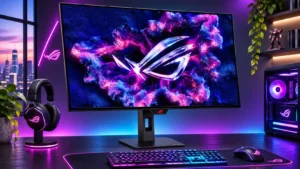
Native 4K looks excellent, but stretching 1080p across 32 inches can make small text and distant objects blocky or soft.
Pros: overall satisfaction, black levels
Cons: reflection handling, Color brightness
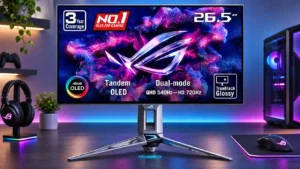
The 720p boosted mode looks soft, while some pixel-mapping choices behave inconsistently with Windows timing.
Pros: black levels, motion clarity
Cons: value for money, Dual-mode versatility

Sending it 4K for desktop use produces softer text than native QHD, so the higher accepted input resolution is not a substitute for a native 4K panel.
Pros: color gamut, overall satisfaction
Cons: reflection handling, VRR flicker