
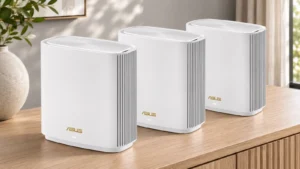
ASUS ZenWiFi ET9 Feature Scores
Overall Scorata score: 4.3/5
Based on 5 analyzed reviews · View source samples
Explore all 64 feature scores for ASUS ZenWiFi ET9, organized into pros and cons.
Scores by Feature
Summary
64 reviewed features-
Very positive 4.5-5.055 (86%)
-
Positive 3.5-4.46 (9%)
-
Neutral 2.5-3.41 (2%)
-
Negative 1.5-2.42 (3%)
Pros
Sort
-
Wi-Fi 6E is a useful addition for compatible clients, giving them access to less crowded 6 GHz spectrum.
-
Range is a highlight, with reports of strong signals throughout large homes and even into a backyard.
-
Fast wireless speeds are a major strength, especially for high-bandwidth household activity. Newer Wi-Fi 7 systems can be faster on 6 GHz.
-
Wireless performance is generally strong for streaming and ordinary household traffic, though latency can worsen through a satellite.
-
Multiple devices can stream, game and communicate with little noticeable slowdown in household testing.
-
Demanding activities remain smooth when several high-bandwidth tasks are running.
-
Included security is a prominent selling point, particularly the scanning tools and protection without a recurring fee.
-
Built-in security without subscription fees is a recurring reason to favor this mesh system.
-
Whole-home coverage is a consistent strength, including difficult indoor areas and one normally poorly served backyard.
-
AiMesh and ASUSWRT provide appealing flexibility for expanding and configuring a home network.
-
Mesh coverage is strong in large homes, although a higher-end alternative scores better on combined coverage and backhaul.
-
Overall impressions are favorable for homes that need strong coverage, flexible administration and useful security, with pricing and satellite latency as caveats.
-
Expansion is a major advantage, since compatible ASUS mesh routers can be added as coverage needs grow.
-
AiMesh makes it easy to grow the mesh with additional compatible ASUS access points.
-
Household reports describe strong, reliable connections across difficult locations.
-
The system is well suited to many connected devices, with little slowdown reported in a busy home.
-
The setup process is user-friendly, making it approachable even without extensive networking experience.
-
Installation can be completed in minutes, with clear instructions and an app-guided process.
-
The network remains stable during ordinary household activity, including simultaneous high-bandwidth tasks.
-
Setup is repeatedly described as quick and straightforward.
-
The additional 6 GHz band helps reduce congestion, and a household test reported little slowdown with multiple devices.
-
Content filtering and safe browsing are valued for helping protect children online.
-
Advanced parental controls are praised for customizable content restrictions, safe browsing and visibility into children’s usage.
-
Privacy protection receives favorable assessments, including encrypted VPN access and the included security offering.
-
The extra 6 GHz spectrum helps busy households, but newer Wi-Fi 7 alternatives can deliver significantly higher speeds on that band.
-
The 2.5 Gbps WAN connection is valuable for service faster than a gigabit, although it cannot speed up a slower internet plan.
-
Multi-gigabit WAN support is a useful connectivity upgrade for faster internet service.
-
Three bands are valued for relieving congestion and increasing capacity in demanding households.
-
The 2.5 Gbps WAN port is a useful advantage over alternatives with slower internet-facing connections.
-
The mesh offers strong coverage and useful household capacity, but satellite latency is a meaningful weakness.
-
Customizable internet access restrictions are a useful part of the parental controls.
-
The mobile app walks users through setup step by step and helps make initial configuration easy.
-
The units feel premium and well constructed.
-
One setup experience found ASUS support responsive, quick and helpful.
-
The mesh performs robustly in difficult areas where dead zones would otherwise be a concern.
-
Sleek, unobtrusive styling helps the mesh units blend into a living room.
-
Ample LAN ports distinguish it from several competing Wi-Fi 6E mesh systems.
-
The system has enough range for larger homes with multiple floors.
-
Ventilation is favorably described for keeping the units cool during heavy use.
-
Instructions are easy to follow, helping users get the mesh online quickly.
-
The mobile app earns praise specifically for its clear guided installation.
-
One household test found that a backyard which normally struggled for Wi-Fi received strong coverage.
-
Step-by-step app guidance and easy-to-follow instructions make setup straightforward.
-
The compact units are easy to accommodate in a typical living space.
-
Helpful, prompt answers from support made setup questions easier to resolve.
-
The USB port adds useful connectivity that some similarly performing mesh rivals lack.
-
The ability to keep track of children’s internet activity is a useful part of the parental controls.
-
The one-tap scanning feature is valued for helping protect connected devices.
-
One-tap security scanning is praised for making connected-device protection accessible without a subscription.
-
Large downloads are among the high-bandwidth tasks the system handles well.
-
A mature firmware platform is highlighted as a reason to choose this model over less established alternatives.
-
Smart TVs and IoT devices worked alongside other clients without significant slowdown.
-
Smart-home devices can coexist with other household clients without significant slowdown.
-
Regular software maintenance is appreciated as a sign that ASUS continues improving the mesh platform.
-
Included security scans are considered a useful way to help protect the home network from threats.
-
The shareable VPN feature is valued for providing a protected connection when away from home.
-
ASUSWRT administration is valued for its flexible controls.
-
Value is strongest for buyers who will use the coverage, security and flexibility. The price can be hard to justify when newer or simpler alternatives meet the same needs.
-
The 6 GHz band is viewed as a forward-looking upgrade for compatible devices, although it is not Wi-Fi 7.
-
Wireless latency is adequate for everyday browsing, calls and casual play, but satellite connections are less responsive.
-
The 5 GHz band produces latency and jitter broadly comparable to the 6 GHz band in testing.
Cons
Sort
-
Latency becomes less consistent through satellite nodes, with unusually large and frequent spikes in repeated testing.
-
Satellite performance is the main measured drawback: responsiveness deteriorates when traffic passes through a mesh node.
-
Backhaul performance is less convincing than the overall coverage, with satellite-related latency spikes and stronger alternatives available.
Use Cases
Best for
Sort
-
Busy households benefit from the extra 6 GHz spectrum and the system’s ability to handle several active devices without significant slowdowns.
-
4K streaming is well within the system’s capabilities, even alongside other household activities.
-
It is a flexible choice for expanding an ASUS AiMesh network rather than replacing every compatible router.
-
Video calls are generally smooth or adequate, although satellite latency spikes may matter when consistency is critical.
-
New router users benefit from straightforward installation and clear app-based guidance.
-
Large and multi-story homes benefit from the strong reach and speed, with room to add more access points if needed.
-
Online gaming is reported to work smoothly during household testing, although satellite-related latency spikes remain a caveat.
-
Families with children benefit from customizable parental controls, content filters and internet usage oversight.
-
The 2.5 Gbps WAN port makes this a useful option for internet service above one gigabit within the port’s capacity.
-
Casual gaming is a reasonable fit for the router’s ordinary wireless latency.
-
Everyday web browsing works adequately without demanding exceptional latency performance.
-
The system is suited to downloading large files without making ordinary household networking a bottleneck.
-
Working from home is a suitable use when reliable ordinary connectivity is the priority, though satellite responsiveness can be less consistent.
-
Flexible ASUSWRT and AiMesh controls suit buyers who want more control over their home network.
-
The secure VPN is useful for accessing a protected connection while away from the home network.
-
Frequent public Wi-Fi users may benefit from the router’s shareable encrypted VPN connection.
-
Smart-home networking benefits from the capacity to accommodate IoT devices alongside phones, laptops and televisions.
Conditional or not ideal for
Sort
-
Latency-sensitive satellite connectionsFor tasks that need consistently low latency, connections through a satellite are a weak point. Repeat testing found more frequent and larger spikes than competing mesh systems.
-
Budget-conscious buyersThe value assessment depends on price and needs: one ranking rates total cost highly, but a hands-on assessment considers it expensive for basic networking.
-
Wi-Fi 7 device householdsHouseholds that specifically require Wi-Fi 7 should choose another system, since this is a Wi-Fi 6E model.
-
Basic home networkingA simpler network may be better value when the home does not need this much coverage or advanced capability.
-
Small homes and apartmentsSmall homes may not need the coverage or advanced features, making the mesh package potentially excessive.