Best for refresh rate
LG 27GR83Q-B
5.0 attribute score
Highest scored product for this attribute based on supporting review evidence.

Highest scored product for this attribute based on supporting review evidence.
Balances the attribute score, supporting reviews, and overall product strength.
Has the broadest review evidence for this attribute.
Strongest overall product among items with scored evidence for this attribute.
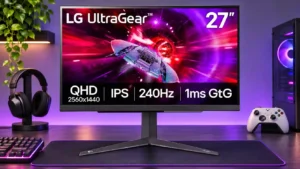
Its 240Hz operation is a major draw, noticeably smoothing fast games compared with 144Hz or 165Hz displays when the PC can supply enough frames.
Pros: refresh rate, overall satisfaction
Cons: HDR performance, contrast
A native 480Hz refresh makes motion dramatically smooth and is its clearest reason to buy, provided the PC can render enough frames.
Pros: refresh rate, competitive gaming suitability
Cons: value for money, brightness
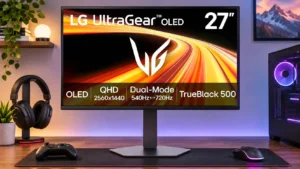
Native 540Hz QHD feels extraordinarily fluid and crisp. The 720Hz option is less universally useful because it drops to 720p and demands extremely high frame rates.
Pros: competitive gaming suitability, refresh rate
Cons: Dual-mode versatility, GPU demands
The 240Hz refresh delivers noticeably fluid gameplay, although the more expensive 27GX700A-B rises to 280Hz.
Pros: overall satisfaction, value for money
Cons: reflection handling, screen uniformity
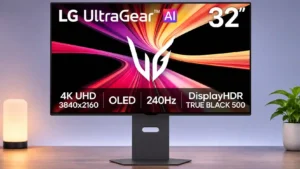
Native 4K/240Hz is already fast, and the optional Full HD/480Hz mode adds another level of smoothness for suitably powerful systems.
Pros: brightness, color gamut
Cons: AI scene optimization, value for money
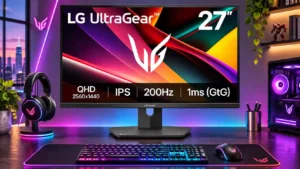
The 200Hz refresh rate is the standout strength, producing a smooth, responsive sensation with a sufficiently fast PC. Some similarly priced alternatives trade a little speed for other advantages.
Pros: refresh rate, value for money
Cons: HDR performance, contrast
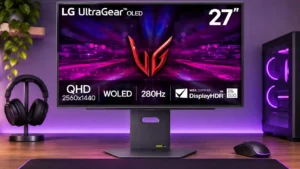
At 280Hz, gaming feels notably smoother and motion is clearer than at mainstream refresh rates. A few premium alternatives go even faster.
Pros: reflection handling, HDR performance
Cons: screen uniformity, Screen coating clarity
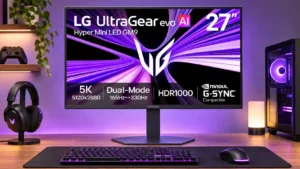
Switching between 165Hz at native 5K and 330Hz at QHD gives players a real speed-versus-detail choice. The top rate requires compatible hardware and the lower resolution.
Pros: Resolution, Dual-mode versatility
Cons: value for money, GPU demands
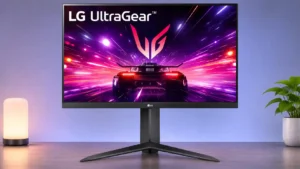
A 180Hz refresh rate makes camera movement, aiming, and scrolling noticeably smoother than ordinary 60Hz screens. Faster 240Hz and 280Hz alternatives exist.
Pros: adaptive sync performance, response time
Cons: HDR performance, console gaming compatibility
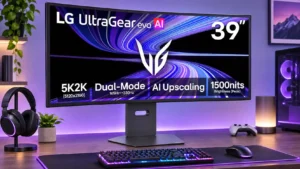
Native 165Hz is fluid for detailed 5K2K gaming, but lower than some flagship alternatives; 330Hz demands a drop to 2560×1080.
Pros: Resolution, overall satisfaction
Cons: value for money, Image scaling
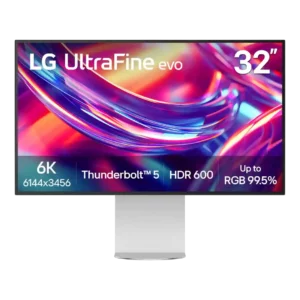
The 60Hz ceiling is one of the most repeated compromises. It is tolerable for static productivity work, but scrolling, mouse motion, and gaming feel dated next to 120Hz and faster...
Pros: port selection, overall satisfaction
Cons: value for money, cable management