
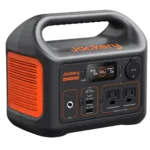
Jackery Explorer 300 Feature Scores
Explore all 98 feature scores for Jackery Explorer 300, organized into pros and cons.
Scores by Feature
Summary
98 reviewed features-
Very positive 4.5-5.047 (48%)
-
Positive 3.5-4.425 (26%)
-
Neutral 2.5-3.412 (12%)
-
Negative 1.5-2.47 (7%)
-
Very negative below 1.57 (7%)
Pros
Sort
-
Portability is the defining advantage: at about 7.1 pounds, it is easy to carry one-handed, stash in a vehicle or even take on short hikes.
-
Overall sentiment is very strong: reviewers consistently recommend it as a compact, reliable station when expectations stay within its 300W class.
-
Compactness is one of the most consistent strengths; reviewers repeatedly call the Explorer 300 tiny, easy to pack and ideally sized for short trips.
-
USB-C PD is one of the Explorer 300’s strongest features, praised for charging laptops and cameras and, in many reviews, recharging the station itself.
-
At roughly 7.1 pounds, weight is universally praised and is a major reason owners choose it over larger power stations.
-
Reviewers consistently praise the simple controls, labeled ports and no-fuss operation; this is a device that is easy to use without much instruction.
-
Most reviewers describe the Explorer 300 as solid, well made and sturdy, though one direct comparison found its plastic construction much less premium than Anker’s.
-
Long-term reliability is a major positive, with several owners reporting years of travel and frequent use without meaningful failures.
-
Combining the wall adapter with USB-C is consistently praised, commonly reaching about 80% in around two hours.
-
Durability is a major strength: long-term owners report years of travel, bumps and rough handling with little wear or functional trouble.
-
Quiet operation is a consistent strength; the fan is usually barely noticeable and low-load use can be essentially silent.
-
Recharge speed is generally good—especially with dual input—but AC-only results around four hours feel slow beside the newest competitors.
-
Value is usually rated positively, especially on sale, but some reviewers note that newer LFP competitors or the 300 Plus can offer better longevity for a little more.
-
Runtime is strong for phones, laptops, lights and other modest loads, but fridge and CPAP endurance varies sharply with wattage.
-
Solar charging is usually practical in good sun, commonly taking about five to six hours, with faster results possible from optimized setups.
-
The large integrated handle is usually praised for easy carrying, though one long-term tester found its sharp steel edges uncomfortable.
-
Real-time wattage monitoring is widely useful for managing loads, although a few reviewers noticed brief screen-update lag.
-
The mix of AC, USB-A, USB-C and 12V outputs is repeatedly praised as versatile for a station this small.
-
The pure sine inverter is repeatedly trusted with laptops, cameras and other sensitive electronics without issues.
-
Paired with a suitable panel, the Explorer 300 becomes a genuinely useful small solar generator for camping and light emergency needs.
-
Official Jackery panels work smoothly, and several reviewers also succeeded with third-party panels when connector and voltage requirements matched.
-
The port mix can power several small devices at once; reviewers successfully ran multiple USB and AC loads together within the 300W limit.
-
The MPPT controller is a standout strength, repeatedly praised for making solar charging much faster and more effective than older Jackery designs.
-
Reviewers report stable, predictable power delivery, including reliable operation in cold weather and remote use.
-
The 12V car-style outlet is useful for accessories and regulated loads, though one reviewer found it less relevant to their own gear.
-
The 293Wh capacity is widely seen as a sweet spot for phones, laptops, cameras and short trips, but too limited for sustained appliance use.
-
The 300W output is well matched to electronics, lights and small devices, but deliberately trades appliance capability for size and weight.
-
The LCD is simple and useful, but some reviewers find the information set too basic compared with newer competitors.
-
Pass-through charging is useful and generally works well, but several reviewers caution that frequent use can add heat or accelerate battery wear.
-
Testing up to roughly 95–100°F was positive, with reviewers reporting stable operation and no obvious overheating problems.
-
Unlike fuel generators, the Explorer 300 needs almost no routine mechanical maintenance, which makes ownership simple.
-
USB-C is one of the most welcomed additions, reducing the need to carry a dedicated charging brick and making the small station more flexible.
-
Voltage regulation tested very well, with AC output staying stable as load changed.
-
The small body is easy to stash, though the fixed handle can make tight van storage more awkward than a flat-topped design.
-
Warranty sentiment is mostly positive for an entry-level station, though shorter coverage than newer five-year rivals is a concern.
-
The included wall and car chargers are appreciated, but some reviewers wish a protective carry bag were standard at this price.
-
Setup is generally straightforward and works out of the box, with the main exception being somewhat awkward solar-panel positioning in one test.
-
The screen is usually bright and readable, especially from above, but viewing angles can be narrow and some units show brief update lag.
-
The front panel is generally clear, logically grouped and easy to understand, with only minor spacing concerns.
-
AC frequency stayed close to 60Hz in testing and held steady under load, which reviewers considered suitable for modern electronics.
-
The USB-A selection is useful, including a Quick Charge port that reviewers found to meet its rated fast-charge performance.
-
Most reviewers like the practical rounded design, though one strongly disliked the oversized top branding on an early unit.
-
Brief overload testing shows useful headroom above 300W, though it is not enough to turn the unit into a high-power appliance station.
-
Charging flexibility is generally strong through AC, car, USB-C and solar, but proprietary connectors and a few finicky input experiences reduce universality.
-
Two AC outlets give the Explorer 300 an advantage over comparable units that provide only one.
-
Short-term cycling tests showed no noticeable capacity degradation, supporting confidence for casual use.
-
One long-term owner reported 99% charge remaining after more than three months in storage, indicating very low standby loss in that sample.
-
The included charging cable was praised for heavy-duty wiring and a solid, non-cheap feel.
-
The regulated DC output impressed in testing by holding steady across battery charge levels, which helps sensitive 12V gear.
-
Rubber feet and a rugged shell help protect the housing from scratches and rough outdoor placement.
-
At light loads the unit can rely on passive cooling, making it effectively silent for phones, cameras and other small devices.
-
Camping trips and occasional bumps produced minimal visible wear in extended testing.
-
The manual was singled out as unusually clear, well laid out and easy to read.
-
Load testing found the inverter strong and well regulated, even handling brief demands above its nominal continuous rating.
-
Occasional users especially benefit from the lack of ongoing oil, filter or engine-service requirements.
-
Materials were described as tough and durable, with practical plastics and well-finished controls rather than luxury construction.
-
Once paired with solar, day-to-day operation can be effectively fuel-free and very inexpensive.
-
When overloaded, the inverter shuts down safely and can be reset after removing the offending load.
-
Custom foam and secure packing gave the unit strong protection in transit.
-
Clean AC output is suitable for sensitive electronics and behaves much like household power.
-
One stored unit retained 99% charge after more than three months, suggesting very low self-discharge in that owner’s experience.
-
Idle inverter draw measured very low in one comparison, helping preserve energy when AC is left enabled.
-
Because it has no combustion engine or exhaust fumes, it is much easier to use indoors than a fuel generator.
-
Thermal shutdown protection adds confidence in hot conditions, even though the older chemistry still needs sensible temperature management.
-
Measured charge efficiency was described as textbook-standard for lithium-ion, so losses are normal rather than exceptional.
-
Jackery’s broader support network is viewed as stronger than some budget rivals and helps justify a modest price premium.
-
Rubber port flaps provide useful basic dust protection, though they do not make the unit waterproof.
-
At full output the fan becomes audible, but measured noise remained moderate rather than disruptive.
-
Built-in thermal shutdown adds a useful safety layer when ambient or internal temperatures climb too high.
-
The 500W peak capability is useful for brief startup demands and compares favorably with some similarly sized competitors.
-
The station continued powering devices below freezing, but cold caused extra drain, slower behavior and stricter charging limits.
-
Solar input is limited compared with newer rivals, though one tester achieved an impressive peak above the nominal rating under ideal voltage.
Cons
Sort
-
The 300W ceiling is the product’s biggest limitation: kettles, heaters, coffee makers, air fryers and many tools are repeatedly ruled out.
-
The display’s lack of time-to-empty and time-to-full estimates is a recurring weakness and makes planning less convenient.
-
The missing built-in light is one of the most repeated complaints; several reviewers wanted a flashlight or lantern for outages and camping.
-
The internal battery cannot be expanded, so buyers who outgrow 293Wh must move to a larger or newer model.
-
The station is not waterproof or water-resistant, so rain and wet campsites require active protection.
-
Its 293Wh battery is too large for commercial airline battery limits, so it is not suitable for carry-on or checked air travel.
-
The original design offers no meaningful expansion path, limiting how far the system can grow with changing power needs.
-
The fixed handle is sturdy but cannot fold flat, making the unit more awkward to store in tight van or cabinet spaces.
-
Cycle life is the clearest aging concern: roughly 500 cycles is acceptable for occasional use but far behind newer 2,500–4,000-cycle alternatives.
-
Solar cabling is a weak spot: proprietary or uncommon connectors can require adapters, even though third-party panels can often be made to work.
-
The older NMC lithium-ion chemistry keeps weight down but is repeatedly criticized for shorter life than modern LiFePO4 rivals.
-
UPS-like behavior is inconsistent in how it is described: some reviewers use pass-through charging as office backup, while others note there is no true UPS mode.
-
Direct sun and pass-through use can raise case temperature and reduce charging efficiency, so heat management requires some care.
-
The station works across a useful camping range, but very cold conditions restrict charging and reduce flexibility.
-
The 300W continuous rating is a hard ceiling in practice, so buyers need to check appliance draw carefully.
-
One reviewer disliked Jackery’s storage guidance because keeping lithium-ion at 100% is not ideal for long-term battery life.
-
Outdoor use is practical only when sheltered; reviewers explicitly caution against relying on it in rain.
-
The solar bundle is useful but divisive on price; the panel can substantially raise total cost and is not always discounted with the battery.
-
Wall charging draws mixed reactions: some find roughly 3–4.5 hours reasonable, while others call it slow beside newer rivals.
-
Battery percentage reporting varies by sample: one reviewer found it fairly accurate, while another unit shut down with 12% still displayed.
-
The original battery is expected to lose capacity sooner than LFP competitors, though occasional users may still find the lifespan acceptable.
-
Real-world appliance testing is mixed: some refrigerators or motors run, while other seemingly similar loads trip the unit unexpectedly.
-
The two AC outlets are useful, but their close spacing can make two bulky wall-wart adapters difficult to use together.
-
It works well as light emergency backup for phones, routers, lights and computers, but it is not a whole-home or major-appliance solution.
-
Car charging ranges from useful to frustratingly slow, with results depending on setup; one test took about seven hours while others saw strong input wattage.
-
Efficiency is acceptable but not exceptional: AC conversion losses reduce usable runtime, while direct USB use avoids some of that waste.