
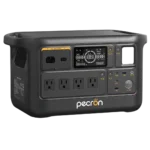
Pecron F1000LFP Feature Scores
Explore all 97 feature scores for Pecron F1000LFP, organized into pros and cons.
Scores by Feature
Summary
97 reviewed features-
Very positive 4.5-5.057 (59%)
-
Positive 3.5-4.426 (27%)
-
Neutral 2.5-3.43 (3%)
-
Negative 1.5-2.48 (8%)
-
Very negative below 1.53 (3%)
Pros
Sort
-
At roughly 24–26 pounds, the F1000 is repeatedly described as unusually light for a 1kWh-class station and easy for most people to carry.
-
Near-rated 1,500W loads are handled very well in most tests, including heaters, tools, and coffee makers. Limits appear with some high-inrush saws and one combined AC/DC test.
-
Wall charging is exceptionally fast, with full-charge tests commonly landing around an hour and customers also reporting very quick top-ups.
-
Value is one of the strongest themes, with the F1000 repeatedly described as hard to beat for its combination of price, inverter power, charging speed, and portability.
-
Portability is one of the F1000’s clearest strengths: the light, compact chassis is easy to move for camping, road trips, RV use, and outages.
-
The F1000’s sleeker F-series styling is a consistent strength, with its clean, modern shape repeatedly preferred over older Pecron designs.
-
The front light is widely appreciated for blackouts, roadside use, and camping, with adjustable brightness and SOS modes making it more than a token extra.
-
Most impressions are strongly positive, especially around value and performance. A smaller but important group of customers reports serious failures, including Err25 and zero-output units.
-
Its compact body is a major advantage for trunks, condos, camping setups, and other spaces where a larger power station would be awkward.
-
Putting the inputs, outputs, screen, and controls on the front makes the F1000 especially convenient in vehicles, under desks, and against walls.
-
Solar charging is a standout when paired with suitable panels, with strong input rates and full-charge times that can approach roughly 1.5 hours under favorable conditions.
-
The large front display is praised for clear status information, power readings, and richer tracking data than a basic battery gauge.
-
Switchover is fast enough to keep tested computers, a laptop, and a 3D printer running without visible interruption during grid loss.
-
The four AC outlets are spaced well enough for larger power bricks, and the front-facing layout keeps connections usable even when the unit is packed tightly.
-
Oscilloscope and audio tests consistently show a very clean sine wave, making the AC output well suited to electronics that are sensitive to noisy power.
-
Most users find the F1000 quiet in ordinary use, and several tests report very low fan noise. One customer calls the fan very noisy, so noise experience is not completely consistent.
-
Runtime is impressive for many essential loads, with refrigerator tests ranging from roughly 9 to more than 18 hours depending on the appliance. Some customers still find the fixed 1kWh capacity limiting.
-
The screen is repeatedly described as bright, clear, and easy to read, including outdoors and in dark rooms.
-
Trip-style and total energy counters are a standout convenience, letting users see how much energy has moved in or out without adding a separate meter.
-
Overload behavior is well judged: the F1000 shuts down instead of continuing with unsafe low voltage, and recovery is generally simple after cycling the AC output.
-
Power quality is a major strength, with clean audio behavior and smooth sine-wave traces holding up under load.
-
Customer feedback strongly reinforces the fast-charging theme, with quick top-ups from both outlets and solar called out as a practical advantage.
-
The extended five-year coverage available after registration is repeatedly praised as unusually generous for a budget-focused power station.
-
UPS performance is strong in hands-on tests, keeping PCs, laptops, and a 3D printer running through simulated or real outages. The 20ms-class transfer time may still be marginal for unusually sensitive equipment.
-
Voltage stays impressively steady around rated loads, though one extreme over-rating test showed noticeable sag before overload shutdown.
-
Voltage remains very steady around 118–120V through substantial loads, with regulation only becoming less comfortable when the inverter is pushed well above rating.
-
App impressions range from polished and highly capable to buggy on some phones. Charging controls, output toggles, monitoring, and light control are useful, but one reviewer wanted much more refinement.
-
The 3,500-cycle LFP rating is treated as a major longevity advantage, with reviewers describing it as suitable for many years of regular use.
-
The included AC cable is repeatedly described as thick, substantial, and high quality.
-
The roughly 24-pound weight and side handles make the F1000 notably easy to lift and reposition for a 1kWh-class station.
-
A 600W solar-input ceiling is unusually strong for a station this small and supports rapid off-grid recovery when panel voltage is configured correctly.
-
Solar-controller performance is excellent in testing, pulling roughly 300W from a 327W panel and earning direct praise for efficiency.
-
Rated 1,500W output is well supported by testing, including sustained loads at or slightly above the nominal limit without immediate problems.
-
Setup is generally simple, especially for AC and solar charging, though one customer needed extra help getting everything connected at first.
-
The F1000 works well for essential backup loads such as refrigerators, lights, internet gear, and device charging, but it is not a whole-home system and one customer reported inadequate refrigerator performance.
-
Four AC outlets are considered generous for a compact station, though the older E1000 offers one additional outlet.
-
The side handles provide plenty of room and useful grip, and customers appreciate how much easier they make carrying the relatively light unit.
-
The combination of four AC outlets plus USB and 12V connections gives the F1000 enough flexibility for mixed everyday loads without relying heavily on adapters.
-
Being able to power connected devices while the F1000 itself is charging is a welcome convenience for backup and everyday setups.
-
The 100W USB-C port met its output target, while the secondary 33W port is appreciated for devices that do not need full laptop-class charging power.
-
Support experiences are mostly encouraging, including responsive expert contacts and successful replacement help. One customer, however, strongly disliked having to pay return shipping.
-
The manual is generally appreciated and one customer specifically valued receiving a detailed English copy. Another reviewer found an important combined-output limit missing from the documentation.
-
The inverter earns strong praise for clean output and substantial headroom above 1,500W in testing, but one customer reported an Err25 failure identified as an inverter problem.
-
Pecron generally earns praise for including core AC and solar cables, though some units omit the car-charging cable and the older zippered cable bag.
-
The 12V car socket performed strongly in load testing, sustaining roughly 130–145W before protection eventually cut in above its nominal limit.
-
Remote commands responded quickly in testing, including switching the built-in light from the app.
-
Around 1kWh of storage is viewed as a useful middle ground, providing meaningful appliance runtime while keeping the unit easy to move.
-
Lithium iron phosphate chemistry is treated positively, especially because the pack is intended for repeated cycling over many years.
-
The LFP cycle-life expectation suggests the pack should retain useful capacity for many years, even with frequent charging and discharging.
-
The BMS is praised for monitoring conditions such as overload and temperature and shutting the system down before damage.
-
A simulated vehicle input produced about 110W, which was considered a strong and appropriate result for standard 12V car charging.
-
DC testing produced the expected power cleanly, making the 12V and USB side useful for direct, efficient device charging.
-
Simultaneous solar and AC charging worked successfully, with the unit prioritizing solar and using grid input to supplement it up to the overall charge limit.
-
The removable mesh vent filters are praised for keeping dust from building up inside and for being easy to clean.
-
The inverter produced no noticeable extra buzz through a guitar amplifier compared with grid power, a strong result for radio and audio use.
-
At light or residual fan speeds, the unit can be quiet enough that a room has to be very still to hear it.
-
Built-in tracking for incoming and outgoing energy is praised as a valuable way to understand daily usage and solar production.
-
The LFP chemistry is viewed as a strong fit for the F1000, pairing the portable format with a battery type reviewers associate with long service life.
-
The protection system is praised for detecting overheating and shutting down before damage, adding reassurance under demanding use.
-
The F1000 arrives very well protected with thick fitted foam, and the packaging is considered worth keeping for warranty or return shipping.
-
Short bursts above the 1,500W rating show useful headroom before overload protection intervenes, adding confidence for momentary peaks.
-
App-based switching can turn outputs on from a distance while leaving the main unit ready without keeping the inverter idling unnecessarily.
-
The app makes it easy to check battery percentage and power status from nearby without walking back to the station.
-
The F1000’s footprint is considered close to ideal for buyers who want meaningful backup power without a bulky station dominating the space.
-
The F1000 successfully woke itself and began solar charging automatically the next morning without user intervention.
-
Hands-on testing found the F1000 delivered close to its advertised capabilities, easing the usual concern about inflated claims on low-cost power stations.
-
Moving the charger inside the power station is a welcome improvement because it eliminates the bulky external power brick used by older models.
-
Testing showed useful headroom above the 1,500W continuous rating before overload protection activated, helping with short startup surges.
-
The 1,500W output is considered strong for a compact 1kWh station and sufficient for many household and camping loads. A few customer reports sharply disagree, including one zero-output unit.
-
The 1,500W inverter runs many power tools, coffee makers, heaters, and cooking appliances, but higher-demand microwaves, air fryers, and large saws can exceed its practical limits.
-
Idle inverter draw lands around 14–16W in several tests, which is average to slightly high for the size. One customer still retained 60% after a 24-hour standby test.
-
Around 80% efficiency under heavy AC loads was viewed as respectable for the inverter-to-battery balance rather than a weakness.
-
On-device controls make common settings straightforward, but some reviewers found important charging controls too dependent on the app, creating a mixed usability picture.
-
The F1000 is described as well built and slightly above average for its class, reinforcing the impression that the low price does not automatically mean cheap construction.
-
Eco mode is a useful camping feature because it can shut the station down when no load is present and avoid wasting stored energy.
-
A customer successfully replaced the supplied repair part and reported the unit working perfectly afterward, suggesting at least some faults can be field-corrected.
-
One customer received a replacement part for an Err25 fault and was able to restore the unit to normal operation.
-
A bundle including the 300W ZOUPW panels is viewed as potentially good value, particularly because the panels include multiple connector options.
-
The 18W USB-A ports are considered reasonably fast for legacy USB-A charging and remain useful for phones and accessories.
-
The USB-C mix is practical rather than maximal, with one 100W port and a lower-power 33W port that one reviewer specifically liked for smaller devices.
-
Experiences conflict: one reviewer could not remove the fan cover for cleaning, while another demonstrated removable mesh vents and praised the maintenance access.
-
Cable organization is inconsistent: one setup included a handy zippered bag, while another reviewer specifically missed the bag supplied with older Pecron units.
-
Fan noise under heavy load is mixed. One tester found it surprisingly quiet at full output, while another found the high-load fans too loud for sleeping nearby.
Cons
Sort
-
The fixed battery is the F1000’s most consistent design limitation. Buyers cannot add an expansion battery later, so growing energy needs require a different or additional power station.
-
Reliability is the biggest customer-side concern: several units developed Err25 faults, one failed after only a couple of uses, and another arrived with zero output.
-
One customer strongly objects to the breadth of app permissions requested and considers the privacy tradeoff unacceptable.
-
One customer received a dead-on-arrival unit that immediately displayed Err25 and produced no output, creating a serious startup-quality concern.
-
This is not intended for whole-home backup; its capacity and 1,500W inverter are better suited to selected essentials and portable use.
-
The F1000 lacks the battery heaters found on the E1000, making it a weaker choice for charging and use in below-freezing environments.
-
Physical durability is the main question around the sleeker enclosure: it looks better indoors, but one comparison suggests it gives up some ruggedness.
-
The cleaner F-series shell looks better indoors but may be less impact-tolerant than the E1000’s rugged bumper-style housing.
-
The sleek F-series shell may be more vulnerable to knocks than the older E1000’s bumper-style housing, so it is less reassuring for rough handling.
-
One stress test uncovered a concerning limitation where substantial DC output and AC output would not operate together as expected.
-
The 60V solar-input ceiling is restrictive for some panel configurations and demands care when arranging panels in series.
-
Delivery experiences are split: one customer says the order arrived quickly, while another calls the shipping super slow.
-
One user initially worried that the display would not dim, although the screen could later be turned off with the power button after settings were adjusted.
-
Measured usable AC capacity varies noticeably, from about 75% in one test to roughly 84–88% in others. Most results sit around the typical range for portable power stations.