
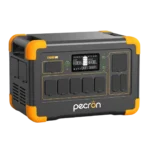
Pecron E1000LFP Feature Scores
Explore all 98 feature scores for Pecron E1000LFP, organized into pros and cons.
Scores by Feature
Summary
98 reviewed features-
Very positive 4.5-5.044 (45%)
-
Positive 3.5-4.425 (26%)
-
Neutral 2.5-3.415 (15%)
-
Negative 1.5-2.412 (12%)
-
Very negative below 1.52 (2%)
Pros
Sort
-
Value is the strongest consensus point: sale prices around the high-$300s deliver unusually rich features, strong DC capability, expansion, and fast charging, although reliability concerns can erase that advantage for heavy-duty users.
-
Most owners see the E1000LFP as an unusually capable budget station and recommend it strongly, but a minority encountered severe thermal behavior that makes the overall picture less uniform than the price alone suggests.
-
The high-current XT60 DC output is one of the E1000LFP's clearest advantages, giving vehicle, fridge, heater, and RV users much more useful 12V capability than a basic car socket.
-
Five AC receptacles are unusually generous for a compact 1kWh station and are widely appreciated, although one owner felt five was more than this inverter really needs.
-
The refreshed display is broadly liked for its size, brightness, and cleaner presentation, and compares well with more premium competitors.
-
Pass-through operation is consistently reliable, allowing connected loads to keep running while the station recharges from AC or solar.
-
Solar operation is dependable: the station accepts rated input, works during pass-through use, and can wake itself to begin charging when sunlight returns.
-
Despite weighing around 29–30 pounds, the compact case and dual handles make it practical for camping, car travel, RV use, and moving around the home.
-
Wall charging is generally very fast, often around an hour, though one thermal-stressed unit made that speed a liability by overheating and delaying subsequent charging.
-
Self-heating is the E1000LFP's signature advantage and repeatedly works well in freezing conditions, but some users dislike that heating requires incoming wall or solar power rather than using stored battery energy.
-
Usable efficiency is generally strong, often in the mid-80s to mid-90s depending on AC or DC output; the strongest DC results are excellent, though one run was merely average.
-
The selectable 8A/20A DC input is unusually flexible, accommodating car charging, direct batteries, and varied solar configurations when used with the correct wiring.
-
Expansion is a major advantage: the E1000LFP can grow to roughly 4kWh, making it much more adaptable than fixed-capacity alternatives, though some rivals scale slightly higher.
-
Bright backlighting and clear information make the screen easy to read indoors and in sunlight.
-
A true master power button, clear controls, and deliberate shutdown behavior make everyday operation simple and reassuring.
-
Usable capacity is generally solid to excellent, commonly returning the mid-to-high 80% range or better, though extreme cold can erase the E1000LFP's nominal capacity advantage.
-
The app itself is a strong feature, with remote controls, charging-rate settings, display options, status information, and even the manual; setup friction is the main caveat.
-
The side handles are consistently comfortable and make the roughly 30-pound station easier to carry.
-
The 600W solar ceiling is strong for a 1,024Wh station and beats some direct competitors, though it becomes less adequate if the battery system is expanded heavily.
-
The 3,500-cycle rating is consistently viewed as a strong longevity figure and compares well with several competing 1kWh stations.
-
The port mix is broad and practical for camping, cameras, small electronics, and backup use, with AC, USB, car-socket, barrel, and high-current XT60 options.
-
With enough panel power, a full solar recharge can take roughly two to two-and-a-half hours, which is strong for a 1kWh-class station.
-
Most units sustained demanding loads at or near the 1,800W rating without trouble, but one sample repeatedly shut down from heat during continuous discharge.
-
The retained 12V car socket is a real strength for camping and overlanding gear, especially alongside the barrel and XT60 DC outputs.
-
The 20A current allowance is excellent for parallel and rigid-panel setups, but the 60V ceiling limits how many common panels can be placed in series.
-
The redesign is more modern and rounded than older Pecron stations, yet opinions range from sharp and good-looking to utilitarian or outright unattractive next to sleeker EcoFlow models.
-
The E1000LFP packs substantial capability into a relatively compact body that is easy to place and move compared with many similarly capable stations.
-
Simultaneous AC and DC charging works well, with the station intelligently giving priority to DC input while filling the remainder from AC.
-
At maximum output, some units remained surprisingly quiet and non-intrusive, showing that the fan system can behave very well under load.
-
Voltage remained stable near heavy continuous loads in the favorable stress tests, with little or no sag.
-
Wi-Fi/app access is genuinely useful for checking remaining charge and operating status from a tent, another room, or another building.
-
Real refrigerator results ranged from roughly 13 to over 16 hours depending on the appliance and test, with one comparison giving the Pecron the longest runtime among several similar stations.
-
UPS behavior is generally dependable and fast enough for computers and home backup, though one specialist rates its backup implementation as only average for the class.
-
Both USB-C ports can deliver up to 100W and performed well, but some rivals now offer 140W ports and heavy DC loads can temporarily disable the 100W outputs.
-
Rubberized bumpers and a rugged shell feel ready for vehicle and RV use, although broader durability feedback is not uniformly positive.
-
Fan noise varies notably by unit and workload, ranging from whisper-quiet to clearly louder than competitors; most owners find it acceptable, but noise-sensitive bedroom users should be cautious.
-
It is well suited to basic outage loads such as refrigerators, lights, routers, and smaller appliances, but weak surge headroom and one severe overheating report make it less convincing for demanding whole-home backup.
-
Transfer time is serviceable to strong, with a measured 13.5 ms cutover keeping a desktop running, though one comparison notes faster competitors exist.
-
System expansion to around 4kWh meaningfully broadens backup capability, even if a few competitors support still larger totals.
-
The inverter does produce a pure sine wave and can look very clean at moderate loads, although visible distortion increases as output approaches the maximum.
-
Pecron's optional direct-battery and expansion accessories add unusual flexibility, including ways to move substantial DC power to other equipment.
-
The included drawstring cable bag is a simple but useful touch for keeping the charging leads together.
-
AC charging efficiency measured about 90.6%, a strong result for this size of portable station.
-
One hands-on evaluation called the inverter outstanding after it powered a broad set of real appliances without instability.
-
LiFePO4 chemistry adds to the value proposition, especially at the sub-$400 pricing highlighted by one owner.
-
Thermal protection correctly prevented charging when the pack was too hot, helping protect the battery after a demanding run.
-
When pushed past its limit, the inverter shut down cleanly rather than continuing an unsafe overload, which is the desired behavior.
-
The power-to-size ratio is a strong point, providing 1,800W output and 1kWh-class storage without an oversized enclosure.
-
With most connections on the front and one side, the station can sit flush near a wall while remaining easy to access.
-
The two USB-A ports are a welcome addition alongside USB-C, preserving support for older accessories and charging cables.
-
Dual USB-C ports complement the legacy USB-A connections and give the front panel a well-rounded device-charging setup.
-
Around 29–30 pounds is manageable for short carries but heavy enough that some users will notice it, especially compared with newer lighter alternatives.
-
Power quality is generally usable to good, but high-load waveform distortion and at least one cleaner competing inverter keep it from being a class leader.
-
Its long-cycle LiFePO4 pack is positioned as something to keep for years rather than replace quickly.
-
Measured inverter EMI was relatively low, and an audio test produced no noticeable interference.
-
The inverter held 60Hz during a sustained heavy-load run, supporting stable operation under stress.
-
Solid corner bumpers provide useful protection against everyday knocks and handling, adding confidence when moving the station around.
-
The supplied AC, car, and solar charging cables cover the core charging methods without requiring immediate extra purchases.
-
App-based temperature and operating information adds useful visibility beyond the front display.
-
The manual is reasonably comprehensive and covers the information a typical owner is likely to need.
-
App control makes it convenient to switch outputs and manage the station without standing next to it.
-
Voltage held near the expected 120V level during sustained high-load operation, indicating solid regulation in that test.
-
Wi-Fi worked reliably in regular use and was especially useful for checking the station remotely, even when Bluetooth setup was less straightforward.
-
The BMS successfully protected the pack during a frozen recharge scenario, even though the displayed state of charge became inaccurate.
-
At about 30 pounds it is not light, but the dual handles make it manageable for an average adult to lift and move.
-
The 1,800W continuous inverter gives the E1000LFP more AC headroom than some compact rivals, though the benefit depends on how many devices are used together.
-
Basic hardware setup is simple and clearly labeled, but app onboarding can be clunky enough to drag down the otherwise easy experience.
-
Most core behavior matched its ratings, but surge performance fell well short of the advertised 3,000W claim in at least one controlled test.
-
The 1,024Wh pack offers decent capacity for the size, but capacity alone does not offset concerns about heat and standby behavior in the most negative evaluation.
Cons
Sort
-
The lack of an integrated light is a repeated annoyance for camping and blackout use, especially because several competing stations include one.
-
Bluetooth pairing is a weak spot: multiple users had trouble connecting directly and ended up relying on Wi-Fi or setting Wi-Fi up first.
-
Confidence is weakened by reports that one unit would not stay fully topped off while plugged in, particularly for emergency standby use.
-
Surge headroom is the most consistent performance weakness: motors and large power tools can trip the inverter quickly, and several competitors handle startup spikes better.
-
One problematic sample kept its internal fans running even at full charge with all output ports disabled, an undesirable behavior for quiet standby use.
-
Cooling results conflict sharply: several units stayed cool with smooth, quiet fan control, while one sample overheated repeatedly and required long cooldown periods.
-
Long-term confidence is mixed: LiFePO4 cycle life is promising, but severe thermal behavior in one sample created legitimate concerns about component longevity.
-
After the battery drains completely, AC output does not automatically re-arm when power or solar returns, so unattended loads such as a refrigerator need manual intervention.
-
One carefully handled sample lost a bottom bumper foot, creating a serious concern about long-term physical durability.
-
The E1000LFP is not a whole-home solution; it is better suited to selected essential loads and lighter outage coverage.
-
Cold-weather self-heating can confuse the state-of-charge display, with readings temporarily stuck or implausibly high; the charging system may still be functioning correctly underneath.
-
Car charging works but is slow enough to be a meaningful limitation for users who depend on topping up while driving.
-
The vented enclosure does not inspire confidence around water, so it is better treated as a dry-location power station.
-
Its open ventilation and need for a dry environment make it poorly suited to unprotected exposure in rain, dust, or harsh weather.
-
Idle draw is inconsistent across measurements, from acceptable or better-than-average to enough to drain roughly 40% in a day; turning unused outputs off is important.
-
Storage retention trails at least one close competitor, making the Pecron less ideal for buyers who plan to leave it sitting for long periods between outages.
-
Large ventilation openings make this a poor choice for very dusty environments unless it is kept well protected.
-
Compared directly with EcoFlow, the Pecron's plastics feel less premium and contribute to its more utilitarian presentation.
-
Warranty coverage is adequate rather than generous: registration can extend it to three years, but some close rivals provide five years.
-
All-front access is convenient in tight spaces, yet floppy protective covers and crowded spacing can make actual plug access less pleasant than the layout first suggests.
-
Wireless control is useful once connected, but setup quality varies sharply: some users had seamless Wi-Fi/Bluetooth access while others found pairing clunky or dependent on Wi-Fi first.
-
There is no wireless phone charging pad; some users miss it, while others consider it a convenience rather than a requirement.
-
The many ports support several devices at once, but heavy use of the high-current DC output can disable the 100W USB-C ports to protect the shared DC power budget.
-
The included MC4-to-XT60 lead is useful, but its very short length may require an extension with some panels.
-
Construction impressions are mixed: some units feel solid and substantial, while another lost a bumper foot despite careful handling and raised durability concerns.
-
Clear labels and a straightforward front panel are positives, but tight AC outlet spacing and awkward side covers can make bulky plugs or frequent access frustrating.
-
Thermal behavior is the biggest point of disagreement: multiple units handled full load without overheating, while one sample repeatedly ran dangerously hot and shut down.
-
Support is improving with phone access and successful callbacks, but knowledge and consistency still lag stronger service organizations and remain a common budget-brand concern.
-
The 1,800W inverter handles kettles, mixers, air fryers, refrigerators, and some tools well, but high-inrush saws, large vacuums, and simultaneous heavy loads can exceed its limited surge headroom.