
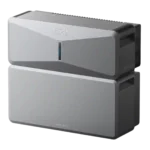
Anker SOLIX E10 Feature Scores
Explore all 68 feature scores for Anker SOLIX E10, organized into pros and cons.
Scores by Feature
Summary
68 reviewed features-
Very positive 4.5-5.044 (65%)
-
Positive 3.5-4.48 (12%)
-
Neutral 2.5-3.43 (4%)
-
Negative 1.5-2.48 (12%)
-
Very negative below 1.55 (7%)
Pros
Sort
-
Scalability is a defining E10 advantage. Buyers can start relatively small and grow toward multiple inverter stacks, more batteries, solar, and generator support without replacing the original core system.
-
Whole-home backup is the E10's strongest use case: reviewers repeatedly report real or simulated outages where the house kept operating normally, often without occupants noticing the grid had failed.
-
Outdoor durability earns consistent praise. Reviewers repeatedly cite IP66/NEMA-style weather protection and successful use across rain, snow, heat, and cold.
-
Overall sentiment is strongly positive: reviewers repeatedly call the E10 powerful, well engineered, and highly capable for whole-home resilience. Reservations center on software maturity, proprietary hardware, local controls, and total installed cost.
-
Once the required electrical work is complete, battery stacking, color-coded connections, and app commissioning are widely described as unusually simple. The caveat is permitting and professional installation, which can range from painless to months of delay.
-
With the Power Dock, batteries, solar, and generator connected, the E10 behaves like one coordinated home-energy platform rather than a collection of separate devices.
-
The 9kW-per-inverter solar input is one of the most celebrated specifications, repeatedly described as a major advantage over competing modular home-backup systems.
-
Silence is a major E10 strength. The passive-cooled inverter has no fans, and users repeatedly describe it as effectively unnoticeable indoors, in garages, or overnight.
-
Surge performance is exceptional. Multiple tests pushed the system toward roughly 28-30kW without immediate failure, making large motor and HVAC startup one of its signature strengths.
-
Adding storage is one of the E10's clearest strengths: batteries stack directly, expansion is straightforward, and several users said they could add capacity without reworking the core installation.
-
Direct DC charging from the Smart Generator is repeatedly praised for avoiding extra conversion losses and maintaining strong charging efficiency while the system is under load.
-
Central air conditioners and other heavy household loads are a standout strength. Multiple tests report successful startup of large HVAC loads, including 3-ton to 5-ton systems, without trouble.
-
Most real-world tests describe transfers as effectively seamless, with no flicker, reboot, or brownout. One AC-coupled solar test did produce an abnormal roughly 20-second delay, so that edge case keeps the result from being flawless.
-
Load management is excellent when properly configured: reviewers praise circuit prioritization, high simultaneous demand handling, and the ability to keep essential loads running as battery levels fall.
-
Remote generator control works well from the app, letting users start backup generation from inside the home rather than going outdoors.
-
Automatic behavior is a major strength when the full system is installed: the Smart Generator can start and stop as needed, and Power Dock configurations can take over without manual intervention.
-
Owners consistently like the clean, premium appearance; several said the installed hardware looks polished enough to live visibly on or around the home.
-
The E10 works particularly well as the center of a solar-plus-storage-plus-generator setup, with reviewers praising the unified hybrid approach for both backup and off-grid use.
-
The Smart Generator's gasoline, propane, and natural-gas flexibility is a major resilience advantage when one fuel source is unavailable.
-
Value depends heavily on configuration and installation. Many reviewers see strong long-term value in modular growth, solar use, and outage protection, while others warn that batteries, Power Dock hardware, and electrician costs can make the total system expensive.
-
Storm Guard and automatic backup behavior generally worked well in real homes, but not perfectly. One tester saw missed storm preparation, while another found generator start/stop thresholds a little imprecise.
-
App impressions are split. Several long-term users praise the clean interface, energy flow views, and control depth, while others call the software basic, unfinished, or frustratingly mandatory because the inverter lacks a real screen.
-
Local Bluetooth control remains available when internet service is down, giving the system a useful fallback during outages.
-
The main enclosures and base hardware earn strong marks for solidity, weather-ready construction, and a premium physical feel.
-
Two hands-on users reported unusually positive phone support, including immediate access to knowledgeable staff who solved setup questions quickly.
-
Reviewers successfully used the system for EV charging, including a roughly 10kW Rivian load and solar-powered Tesla charging.
-
Safety credentials are a meaningful strength, with reviewers highlighting UL testing and fire-propagation protection as important for residential installation and permitting.
-
Hands-on testing generally matched or exceeded Anker's advertised performance, and installers said the system does a good job of delivering what it promises.
-
Day-to-day operation is approachable for a whole-home energy system, though a few configuration menus still have a learning curve.
-
Despite its large capability, the stacked layout can be surprisingly low-profile and space-efficient once installed.
-
The system can combine charging sources simultaneously, a capability reviewers highlighted as especially useful for keeping large battery banks replenished.
-
The Smart Generator's electric start worked on the first try in testing and was described as exceptionally easy to use.
-
Even when pushed well beyond normal continuous output in surge testing, the passive-cooled E10 remained whisper quiet.
-
The app presents energy flow and consumption clearly enough that users can understand where power is coming from and where it is going in real time.
-
The manuals are unusually clear and visual, with simple diagrams and color-coded guidance that make a complex system less intimidating.
-
In a week-long real-world resilience test, the system was described as rock solid with no meaningful reliability problems.
-
The broad rated temperature range impressed off-grid users who need the system to operate through both winter cold and summer heat.
-
When overloaded in testing, the E10 recovered automatically instead of remaining shut down, an important advantage for unattended home backup.
-
One off-grid test praised the system's clean output, an important benefit for sensitive electronics when generator support is involved.
-
The Smart Generator's push-to-start design eliminates routine recoil-pull starting, a convenience reviewers clearly appreciated.
-
The E10 sustained its rated 7.6kW-class output without issue in testing before reviewers moved on to much higher surge loads.
-
The app's live remaining-runtime estimate is a practical outage tool, giving owners a direct view of how long their current load can be supported.
-
With a large array connected, reviewers found the E10 capable of replenishing a multi-battery stack very quickly each day.
-
A real AC-coupled Enphase installation continued producing during outages without extra microinverter configuration, a strong result for retrofit solar compatibility.
-
Idle draw around the mid-40-watt range was considered excellent for a whole-home system of this size.
-
Existing transfer-switch owners can integrate the E10 cleanly, and one reviewer specifically praised being able to do so without buying additional core hardware.
-
Rain exposure is not a practical concern for the weather-rated hardware; one tester simply described leaving it in the rain as 'no problem.'
-
Measured round-trip and inverter efficiency landed in solid-to-above-average territory, competitive with other premium residential storage systems.
-
Energy monitoring is useful for seeing battery, grid, and household consumption, but graph precision varies; one tester loved the live visibility while another wanted clearer numerical summaries.
-
Time-of-use shifting can reduce energy costs substantially in the right rate plan, but the economics are highly utility-dependent; one NEM2 user saw little annual savings despite strong month-to-month results.
-
Runtime varies dramatically with load. Light household use can stretch well into a day or overnight, while central AC or other heavy loads can cut a two-battery setup to only a few hours.
-
The batteries are heavy, but splitting the system into modular pieces makes positioning easier than moving a single large residential battery that may require lifting equipment.
Cons
Sort
-
The lack of a meaningful built-in display is one of the most consistent complaints. Status and diagnostics are largely app-dependent, and the light bar or minimal front indicators do not replace a proper screen.
-
California is a major limitation for the Smart Generator side of the system: sources note that the generator is not yet CARB-certified for sale or battery-backup use there.
-
There are no built-in USB-A ports on the E10 inverter, a repeated complaint from reviewers who expected direct device charging.
-
USB-C is also absent from the inverter, reinforcing that this is a home energy system rather than a conventional portable power station.
-
The biggest ecosystem complaint is how proprietary the E10 feels: batteries, plugs, and some accessories are E10-specific, with limited crossover to other Anker gear and lingering forward-compatibility questions.
-
The inverter itself has no built-in AC receptacles, forcing buyers to use an adapter or home-integration hardware for plug-in loads.
-
Direct plug-in flexibility is poor because the E10 inverter has no built-in AC outlets; adapters or home-integration hardware are required.
-
Standalone 120V charging is a weak point for a system this large; one full-system test called it extremely slow and impractical without faster integration hardware.
-
Multi-stack state-of-charge reporting can be misleading because the app may average stacks with very different charge levels, obscuring when one stack is nearly empty.
-
Overall hardware is sturdy, but one tester broke a battery handle during normal use, exposing a notable durability weak point on a very heavy module.
-
The Smart Generator package drew criticism for omitting a natural-gas hose, leaving one owner to source a custom solution.
-
A weak spot is the battery handle construction: plastic handles and cheap-looking riveted hardware disappointed one hands-on tester.
-
Solar wiring is not entirely plug-and-play: one reviewer strongly disliked the isolator arrangement and the lack of pre-fitted MC4 connectors.
-
Warranty impressions are mixed: some sources criticize five-year coverage and modest capacity-retention terms, while another cites an eight-year offer that compares very favorably with rivals.
-
Capacity is highly scalable, but the entry configuration can be tight for serious whole-home use. Tested usable capacity was solid, while one guide recommends more than the base battery for meaningful backup.
-
Portability is mixed. The E10 is mainly a set-and-forget home installation, but modular components, relocation-friendly architecture, and an optional trolley make occasional movement possible.