If you want better maximum volume
Choose Sony Bravia 7 II. It scores 4.8 vs 2.0 for maximum volume, with a 4.2 overall score.

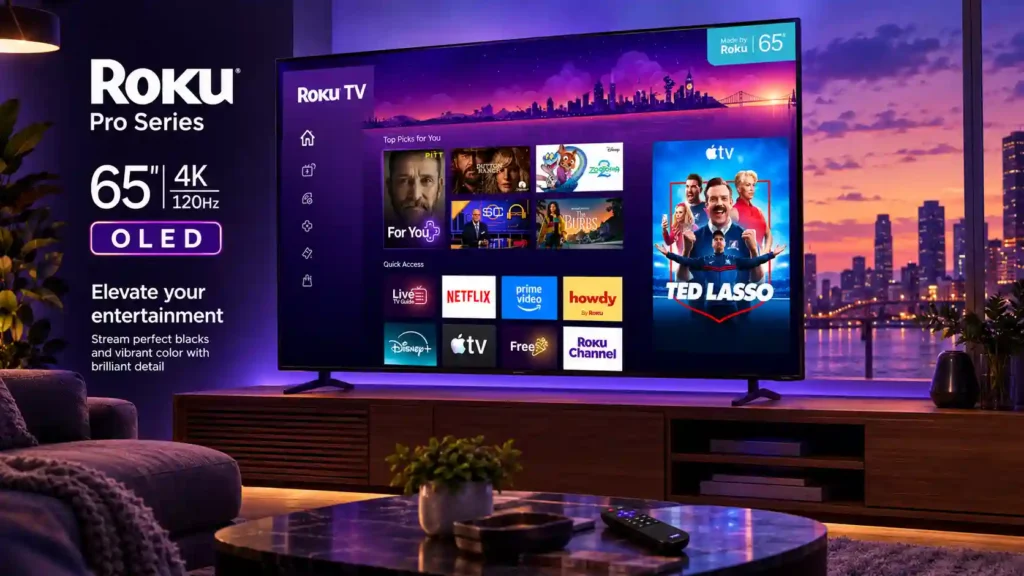
Choose it for affordable OLED contrast, responsive console gaming, and easy Roku operation in a dim room. Skip it for sunlit viewing, powerful built-in sound, or advanced gaming tools.
First-time OLED buyers, dark-room movie fans, and budget-conscious console gamers who value contrast, responsiveness, and straightforward operation.
Sunlit living rooms, desktop text work, or enthusiasts seeking higher refresh rates and advanced gaming controls. Movie fans wanting strong bass should budget for external audio.
The Roku Pro Series makes OLED accessible without giving up the qualities that matter most for dark-room movies and console games: deep blacks, precise contrast, natural colors, and very low input lag. Tool-free installation, a backlit remote with a finder, and the approachable Roku platform add practical appeal. The savings come with clear compromises. Peak and full-screen brightness trail brighter OLED and mini-LED alternatives, so dark scenes can struggle against room lighting. Built-in sound divides opinion, but limited bass is a recurring complaint. Enthusiasts also lose higher refresh rates and a dedicated game bar, while some dislike the revised home screen and required login. It is a compelling first OLED for controlled lighting, especially at the discounted prices reported, rather than a universal living-room upgrade.
Compared with other TVs, this product is above average in panel type, response time, account requirements, near average in input lag, high-refresh-rate gaming, below average in noise reduction, gaming dashboard, peak brightness.
| Attribute | This product | Category average | Difference |
|---|---|---|---|
| noise reduction | 2.0 | 4.6 | -2.6 |
| gaming dashboard | 2.0 | 4.3 | -2.3 |
| peak brightness | 2.5 | 4.3 | -1.8 |
| upscaling quality | 2.5 | 4.4 | -1.9 |
| panel type | 5.0 | 3.4 | +1.6 |
| daytime viewing performance | 2.4 | 4.0 | -1.6 |
| HDR brightness | 2.9 | 4.4 | -1.6 |
| low-resolution content handling | 2.5 | 4.2 | -1.7 |
Choose Sony Bravia 7 II. It scores 4.8 vs 2.0 for maximum volume, with a 4.2 overall score.
Choose Sony Bravia 8 II. It scores 4.5 vs 2.9 for HDR brightness, with a 3.9 overall score.
Choose LG C6. It scores 5.0 vs 2.0 for noise reduction, with a 4.1 overall score.
Choose Hisense U65QF. It scores 4.9 vs 2.5 for peak brightness, with a 4.2 overall score.
Products reviewers directly compared with this model, grouped into quick takeaways.
It is best in dim or controlled lighting. Bright scenes can remain usable, but dark scenes and reflections expose its limited brightness.
Smooth 120Hz motion and very low input lag are major strengths. VRR works well in the reported tests, but there is no dedicated game bar.
The supplied coverage conflicts on this point. Detailed testing reports four HDMI connections with two supporting 4K120, while some launch coverage describes all four as full-rate.
Some find the speakers adequate for everyday television, but others hear thin or unclear sound. Limited bass makes external audio worthwhile for immersive movies.
Yes. Tool-free adjustable feet, cable straps, and straightforward startup draw consistent praise; several hands-on accounts finish setup in about ten minutes.
The included remote uses push-to-talk voice commands. Its backlighting and finder are praised, but some miss the earlier Pro’s hands-free voice and rechargeable battery.
The supplied coverage identifies 55- and 65-inch versions. The limited size range is a drawback for buyers needing a different fit.
These are a few of the reviews included in our analysis.



For Amazon’s October Prime Day, you can save a ton of cash on Roku’s Pro Series OLED TVs, which start at $699.99.
The Roku Pro Series OLED TV is an upgrade thanks to that OLED panel, but trades off some performance in other areas.
The 65-inch Roku Pro Series OLED, a PCMag Lab Award winner for lowest input lag, has been discounted a staggering 33% for Amazon's Big Deal...
The 65-inch Roku Pro Series 4K OLED was already priced aggressively, and now it's 33% cheaper
The Roku Pro Series OLED TV delivers excellent color accuracy and record-breaking input lag for an unbeatable price, making it a strong...

Choose the S90H for bright-room OLED viewing, deep blacks and top-tier gaming without flagship pricing. Skip it if you want Dolby Vision, a glossy screen or the simplest smart-TV software.
Pros: glare resistance, black levels
Cons: Dolby Vision support, color gamut

Best for bright Mini-LED picture, excellent built-in audio, easy Roku navigation, and responsive 4K/120 gaming. Skip it if you want ad-free menus, premium motion consistency, or stronger confidence in long-term...
Pros: overall satisfaction, picture quality
Cons: reliability, portability and versatility

Choose the QM8L for a big, brilliantly bright TV with vivid HDR, deep mini-LED blacks, low input lag, and four HDMI 2.1 ports. Skip it if you need OLED-clean motion,...
Pros: picture quality, value for money
Cons: stand quality, judder handling

Choose the G6 for class-leading bright-room OLED picture, rich color, deep blacks and elite gaming. Skip it if you want strong built-in audio, polished launch firmware, no account sign-in, or...
Pros: picture quality, peak brightness
Cons: value for money, sound quality