If you want better Ethernet port count
Choose ASUS ZenWiFi ET9. It scores 5.0 vs 2.0 for Ethernet port count, with a 4.3 overall score.

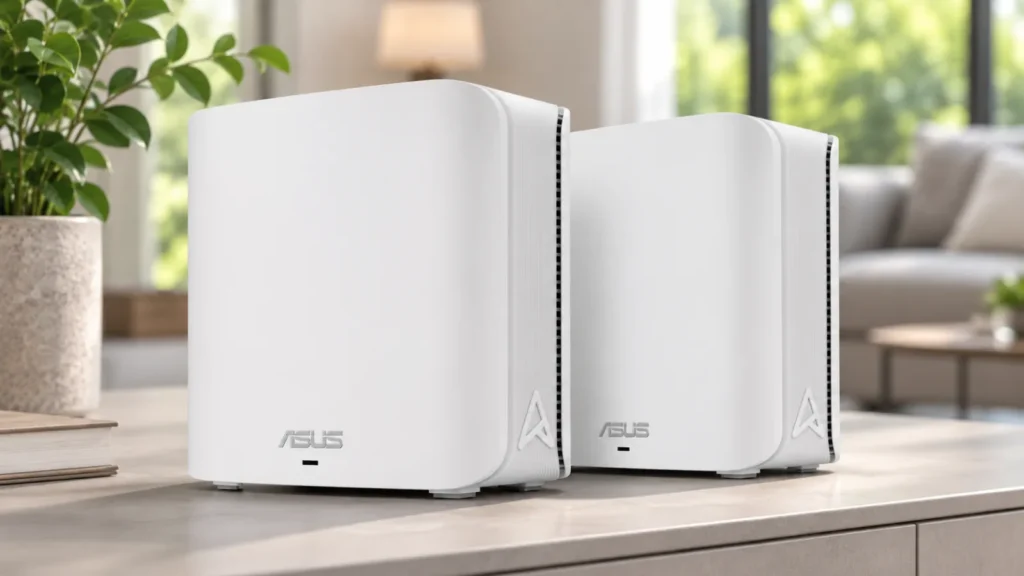
Excellent indoor range, flexible AiMesh expansion and subscription-free controls make this a compelling mesh system for larger homes. Its missing 6 GHz band and variable wireless satellite latency limit its appeal for demanding gaming and faster networks.
Large or multi-story homes with gigabit-class internet, multiple active users and a need for flexible mesh coverage. Households with Ethernet cabling or compatible ASUS AiMesh hardware can take particular advantage of the system.
Competitive gamers relying on wireless satellites, households needing 6 GHz connectivity, or wired power users who require more than two ports per node or faster than 2.5 Gbps Ethernet.
The ASUS ZenWiFi BE5000 Pro delivers the most practical benefits of mesh networking: strong indoor reach, good everyday speeds and flexible expansion. It is especially appealing for large or multi-story homes where several people stream, download files or make calls simultaneously. Dual 2.5 Gbps Ethernet ports on each unit make wired backhaul an attractive option, and the extensive parental controls, VPN options and security features do not require a recurring subscription. The trade-off is its dual-band design: there is no 6 GHz band, and extra wireless nodes can reduce throughput while satellite latency becomes less consistent. Competitive gamers and owners of faster multi-gigabit connections may benefit from higher-tier hardware. Assess the three-pack against your floor plan and existing cabling rather than assuming more nodes automatically improve speed.
Compared with other Routers, this product is above average in channel width support, long-range speed, subscription requirements, near average in expandability, configuration flexibility, below average in network migration ease, Ethernet port count, 6 GHz performance.
| Attribute | This product | Category average | Difference |
|---|---|---|---|
| network migration ease | 2.0 | 4.5 | -2.5 |
| Ethernet port count | 2.0 | 4.0 | -2.0 |
| channel width support | 4.5 | 2.8 | +1.8 |
| 6 GHz performance | 2.1 | 3.7 | -1.6 |
| long-range speed | 5.0 | 3.4 | +1.6 |
| subscription requirements | 5.0 | 3.6 | +1.4 |
| hardware reliability | 5.0 | 3.6 | +1.4 |
| 10 GbE support | 2.0 | 3.3 | -1.3 |
Choose ASUS ZenWiFi ET9. It scores 5.0 vs 2.0 for Ethernet port count, with a 4.3 overall score.
Choose ASUS ZenWiFi BT10. It scores 5.0 vs 2.0 for 10 GbE support, with a 4.0 overall score.
Choose TP-Link Deco 7 Pro BE67. It scores 4.8 vs 2.0 for network migration ease, with a 4.1 overall score.
Choose ARRIS SURFboard G54. It scores 4.0 vs 2.1 for 6 GHz performance, with a 3.7 overall score.
Compared with ASUS ZenWiFi BE5000 Pro
No. It is a dual-band Wi-Fi 7 system using 2.4 GHz and 5 GHz, so compatible devices cannot use a 6 GHz connection.
Yes. Strong indoor range and the ability to add compatible AiMesh nodes make it a good fit, though actual coverage depends on construction and placement.
Yes. Each node has two 2.5 Gbps Ethernet ports, and wired backhaul is particularly useful for improving the connection path to satellite nodes.
Yes. ASUS offers parental controls and security features without a recurring subscription. Filtering, device blocking and schedules are supported, but daily usage limits are not.
The main router is suitable for everyday use and gaming tests found reduced lag, but competitive gaming through wireless satellites is less advisable because latency can rise and fluctuate.
The tested BE5000 Pro is described as a Best Buy three-pack variant of the BD5 with no apparent hardware differences. BD5 kits come in other pack sizes, so check the exact listing.
These are a few of the reviews included in our analysis.
Review the ASUS ZenWiFi BE5000 Pro three-pack: dual-band Wi-Fi 7, two 2.5G ports per unit, ASUS coverage claims, RTINGS findings, and key...
Review of the dual-band ASUS ZenWiFi BE5000 Pro: RTINGS’ range and latency findings, two 2.5G ports per unit, ASUS coverage claims, and...
The ASUS ZenWiFi BE5000 Pro is a dual-band Wi-Fi 7 mesh system with 2.4GHz and 5GHz bands. It's a variant of the ASUS ZenWiFi BD5, with the...
The best Wi-Fi routers and mesh systems with tri-band and Wi-Fi 7 support for gaming, work, smart home, security, and parental controls from...
The ASUS ZenWiFi BD5, with its flexible hadrware and high Gig+ real-world performance, is an excellent Wi-Fi 7 system for those on a budget...

Choose the R95 for a busy home that needs fast Wi-Fi 7, strong range, multi-gig ports, and low-lag gaming. Skip it for a small, lightly connected space or if advanced...
Pros: Wi-Fi 7 support, Wi-Fi speed

Best for frequent travel, fast VPNs, dual 2.5GbE and resilient multi-WAN. Skip it if you need full 6GHz/320MHz Wi‑Fi 7, mesh, or desktop-class USB storage and long-range indoor coverage.
Pros: VPN client support, value for money
Cons: 6 GHz performance, USB storage sharing

Exceptional VPN speeds, strong Wi-Fi 6 coverage and extensive OpenWrt controls make the Flint 2 a compelling value. Its advanced setup, missing 6GHz band and firmware-specific caveats matter if you...
Pros: setup ease, configuration flexibility
Cons: Wi-Fi 7 support, USB storage sharing
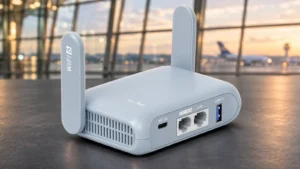
The Beryl AX packs exceptionally flexible VPN and networking tools into a pocket-sized router. It is a great travel companion, but hotel login issues, limited whole-home range and a single...
Pros: Overall satisfaction, size and footprint
Cons: Captive portal handling, Ethernet port count