
If you want better app setup quality
Choose Ubiquiti UniFi Travel Router. It scores 4.6 vs 2.0 for app setup quality, with a 3.8 overall score.

The ASUS RT-BE58 Go makes sharing a private Wi-Fi connection on trips remarkably convenient, with fast nearby speeds and useful VPN and mesh tools. Limited reach, a single gigabit LAN port, and slow network switching are its main compromises.
Families and remote workers traveling with multiple devices who want a private network, flexible internet sources and VPN access. It also suits small apartments and compatible ASUS mesh households.
Buyers who need broad coverage across large homes, a self-contained cellular hotspot, or sustained multi-gigabit wired networking. A simpler router may suffice for occasional single-device travel.
The ASUS RT-BE58 Go is particularly appealing for travelers who want their devices to connect to a familiar private network in hotels and other temporary locations. Its compact folding design, USB-C power options, phone tethering, and extensive VPN controls make it more versatile than a basic hotspot. Nearby 5 GHz performance is a strength, and compatible ASUS households can reuse it as an AiMesh node between trips. Coverage is less convincing across larger spaces, and its single gigabit LAN port and reported wired-routing bottleneck limit demanding wired networking. The software is powerful but not always intuitive, and changing upstream networks can involve a lengthy reboot. There is no internal battery or cellular modem. For multi-device travel, small apartments, and feature-focused users, it is a capable choice; simpler or less expensive alternatives may be sufficient for occasional single-device use.
Compared with other Routers, this product is above average in wall-mounting support, Device compatibility, preconfigured network credentials, near average in Wi-Fi 7 support, web interface quality, below average in wired device performance, Multi-Link Operation, app setup quality.
| Attribute | This product | Category average | Difference |
|---|---|---|---|
| wired device performance | 2.0 | 4.7 | -2.7 |
| Multi-Link Operation | 1.0 | 3.5 | -2.5 |
| app setup quality | 2.0 | 4.4 | -2.4 |
| settings organization | 2.0 | 4.4 | -2.4 |
| interface responsiveness | 2.0 | 4.2 | -2.2 |
| whole-home coverage | 2.0 | 4.2 | -2.2 |
| multi-gig Ethernet support | 2.0 | 4.1 | -2.1 |
| LAN port speed | 2.0 | 3.7 | -1.7 |
Choose Ubiquiti UniFi Travel Router. It scores 4.6 vs 2.0 for app setup quality, with a 3.8 overall score.
Choose ASUS ZenWiFi BT10. It scores 5.0 vs 2.0 for interface responsiveness, with a 4.0 overall score.
Choose GL.iNet Flint 3 (GL-BE9300). It scores 5.0 vs 2.0 for LAN port speed, with a 4.2 overall score.
Choose GL.iNet Flint 2 (GL-MT6000). It scores 5.0 vs 2.0 for Power-on readiness, with a 4.4 overall score.
Compared with ASUS RT-BE58 Go
Yes. WISP mode allows several preconfigured devices to share a private network after the upstream connection is established. Captive portals and hotel policies can affect compatibility.
No. It requires external USB-C power and an upstream internet connection, which can include a compatible tethered phone or USB cellular modem.
One test measured 865 Mbps on 5 GHz at six feet and 391 Mbps at 25 feet. Actual speeds depend on distance, network conditions and the incoming internet connection.
It can suit a small apartment or act as an AiMesh node. Its limited range and single gigabit LAN port make it less suitable for larger homes or demanding wired networking.
Yes. Router-level VPN tools support private networking and selective routing, although VPN speed depends on the service, connection and protocol.
No. It is a dual-band Wi-Fi 7 router using 2.4 and 5 GHz. Testing also found that enabling its limited MLO implementation could reduce speeds.
These are a few of the reviews included in our analysis.



The ASUS RT-BE58 Go Portable WiFi 7 Router Review finds strong 5 GHz performance, WISP, USB tethering, VPN, and AiMesh support—but no...
The ASUS RT-BE58 Go is a dual-band Wi-Fi 7 travel router designed for portability, with foldable antennas and support for power via a...
The ASUS RT-BE58 Go Router is designed to bring next-generation connectivity into a compact, travel-friendly form factor without compromising...
Small and powerful for true mobile warriors
Discover how the ASUS RT-BE58 Go travel router can secure public WiFi networks, protect your browsing with VPN encryption, and boost...

Choose the R95 for a busy home that needs fast Wi-Fi 7, strong range, multi-gig ports, and low-lag gaming. Skip it for a small, lightly connected space or if advanced...
Pros: Wi-Fi 7 support, Wi-Fi speed

Best for frequent travel, fast VPNs, dual 2.5GbE and resilient multi-WAN. Skip it if you need full 6GHz/320MHz Wi‑Fi 7, mesh, or desktop-class USB storage and long-range indoor coverage.
Pros: VPN client support, value for money
Cons: 6 GHz performance, USB storage sharing

Exceptional VPN speeds, strong Wi-Fi 6 coverage and extensive OpenWrt controls make the Flint 2 a compelling value. Its advanced setup, missing 6GHz band and firmware-specific caveats matter if you...
Pros: setup ease, configuration flexibility
Cons: Wi-Fi 7 support, USB storage sharing
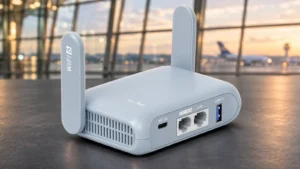
The Beryl AX packs exceptionally flexible VPN and networking tools into a pocket-sized router. It is a great travel companion, but hotel login issues, limited whole-home range and a single...
Pros: Overall satisfaction, size and footprint
Cons: Captive portal handling, Ethernet port count