
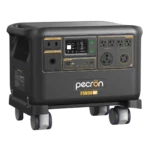
Pecron F5000LFP Feature Scores
Explore all 75 feature scores for Pecron F5000LFP, organized into pros and cons.
Scores by Feature
Summary
75 reviewed features-
Very positive 4.5-5.045 (60%)
-
Positive 3.5-4.411 (15%)
-
Neutral 2.5-3.46 (8%)
-
Negative 1.5-2.410 (13%)
-
Very negative below 1.53 (4%)
Pros
Sort
-
The enormous solar-input ceiling is the most universally praised specification in the entire review set. Reviewers repeatedly call the dual-input platform class-leading or exceptional for the price and well suited to large arrays.
-
Overall sentiment is strongly positive: reviewers repeatedly call the F5000 an unusually capable, high-value home-backup platform. Reservations center on weight, fan noise, waveform quality at heavy load, software polish, and a few early-owner quirks.
-
Value is the clearest consensus strength after solar input. Most reviewers say the F5000 delivers flagship-class output, storage, and charging capability for dramatically less than premium rivals, though one owner prefers a cheaper Pecron alternative when 240V is unnecessary.
-
The touchscreen is one of the most consistently praised usability features. Reviewers describe it as responsive, high-resolution, information-rich, and capable of handling nearly all important settings without the app.
-
Home backup is the F5000's strongest use case. Reviewers consistently praise its 7,200W split-phase output, large battery, solar input, transfer-switch compatibility, and ability to run multiple essential household loads.
-
Integrated battery heating is universally praised as a meaningful advantage for winter operation. Reviewers see it as especially useful for garages, cabins, RVs, and off-grid installations exposed to freezing temperatures.
-
The adjustable high-power DC output is one of the most consistently praised features. Reviewers like its unusually high wattage, adjustable voltage range, strong efficiency, and usefulness for RV, off-grid, and power-station-to-power-station loads.
-
Solar recharge is exceptionally fast with a suitably large array, with reviewers repeatedly describing sub-two-hour and even near-one-hour potential. Real-world speed still depends on sun, array size, and voltage configuration.
-
The 7,200W 120/240V split-phase inverter is a standout strength and repeatedly handles rated or demanding real-world loads. Reviewers see the output level as unusually high for the price.
-
Expansion is a major strength, with reviewers praising the ability to build a much larger storage system over time. Pecron's cross-model expansion-battery compatibility and relatively affordable add-on batteries also earn praise.
-
UPS performance is a clear strength across hands-on testing. Reviewers repeatedly report seamless or imperceptible switchover that kept computers, networking gear, and other connected loads running.
-
Being able to charge from 120V while continuing to provide 240V output is repeatedly praised as a rare and valuable capability. Users do need to manage total pass-through load so they do not exceed the AC input limit.
-
The 5,120Wh base battery is consistently viewed as substantial for home backup and off-grid use. Reviewers highlight enough stored energy for long essential-load runtimes while still leaving room for expansion.
-
Reviewers repeatedly demonstrate the F5000 running demanding loads such as well pumps, water heaters, air conditioners, furnaces, dryers, and power tools. Native 240V output is central to this strength.
-
Setup is usually described as straightforward or nearly plug-and-play for users comfortable with basic electrical connections. More advanced home integration and solar-voltage requirements add some learning for first-time buyers.
-
Wall charging is generally considered fast, especially with the 30A/3,600W cable, though a few reviewers note it trails the fastest large systems. The lack of 240V AC input also limits how quickly it can refill while supporting heavy loads.
-
Pecron earns praise for including useful AC and solar cables that some competitors sell separately. The trolley is also often bundled, although one reviewer wished a solar panel were included at the price.
-
Support feedback has improved noticeably compared with Pecron's past reputation. Most reviewers report helpful callbacks or responsive troubleshooting, though a few still find phone response slower than ideal.
-
Automatic wake and output restart are strongly praised for unattended solar and backup operation. Reviewers especially like that the unit can resume powering loads after solar charging brings a depleted battery back online.
-
Combining AC and DC/solar charging works well and can materially shorten recharge time. Hands-on tests confirmed simultaneous inputs even with the higher-power 30A AC cable.
-
The F5000 is easy to operate despite its advanced capabilities. Responsive on-device controls and clear settings let beginners handle basic tasks while still giving experienced users deeper configuration options.
-
At light loads, several reviewers find the unit extremely quiet or nearly inaudible. The contrast with its much louder full-load fan behavior is important for placement.
-
Real-world load tests are very strong, with the F5000 sustaining rated output and running multiple household appliances together. Reviewers report little trouble with ordinary heavy backup loads.
-
Expansion batteries are viewed as unusually affordable relative to competing ecosystems. Reviewers like that extra capacity can be added without paying the premium prices common among flagship brands.
-
The LiFePO4 pack's long rated cycle life is generally viewed as a durability advantage. One reviewer is more cautious, noting that the 4,000-cycle claim has not yet been proven through years of real ownership.
-
The newer F-series styling is generally well liked, with reviewers calling it cleaner, more modern, and better looking than older Pecron units. One source finds the design more utilitarian than polished.
-
Measured usable AC capacity lands around the mid-to-high-80% range and is generally judged good for a pack this large. DC testing can recover even more of the rated 5,120Wh.
-
Despite its very large battery and inverter, several reviewers find the footprint impressively compact for the capability on offer. It is space-efficient for the class even though it is far from lightweight.
-
Noise depends heavily on operating conditions. Light-load and quiet-mode behavior can be very quiet, but multiple reviewers report clearly audible or intrusive fan noise once charging or output climbs.
-
The removable fan vent is appreciated because it makes dust cleanup straightforward. Reviewers called out the easy access as a thoughtful maintenance detail.
-
Measured DC-side efficiency is excellent, with reviewers recovering around 90% of rated capacity through direct-current loads. That makes the high-power DC path especially attractive.
-
The display provides unusually detailed live monitoring of individual solar inputs, AC/DC flows, battery status, and historical usage. Reviewers repeatedly praise how much operational information is available on-device.
-
Hands-on reviewers found the advertised output and solar capabilities broadly matched real performance. That is a strong result for a product whose headline numbers are unusually aggressive.
-
Most reviewers describe the chassis as solid, rugged, or premium for the price. One owner questioned overall quality after receiving incorrect trolley hardware, so confidence is high but not spotless.
-
Backup transfer is typically fast enough to keep computers and network gear running, with hands-on tests measuring near-zero or single-digit-millisecond transitions on some UPS outlets. One reviewer still considered the slower 20ms mode less impressive.
-
The system can scale into a much larger backup setup and reviewers generally like that flexibility. EcoFlow's premium ecosystem can scale further, but Pecron's expansion remains strong for the price.
-
Runtime is strong for essential household loads and can stretch to many hours or days when demand is modest. Heavy 240V loads can drain the 5.1kWh base battery quickly, so large-load users may need expansion batteries or solar.
-
Surge handling is generally strong, especially for common appliance and tool starts. A few reviewers note that the margin above the high continuous rating is narrower than some competing designs.
-
Native 240V output and generator-inlet/transfer-switch use make the F5000 practical for many whole-home backup setups. The main limitation is the lack of a mature automatic smart-home panel ecosystem, so most integrations remain manual.
-
The display is generally easy to read, including in bright conditions. One reviewer wanted a clearer state-of-charge presentation, but overall visibility remains strong.
-
Measured electrical noise was low in two hands-on tests, which is a positive result for general use. One tester still heard a small amount of buzz through a guitar amplifier.
-
The combination of large battery storage and very high solar input makes the F5000 a compelling solar-first power system. Reviewers have used it for sustained off-grid operation, though weather still limits fully solar-dependent setups.
-
Conversion efficiency is mostly respectable for a power station of this size, with several tests landing in the mid-80% range or better. One reviewer is less impressed by losses relative to the unit's large capacity.
-
App pairing worked quickly in hands-on use, giving the F5000 a convenient remote-control path when desired. The broader app experience remains more mixed than the connection itself.
-
One owner appreciated being able to use the system without creating another account or handing over personal information. That reduces app dependence for privacy-conscious users.
-
A DIY-focused test found the F5000 worked well with an external battery arrangement using compatible voltage and connections. That opens useful possibilities for experienced users building custom storage setups.
-
The front-panel organization is praised for keeping AC, DC, and UPS connections easy to understand. Reviewers appreciate being able to identify the right ports quickly.
-
The touchscreen and app provide detailed usage statistics, including AC, DC, solar, and cost information. Reviewers value the unusually deep visibility into where energy is coming from and going.
-
A hands-on test found the F5000 capable of providing meaningful emergency EV charging. It is not framed as the primary use case, but the available power makes it a useful fallback.
-
Solar tracking performed well in hands-on testing, with the reviewer satisfied by how the dual inputs handled real arrays. The controller setup complements the unusually large solar-input ceiling.
-
One reviewer sees solar-driven daily use as a way to cut grid electricity costs enough for the system to earn back part of its purchase price. The economics improve when the large solar input is used regularly.
-
A demanding 240V appliance test completed without voltage drop, giving the F5000 strong marks for stable delivery. That supports confidence in serious backup loads.
-
One measured test found very low standby loss on the DC side and good retention when left ready for use. That makes long-duration readiness relatively inexpensive in stored energy.
-
A hands-on test confirmed that AC, DC, and USB outputs can be used together. The F5000's large inverter and strong DC section make multi-device operation especially practical.
-
One full-discharge test found the AC outlets held 120V consistently across battery states. That is reassuring for ordinary household loads.
-
The 3+2-year warranty is described as industry-leading by one reviewer. That helps strengthen the ownership proposition for a value-focused system this large.
Cons
Sort
-
Weight is the most universal physical drawback. At roughly 124 pounds, reviewers repeatedly recommend two-person lifting and treat the unit as stationary or semi-stationary despite its portable-power-station label.
-
The lack of a built-in light is repeatedly criticized. Reviewers find the omission especially frustrating because a 120-plus-pound backup unit may need to be moved through a dark garage or basement during an outage.
-
The missing cigarette-lighter-style 12V socket is a recurring annoyance, especially for RV and camping accessories. Reviewers see the omission as an unnecessary compatibility limitation.
-
High-load fan noise is one of the clearest recurring drawbacks. Several measured tests put the F5000 in the upper-50dB range, making garages, basements, or outbuildings better locations than occupied rooms.
-
The broader ecosystem is a weak point compared with premium competitors. Reviewers specifically note the lack of a mature smart-home panel and the fewer integrated expansion and automation accessories available around the system.
-
The 30V minimum input is the recurring compatibility catch. Owners with low-voltage portable panels may need to reconfigure panels in series or choose different hardware before the F5000 will charge.
-
Firmware support is a concern for at least one long-time Pecron owner, who says updates have been notably absent. That matters because some app and charging quirks appear fixable in software.
-
AC-inverter idle consumption is a notable weakness in several measurements, with some reviewers calling it unusually high. Other tests are more forgiving, but leaving the large inverter enabled still costs meaningful battery capacity over time.
-
The F5000 is movable rather than truly portable. Wheels and handles help on flat surfaces, but the 120-plus-pound weight makes stairs, vehicle loading, and solo carrying impractical.
-
The biggest charging limitation is the lack of 240V AC input, repeatedly called out because output can reach 240V while AC charging remains capped at 120V/3,600W. A DIY battery test did show useful flexibility through the DC/solar inputs.
-
One owner reported charging behavior that stopped unexpectedly at 80%, raising an early reliability concern. The issue was not presented as universal, but it adds uncertainty to an otherwise strong performance picture.
-
Long-term reliability remains uncertain because the model is still new and has limited ownership history. Reviewers generally like the underlying LiFePO4 platform but acknowledge that this specific implementation is less battle-tested.
-
One stress test found overload behavior slower and less decisive than expected when the inverter faced a difficult starting load. The system eventually protected itself, but the response did not inspire confidence.
-
One demanding tool test exposed inconsistent behavior when the inverter had to decide whether it could start a difficult load. Most ordinary appliances fare better, but this result adds caution around challenging motor starts.
-
The lack of a wireless charging pad disappoints one owner. It is a convenience omission rather than a core backup-power limitation.
-
The two 100W USB-C ports are adequate, but multiple reviewers wanted at least one newer 140W port. This is a modest weakness rather than a major limitation.
-
App experiences are sharply mixed: some reviewers find it simple, useful, and feature-rich, while others report language glitches or avoid it entirely. The strong on-device touchscreen softens this weakness because most controls remain available without the app.
-
Waveform quality is the most serious technical disagreement in the reviews. Some tests show clean output at lighter loads, while multiple testers measure THD rising to about 3.5% near full load and warn about sensitive electronics or motors.
-
The bundled trolley is helpful when it is assembled correctly, but feedback is inconsistent. Some reviewers find it easy and stable, while others report cross-threaded or incorrect wheels and even warn about tipping if the casters are locked poorly.