
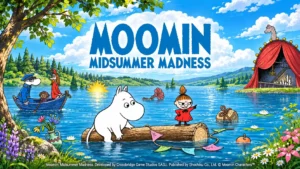
Moomin: Midsummer Madness Feature Scores
Overall Scorata score: 4.0/5
Based on 25 analyzed reviews · View source samples
Explore all 56 feature scores for Moomin: Midsummer Madness, organized into pros and cons.
Scores by Feature
Summary
56 reviewed features-
Very positive 4.5-5.021 (38%)
-
Positive 3.5-4.414 (25%)
-
Neutral 2.5-3.48 (14%)
-
Negative 1.5-2.411 (20%)
-
Very negative below 1.52 (4%)
Pros
Sort
-
Hand-drawn backdrops give Moominvalley the feel of a living picture book, with rich colour and outlines that recall Jansson's illustrations. The artwork is one of the game's strongest attractions.
-
The adaptation captures Jansson's recognizable character designs, oddball conversations and themes of community. Some events are remixed or omitted, but most Moomin enthusiasts regard it as an affectionate interpretation.
-
Moominvalley feels whimsical, gentle and comforting even as a flood upends daily life. Its occasional melancholy and danger give the coziness more texture than a purely carefree outing.
-
A flood and a floating theatre lead to a sweet, quietly thoughtful adventure about helping others. The tale is easy to follow and engaging, though familiar readers may know its major turns.
-
Players can bypass optional mini-games without punishment, keeping the story moving if a maze or other activity frustrates them. This is consistently welcomed as an accessibility-friendly choice.
-
Soft melodies, occasional vocal-jazz touches and gentle themes complement the illustrated setting. The music is frequently praised as a major source of warmth.
-
Moomintroll and Little My handle different obstacles, with occasional chapters reversing or separating their roles. It adds delightful variety, and some wish it were used more often.
-
Scenes look vivid and inviting, from the Moominhouse to the flooded valley and floating theatre. The distinctive 2D presentation often impresses more than the mechanics.
-
A sweet tone, approachable tasks and skippable activities make this inviting for families. Adults may need to help younger children decode less obvious puzzle solutions.
-
The broad response is positive: a beautifully crafted, affectionate Moomin adventure with memorable characters. Frustrating hints, brief length and repetitive errands are the clearest reservations.
-
Subtle character gestures and moving scenery help the illustrations feel alive. Expressive animation carries personality even without full spoken dialogue.
-
Moomintroll's optimism and Little My's unruly energy make a memorable duo. Little My is especially divisive: many find her delightful, while a minority strongly dislike her attitude.
-
Ambient effects and the cast's little vocal noises add charm without overwhelming scenes. Sound supports a calm storybook mood.
-
Dialogue and small requests weave kindness, loneliness, mischief and resilience into apparently simple situations. The writing keeps the recognizable Moomin spirit at the center.
-
Theatre props, tiny objects and intricately decorated rooms invite close inspection. That density can also hide puzzle-critical objects among visual distractions.
-
Little My's sarcastic mischief and the characters' eccentric logic supply playful comedy. The sharper remarks appeal to most critics but are not universally endearing.
-
A frog chase, maze puzzles, music challenges and other short activities break up inventory errands. Many enjoy their variety, though some find them too simple, inconsistent or poorly explained.
-
The adventure inspires nostalgia, hope and a sense of warmth in people drawn to the Moomins. Its gentle mood also makes room for anxiety and sadness beneath the fairytale surface.
-
A notebook tracks current errands, dialogue and sometimes the story so far. It is useful for returning to the game, though it cannot always substitute for a specific hint.
-
Familiar faces from Moominvalley make meetings and small errands enjoyable. The personalities feel true to the books, even if some players would welcome more time with particular favorites.
-
Optional mini-games and alternating protagonists help break up the repeated item hunts. The mix remains light, with some critics finding the chapter structure formulaic.
-
A larger cursor, a dyslexia-friendly font, and skippable mini-games make the story easier to approach. These conveniences matter when individual interactions become confusing.
-
Brief conversations give the eccentric cast distinct voices on the page. Little My's sharp remarks and the gentler exchanges help the humor and personality land.
-
Journal summaries of previous events and conversations help players remember their place after a break.
-
Moominvalley feels lived-in through its eccentric residents, quiet routines and richly illustrated spaces. The world prioritizes intimacy and personality over a sprawling map.
-
Beautiful rooms and whimsical details reward looking around. Repeated sweeps for one overlooked object can make otherwise enjoyable exploration feel like pixel hunting.
-
The story and presentation are gentle, but puzzle comprehension is another matter. Young children can become stuck and lose interest without an adult to guide them.
-
There is no full voiced dialogue, with conversations shown as text bubbles and only brief character noises. Several critics feel the expressive writing and pleasant audio make that absence easy to accept.
-
Collecting and combining items, talking to residents and exploiting different character abilities form an approachable point-and-click foundation. The mechanics are familiar rather than deeply innovative.
-
Most puzzles are accessible and low-stakes, with occasional lateral-thinking surprises. That balance welcomes beginners but may feel too easy for veterans, while a handful of obscure solutions can still frustrate children.
-
Some critics report frame dips without outright crashes. Others encounter issues that interrupt progression even when the application remains running.
-
The warm atmosphere, thoughtful puzzles and chance to explore Moominvalley make the adventure enjoyable without overstaying its welcome.
-
The basic point-and-click loop is easy to learn, making the game welcoming to genre newcomers. Occasional indirect puzzle logic is a separate hurdle.
-
The adventure flows comfortably when characters, clues and chapters move forward. Hidden objects, repeated conversations or opaque puzzle steps sometimes stall its otherwise peaceful rhythm.
-
An early Little My scenario demonstrates basic item use and movement, though some later interactions are not as clearly taught.
Cons
Sort
-
A linear story and fixed solutions offer few fresh discoveries after completion. Several critics see little reason for a second trip once the puzzles are known.
-
The journal and hotspot tools are useful, yet selecting items and recognizing interactions is not always consistent. Touchscreen prompts and cooldown timing create avoidable friction.
-
Helping characters and finding items can be cozy and satisfying, but several chapters lean too heavily on repeated fetch quests. The entertaining cast helps offset that repetition.
-
Intricate art looks delightful but can obscure important objects in crowded scenes. Players who dislike pixel hunting may get stuck searching rather than reasoning.
-
Point-and-click input works, but movement and interaction conventions can feel stiff or counterintuitive. Console navigation is less comfortable for some players than a mouse.
-
Objectives reflect the Moomins' small, personal concerns and are pleasant when their solutions click. The need to gather several objects per chapter sometimes makes progress resemble a checklist.
-
A journal and interactable-object highlighting help identify tasks and hotspots. Critics repeatedly wish the hints were more specific and less constrained by cooldowns when the next step remains unclear.
-
The point-and-click approach is a welcome new lens for Moominvalley, but the underlying tasks borrow familiar genre ideas. Players expecting novel mechanics will find a traditional adventure.
-
One account describes a randomly wiped save and lost hours, while a disappearing quest item required reloading. That is a meaningful risk in an otherwise low-stress adventure.
-
Different characters and settings give errands some variation, yet the repeated collect-and-deliver structure becomes noticeable over time.
-
The first chapter introduces exploration and character switching, but not every touchscreen interaction is explained. Players can discover some unmarked actions only by accident.
-
Several playthroughs include glitches ranging from small hitches to missing inventory items. A few reports are serious enough to make reliability a concern.
-
The quest checklist makes goals approachable, but progress sometimes depends on a poorly signposted prerequisite. That can send players in circles despite the straightforward chapter structure.
-
Minor drops, transition hitches and occasional stutters appear in some versions. Most reports describe them as manageable rather than game-breaking, though PC movement can be noticeably uneven.
-
Console menu navigation can feel clumsier than direct mouse selection, occasionally disrupting an otherwise calm pace.
-
An unusual single-click versus double-click movement scheme can take time to internalize, especially for genre veterans.
-
A compact bag avoids overwhelming players with dozens of unrelated items. Even so, combining and selecting objects can feel awkward, with unclear triggers slowing progress.
-
The roughly $20 asking price can feel fair for an illustrated storybook-sized adventure, but less compelling for buyers counting hours. Discounts make its short duration easier to accept.
-
Portable play is attractive, especially with Switch 2 tabletop mouse input, but small-screen navigation and movement can take adjustment.
-
Most playthroughs take roughly three to six hours, depending on puzzle progress. Some appreciate the storybook-sized runtime; others wish the beautiful world and character-switching sections lasted longer.
-
Inventory combinations and environmental riddles are often clever and satisfying without being punishing. Occasional moon logic, overlooked objects and unexplained steps can turn gentle puzzles into tedious searches.
Use Cases
Best for
Sort
-
The soft music, gentle characters and illustrated world make it an inviting cozy escape. The occasional obscure puzzle can interrupt the relaxation.
-
Fans of classic point-and-click games will recognize familiar inventory puzzles and scene exploration. Those seeking elaborate, difficult riddles may find the adventure lightweight, with some awkward object interactions.
-
Longtime Moomin fans will enjoy the faithful aesthetic, recognizable cast and cozy tone. Some may miss events from the novel or wish for more time with favorite characters.
-
Children may love the characters and skippable mini-games, but more indirect puzzles can exceed a younger child's patience. Very young players benefit substantially from adult assistance.
-
Newcomers can appreciate the self-contained story and learn who the Moomins are as they go. A few perspectives suggest longtime fans will get more from the familiar references.
-
Unhurried exploration and warm storytelling make it well suited to unwinding. Players may still face stretches of frustrating object hunting.
-
Adults and children can share the decisions and help one another through harder moments. Family sessions work best when a grown-up can step in if the hints are not enough.
-
Mouse control works naturally for examining scenes, and the PC approach is praised. Character movement can still be awkward with mouse-style input.
-
Themes of isolation, resilience and community give the gentle children's-book aesthetic an unexpectedly contemplative streak.
-
Colourful illustrated scenes look good on the portable screen. Some players prefer using the Joy-Con as a mouse in tabletop mode over ordinary console navigation.
-
Basic interactions have been adapted for controller use, but some object selection and navigation feels fiddly compared with mouse input.
-
Its short campaign and small objectives work well for players with limited spare time, although one stubborn puzzle can slow an otherwise brief session.
-
Compact chapters make it easy to enjoy a little Moomin story at a time without losing track of a large quest log.
-
Joy-Con mouse input in tabletop mode was enjoyable on a flight, giving the compact adventure a practical travel-friendly setup.
Conditional or not ideal for
Sort
-
Challenge seekersThere are clever moments, but the overall difficulty is intentionally gentle. People seeking sustained, demanding puzzle-solving may be underwhelmed.
-
Budget-conscious buyersThe $20 price is a reasonable storybook treat for some, but the four-to-six-hour campaign can feel expensive. Waiting for a sale is a sensible compromise.
-
Console gamingThe adventure can be enjoyed on consoles, though selecting objects and moving characters is less fluid for some than using a PC mouse.
-
Docked playDocked input is possible, but one reviewer clearly preferred the more natural feel of tabletop Joy-Con mouse controls.
-
Older and experienced playersExperienced adventurers may appreciate the pleasant atmosphere while finding the puzzle challenge too restrained.
-
Players seeking clear puzzle guidanceThe highlight function does not reliably explain the next logical step, so anyone needing precise hints may become frustrated.