
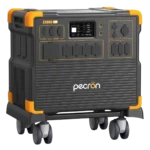
Pecron E3800LFP Feature Scores
Explore all 73 feature scores for Pecron E3800LFP, organized into pros and cons.
Scores by Feature
Summary
73 reviewed features-
Very positive 4.5-5.045 (62%)
-
Positive 3.5-4.414 (19%)
-
Neutral 2.5-3.44 (5%)
-
Negative 1.5-2.47 (10%)
-
Very negative below 1.53 (4%)
Pros
Sort
-
Reviewers repeatedly call the E3800LFP an unusually strong bargain, pairing large capacity, high output, and fast charging with pricing well below many premium rivals.
-
Overall sentiment is strongly positive: most reviewers recommend the E3800LFP for its hardware capability and value despite software, weight, and refinement caveats.
-
Reviewers consistently find it well suited to essential home backup, with enough 120V output for refrigerators, pumps, lights, networking gear, tools, and other outage loads.
-
Dual high-voltage MPPT inputs provide unusually large solar capacity for the price, though one reviewer wanted more voltage headroom near the 150V ceiling.
-
Runtime is strong on essential and moderate loads, including refrigerator tests lasting roughly a day to nearly three days; heavy loads naturally shorten endurance.
-
AC charging is a major strength, with 30A charging commonly reaching full in around 1.4–1.5 hours and standard outlets taking about 2.5 hours.
-
On-device controls are extensive and generally straightforward, and customers often describe basic operation as easy.
-
UPS behavior is generally reliable and fast enough for sensitive electronics, but output limits and some charge-state behavior create caveats in certain setups.
-
Solar charging is consistently praised as fast when the array and sun are adequate.
-
The E3800LFP handles pumps, microwaves, tools, air conditioners, and other demanding loads well, though simultaneous startup-heavy RV loads can still exceed its limits.
-
Testing and owner reports show confident operation with appliances, pumps, tools, RV loads, and mixed devices, with limits mainly when multiple large startup loads coincide.
-
The cart is widely praised for smooth, easy movement, though one long-term user warns the stacked system can tip if all casters are locked in the same direction.
-
Expansion is one of the platform’s strongest advantages, allowing much longer outage runtime without replacing the main unit.
-
The E3800LFP is described as solid, durable, and utilitarian rather than luxurious, with construction oriented toward practical backup use.
-
The station can combine solar with AC or generator charging smoothly, a flexibility testers found especially useful.
-
The bundled rolling base, charging cables, solar leads, and cable case add meaningful practical value.
-
Owners use the E3800LFP effectively for solar-powered home loads, RVs, and off-grid camping.
-
Surge handling is a standout strength, with reviewers repeatedly confirming demanding startup loads and short peaks well above continuous rating.
-
A single unit is limited to 120V, but two E3800LFP units with Pecron’s 240V box can support broader home circuits and split-phase loads.
-
The included rolling base makes flat-floor movement easy, but the station is better treated as semi-portable than grab-and-go.
-
The 4,200W-class inverter repeatedly handles heavy real-world loads and can even exceed its rating briefly without instability.
-
Most lab-style testing found the E3800LFP relatively quiet even under high load, but one customer found the cooling fan unacceptably intrusive even below 200W.
-
Support feedback is mostly positive by email, including fast replies and repair/replacement options, though phone availability can be limited.
-
Solar wake-and-charge/dark-start behavior works automatically after depletion and is considered a valuable resilience feature.
-
Hardware and cell charging were reported as reliable even when software communications caused problems.
-
The station and 240V bundle are generally straightforward to deploy, with plug-and-play behavior praised by beginners.
-
Measured AC efficiency around the mid-80s to low-90s is rated very highly by testers.
-
Transfer between grid and battery is described as smooth and fast enough to keep computers and other electronics running without visible interruption.
-
The platform can grow from one 120V unit into a larger battery bank or two-unit 240V system, giving buyers room to scale.
-
RV owners report strong results, with the 30A connection making dedicated RV use straightforward.
-
AC discharge testing produced about 93% usable capacity, an excellent result, while low-voltage DC use was less efficient.
-
The five-year registered warranty is repeatedly viewed as reassuring for a high-cost power product.
-
Idle draw is generally considered low to acceptable, though one reviewer dislikes the UPS cycling behavior that can add battery cycles.
-
Owners generally praise the large base capacity, though heavier long-duration use may still justify expansion batteries.
-
BMS behavior is generally positive, including good factory calibration and useful cell-level diagnostics, but one owner saw uneven discharge among expansion batteries.
-
The inverter can power several devices at once with substantial headroom, though coincident startup surges can still cause overloads.
-
The touchscreen and app expose unusually detailed telemetry, but a few owners report inaccurate wattage readings or awkward presentation.
-
The 30A output is a particularly useful feature for RVs and certain backup connections.
-
The 3,500-cycle rating is viewed as a major longevity advantage for long-term backup ownership.
-
Owners find the physical panel straightforward for common adjustments without relying on a phone.
-
Reviewers generally view firmware updates positively where discussed, with the comments reflecting real-world use rather than specifications alone.
-
Large smooth side handles make two-person or short-distance lifting easier despite the unit’s weight.
-
The inverter repeatedly delivers stable, strong real-world output near its limits and is one of the hardware highlights.
-
Reviewers strongly approve of the LiFePO4 chemistry for longevity, thermal stability, and backup use.
-
Front-facing, labeled ports and grouped DC connections are described as logical and easy to reach.
-
Reviewers appreciate the broad mix of AC and DC outputs for backup, RV, and off-grid use.
-
Sustained heavy-load testing remained stable without aggressive throttling or erratic behavior.
-
Testing confirmed the unit eventually trips protection when held above its continuous rating, while still allowing useful short-term headroom.
-
One unboxing found extensive foam protection that kept the heavy unit secure in transit.
-
Scope and audio testing found the AC output to be a clean sine wave suitable for sensitive electronics and radio/audio use.
-
Reviewers generally view remote control positively where discussed, with the comments reflecting real-world use rather than specifications alone.
-
The customer who commented on delivery said the unit shipped on time.
-
Owners report successful use with external panels, and the wide solar voltage range supports many array configurations.
-
Reviewers generally view transfer switch compatibility positively where discussed, with the comments reflecting real-world use rather than specifications alone.
-
DC capability is flexible, but one test found materially lower usable capacity through the 12V path than through AC.
-
The touchscreen is generally responsive and useful, though a customer reported a persistent temperature-unit display quirk.
-
For its capacity class, the E3800LFP is considered relatively compact, although it is still heavy and best suited to semi-permanent use.
-
The portable panels are easy to fold, carry, clean, and deploy, though their output is more modest than larger fixed arrays.
-
The industrial E-series look is practical and clean to some reviewers, but less visually refined than newer rounded competitors.
Cons
Sort
-
The roughly 87–90 lb unit is widely described as heavy. It is movable, especially with the cart, but stairs and frequent lifting can require a second person.
-
Multiple reviewers consider the lack of a built-in light an avoidable inconvenience during outages.
-
Reviewers dislike that the unit lacks a simple powered-on ready state without an inverter or DC output active, which can create unnecessary idle drain.
-
Several reviewers miss the wireless charging pads found on the E3600 and view their removal as a small step backward.
-
Reviewers generally view app connectivity positively where discussed, with the comments reflecting real-world use rather than specifications alone.
-
One customer reports the cooling fan is plainly audible even at low output, making nearby living-room use unpleasant.
-
Automation is feature-rich but immature. Multiple testers found conditions that did not reset as expected, making the feature less dependable than the core hardware.
-
Wi-Fi remote telemetry is useful where available, but some testing found slower updates, and one review describes configurations without Wi-Fi as a weakness.
-
One owner reported substantial state-of-charge differences among connected batteries, reducing confidence in pack balancing/readouts.
-
Pecron’s US service footprint is viewed as less established than larger competitors, a caveat for buyers prioritizing local support.
-
The touchscreen carries lots of information, but opinions are mixed: some find it bright and easy to read, while others criticize tiny text and low-contrast state-of-charge information.
-
The broad voltage range is useful, but XT60-only primary solar inputs can require adapters for existing MC4 or Anderson setups.
-
App experiences vary: some users find it functional or trouble-free, while others report rough UI, setup trouble, or outright dislike.
-
Bluetooth can be quick with useful in-home range, but some reports describe inconsistent pairing or complete communication failure.