If you want better third-party app support
Choose Garmin Forerunner 265. It scores 5.0 vs 3.0 for third-party app support, with a 4.0 overall score.

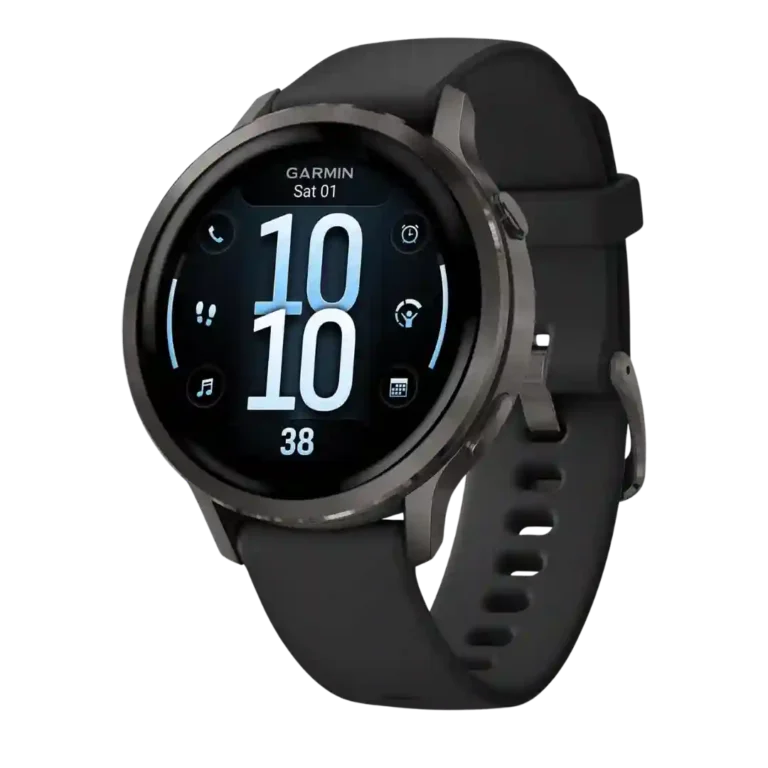
Choose the Garmin Venu 4 if you want a stylish Garmin with strong battery, GPS, health insights, and training depth. Skip it if price, LTE, full maps, or Apple/Google-level apps matter most.
Best for fitness-focused users who want Garmin training depth, long battery life, accurate GPS, and health insights in a stylish watch that can pass outside the gym. It especially suits runners, gym-goers, and wellness-focused users who do not need a phone-like smartwatch.
Not for buyers who mainly want rich third-party apps, LTE independence, full maps, low price, or button-heavy workout control. Casual users who only need basic activity tracking may find the price and feature depth excessive.
The Garmin Venu 4 lands as Garmin’s most polished lifestyle fitness watch in these reviews, combining a premium-looking metal design, bright AMOLED display, strong GPS, useful flashlight, and long battery life with much deeper training and recovery tools than older Venu models. The tradeoff is that it still behaves more like a fitness-first Garmin than a true Apple or Google smartwatch: apps, voice controls, LTE, and full maps remain limited. Reviewers generally trusted its heart-rate, GPS, step, wellness, and recovery data, but they also flagged occasional freezes, touch-first workout frustrations, and a price jump that makes casual use harder to justify.
Compared with other Smartwatches, this product is above average in ECG functionality, activity auto-detection, flashlight usefulness, near average in operating system experience, fitness tracking accuracy, below average in reliability, app ecosystem, charging convenience.
| Attribute | This product | Category average | Difference |
|---|---|---|---|
| ECG functionality | 4.5 | 2.6 | +1.9 |
| activity auto-detection | 5.0 | 3.7 | +1.3 |
| flashlight usefulness | 4.8 | 3.7 | +1.1 |
| reliability | 2.6 | 3.7 | -1.1 |
| app ecosystem | 2.5 | 3.6 | -1.1 |
| charging convenience | 2.3 | 3.3 | -1.1 |
| button controls | 2.9 | 3.9 | -1.0 |
| onboard music storage | 4.0 | 2.9 | +1.1 |
Choose Garmin Forerunner 265. It scores 5.0 vs 3.0 for third-party app support, with a 4.0 overall score.
Choose Garmin Venu 3. It scores 4.8 vs 2.8 for stress tracking, with a 4.1 overall score.
Choose Amazfit Active Max. It scores 4.6 vs 3.3 for value for money, with a 4.1 overall score.
Choose Garmin Tactix 8. It scores 4.8 vs 2.5 for app ecosystem, with a 4.2 overall score.
Products reviewers directly compared with this model, grouped into quick takeaways.
Reviewers generally found GPS, heart rate, steps, and fitness tracking accurate, with strong results against chest straps and other high-end wearables. A few noted heart-rate blips during intervals or strength work.
Battery life was one of the strongest points. Reviewers commonly reported about a week or more in normal use, though always-on display, GPS, and long tracking sessions reduce it.
It covers essentials such as notifications, calls, Garmin Pay, music storage, and voice access, but reviewers repeatedly said it is not as smart as Apple, Google, or Galaxy watches.
No. Reviewers liked the breadcrumb-style navigation and route guidance for many workouts, but the lack of full-color maps and LTE came up as repeated limitations.
Yes. The built-in LED flashlight was one of the most praised additions, with reviewers using it for night runs, household tasks, and extra visibility.
Reviewers saw the Venu 4 as a substantial upgrade in training tools, GPS, build, display brightness, flashlight, and health features. The upgrade makes most sense if you will use those extras enough to justify the price increase.
These are a few of the reviews included in our analysis.

Best for long battery life, accurate GPS and useful offline maps at a strong price. Skip it if you need payments, richer apps, a built-in LED flashlight or polished smartwatch...
Pros: mapping and navigation, value for money
Cons: smartwatch features, contactless payments

Best for accurate run tracking, deep Garmin coaching and phone-free Spotify in a light package. Skip it if you need full maps, triathlon mode, Apple Music support or the strongest...
Pros: value for money, GPS accuracy
Cons: mapping and navigation, third-party app support

Good if you want premium running features, long battery life, and maps for under $200. Skip it if you need flawless heart-rate data, multiband GPS, LTE, or richer app support.
Pros: value for money, battery life
Cons: heart rate accuracy, third-party app support

Best for accurate running metrics, excellent coaching tools, a bright AMOLED display, and dependable battery life. Skip it if you need offline maps, music storage, contactless payments, multi-band GPS, or...
Pros: battery life, value for money
Cons: mapping and navigation, smartwatch features