If you want better battery life
Choose Garmin Venu 3. It scores 4.8 vs 4.3 for battery life, with a 4.1 overall score.

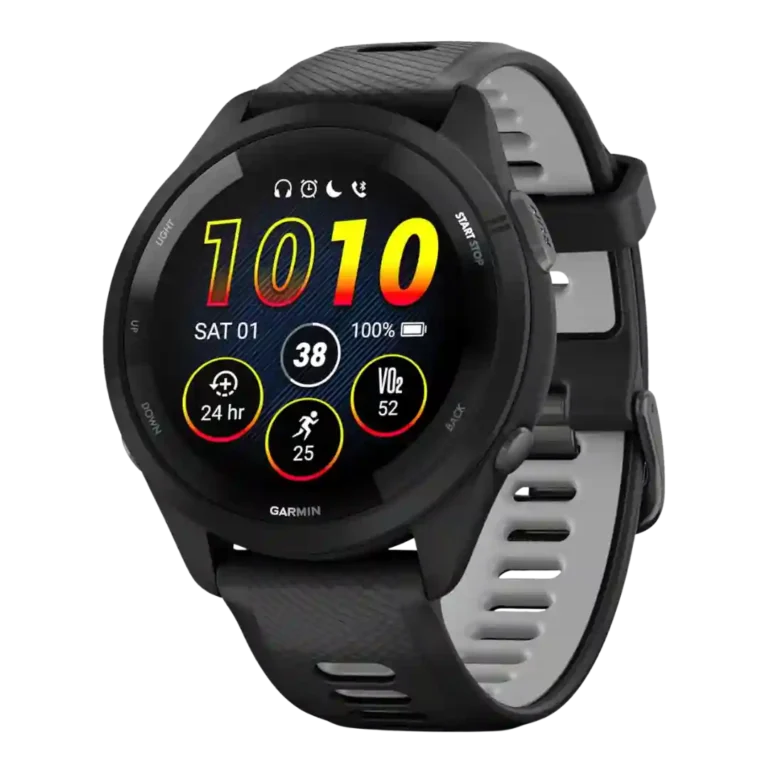
Choose the Garmin Forerunner 265 if you want a comfortable AMOLED running watch with excellent GPS, heart-rate tracking, music, and recovery tools. Skip it if you need full maps, LTE, stronger smartwatch features, or ultra-distance battery life.
Best for runners and multisport athletes who want accurate GPS and heart-rate tracking, a bright AMOLED screen, onboard music, and recovery guidance without moving to a pricier mapping watch.
Not for buyers who need full maps, LTE, calls from the wrist, ECG, a dressier design, or maximum GPS battery life for ultra-distance events.
The Garmin Forerunner 265 earns strong reviewer support as a runner-first AMOLED watch. Reviewers repeatedly praised the bright display, fast and accurate GPS, strong heart-rate tracking, useful Training Readiness, onboard music, comfort, and deep workout customization. The tradeoff is that Garmin moved closer to smartwatch territory without delivering a full smartwatch: no LTE, no ECG, no mic or speaker, limited replies, and no full built-in maps. Battery life is excellent for an AMOLED sports watch, but reviewers coming from MIP, solar, or ultra-focused watches wanted more. It is best understood as a highly capable midrange training watch, not a premium adventure watch or phone replacement.
Compared with other Smartwatches, this product is above average in third-party app support, onboard music storage, size options, near average in value for money, button controls, below average in activity auto-detection, call handling, ECG functionality.
| Attribute | This product | Category average | Difference |
|---|---|---|---|
| activity auto-detection | 1.8 | 3.7 | -2.0 |
| third-party app support | 5.0 | 3.2 | +1.8 |
| call handling | 1.7 | 3.3 | -1.6 |
| ECG functionality | 1.0 | 2.7 | -1.7 |
| voice assistant quality | 1.5 | 3.1 | -1.6 |
| onboard music storage | 4.4 | 2.9 | +1.4 |
| materials quality | 2.5 | 4.0 | -1.5 |
| size options | 4.5 | 3.1 | +1.4 |
Choose Garmin Venu 3. It scores 4.8 vs 4.3 for battery life, with a 4.1 overall score.
Choose Google Pixel Watch 4. It scores 4.8 vs 2.8 for operating system experience, with a 4.2 overall score.
Choose Huawei Watch GT 6 Pro. It scores 4.7 vs 2.5 for materials quality, with a 4.0 overall score.
Choose Huawei Watch Fit 4 Pro. It scores 4.9 vs 2.5 for reliability, with a 4.1 overall score.
Products reviewers directly compared with this model, grouped into quick takeaways.
Yes. Reviewers repeatedly found GPS tracks fast, consistent, and very accurate, with several describing the results as excellent, spot-on, or close to perfect.
Reviewers generally liked the battery life for an AMOLED sports watch, with many seeing roughly a week or more depending on settings. Ultra runners and users prioritizing maximum GPS runtime may want a longer-lasting model.
No. It can follow courses and offer breadcrumb-style guidance, but reviewers repeatedly noted the lack of full built-in maps and found navigation less suitable for trail or ultra use.
It can show notifications and may let Android users send quick replies, but reviewers noted there is no mic, speaker, LTE, or true on-wrist calling.
Mostly yes. Reviewers praised the light weight, silicone strap, and all-day comfort, although a few found the sporty shape or sleep fit less ideal.
For many reviewers, yes. The screen was one of the clearest consensus wins, making stats brighter, sharper, easier to read, and more modern than older MIP Forerunners.
These are a few of the reviews included in our analysis.


Best for long battery life, accurate GPS and useful offline maps at a strong price. Skip it if you need payments, richer apps, a built-in LED flashlight or polished smartwatch...
Pros: mapping and navigation, value for money
Cons: smartwatch features, contactless payments

Best for accurate run tracking, deep Garmin coaching and phone-free Spotify in a light package. Skip it if you need full maps, triathlon mode, Apple Music support or the strongest...
Pros: value for money, GPS accuracy
Cons: mapping and navigation, third-party app support

Good if you want premium running features, long battery life, and maps for under $200. Skip it if you need flawless heart-rate data, multiband GPS, LTE, or richer app support.
Pros: value for money, battery life
Cons: heart rate accuracy, third-party app support

Best for accurate running metrics, excellent coaching tools, a bright AMOLED display, and dependable battery life. Skip it if you need offline maps, music storage, contactless payments, multi-band GPS, or...
Pros: battery life, value for money
Cons: mapping and navigation, smartwatch features