If you want better operating system experience
Choose Google Pixel Watch 4. It scores 4.8 vs 3.1 for operating system experience, with a 4.2 overall score.

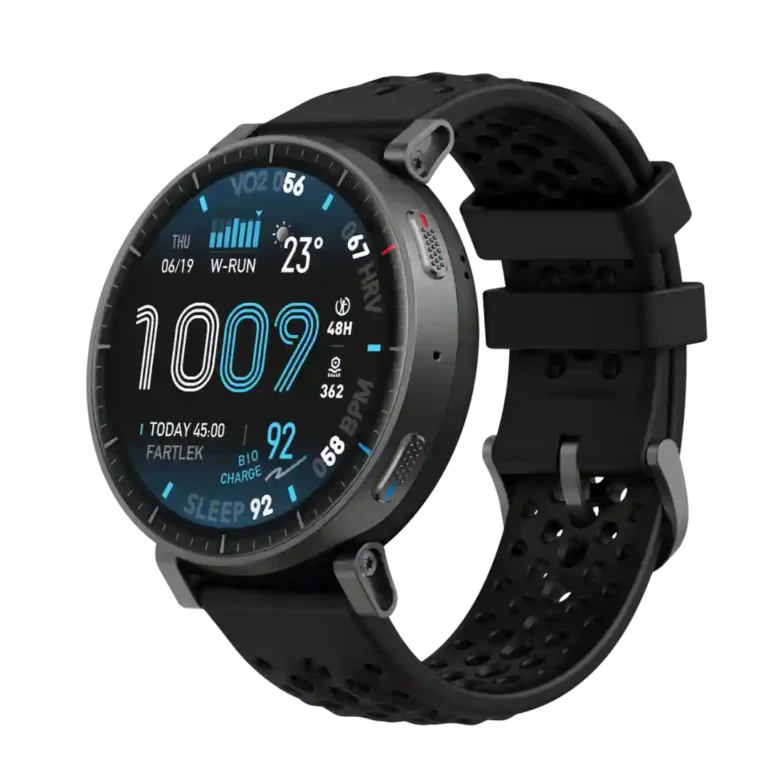
Choose the Amazfit Active Max for long battery life, a bright AMOLED display, offline maps, and broad fitness tools at a low price. Skip it if you need polished smartwatch apps, dual-band GPS, premium materials, or precise interval-level tracking.
Best for casual exercisers, runners, hikers, and value-focused smartwatch buyers who want long battery life, a bright display, offline maps, and plenty of workout modes without paying flagship prices.
Not for users who need a smaller case, premium materials, polished app ecosystems, streaming music support, dual-band GPS, or highly precise heart-rate tracking for intervals, cycling, and strength work.
The Amazfit Active Max lands as a high-value fitness smartwatch built around endurance, brightness, and feature depth. Reviewers repeatedly praised its multi-day battery life, bright AMOLED display, broad workout library, offline maps, comfort, and useful beginner-friendly coaching. The tradeoff is polish: Zepp’s app and interface can feel busy, third-party app support is limited, and the design is large and sometimes plain. Accuracy is good enough for many casual runners and fitness users, but GPS lacks dual-band precision and heart-rate tracking can stumble during cycling, intervals, or weights. It works best as a feature-packed budget sports watch rather than a premium smartwatch replacement.
Compared with other Smartwatches, this product is above average in value for money, call handling, music controls, near average in GPS accuracy, comfort, below average in safety features, user interface, calorie tracking usefulness.
| Attribute | This product | Category average | Difference |
|---|---|---|---|
| safety features | 2.0 | 3.9 | -1.9 |
| user interface | 2.5 | 3.9 | -1.4 |
| calorie tracking usefulness | 2.0 | 3.3 | -1.3 |
| value for money | 4.6 | 3.8 | +0.8 |
| app ecosystem | 2.5 | 3.6 | -1.1 |
| call handling | 4.2 | 3.3 | +0.9 |
| third-party app support | 2.3 | 3.2 | -0.9 |
| materials quality | 3.0 | 4.0 | -1.0 |
Choose Google Pixel Watch 4. It scores 4.8 vs 3.1 for operating system experience, with a 4.2 overall score.
Choose Garmin Forerunner 265. It scores 5.0 vs 2.3 for third-party app support, with a 4.0 overall score.
Choose Apple Watch Ultra 2. It scores 5.0 vs 2.0 for safety features, with a 3.9 overall score.
Choose Garmin Forerunner 955. It scores 4.8 vs 3.8 for GPS accuracy, with a 4.1 overall score.
Products reviewers directly compared with this model, grouped into quick takeaways.
Yes. Reviewers consistently framed it as a strong value because it combines a bright AMOLED display, long battery life, offline maps, broad workout tracking, and smartwatch tools at a relatively low price.
Battery life was the strongest point across reviews. Several reviewers reported or emphasized roughly week-plus to multi-week use depending on always-on display, GPS use, and monitoring settings.
It is generally good enough for casual runs and outdoor tracking, but not class-leading. Reviewers repeatedly noted the lack of dual-band GPS and some deviations, especially compared with higher-end sport watches.
Heart-rate tracking was acceptable to good during steady runs and everyday use, but more mixed during cycling, intervals, cold conditions, and strength workouts. Several reviewers recommended an external sensor for higher accuracy.
Comfort was widely praised, but the large case is not ideal for everyone. Reviewers warned that petite wrists may find the Active Max too big despite its light weight.
It handles basics like notifications, calls, music controls, watch faces, payments in supported regions, and voice assistant features. However, reviewers said it cannot match Apple, Google, or Garmin for app polish and third-party ecosystem depth.
Yes, especially for the price. Reviewers liked having offline maps and route guidance, but some noted that mapping is still more basic than Garmin-style navigation and often requires preloading routes.
These are a few of the reviews included in our analysis.



Best for long battery life, accurate GPS and useful offline maps at a strong price. Skip it if you need payments, richer apps, a built-in LED flashlight or polished smartwatch...
Pros: mapping and navigation, value for money
Cons: smartwatch features, contactless payments

Best for accurate run tracking, deep Garmin coaching and phone-free Spotify in a light package. Skip it if you need full maps, triathlon mode, Apple Music support or the strongest...
Pros: value for money, GPS accuracy
Cons: mapping and navigation, third-party app support

Good if you want premium running features, long battery life, and maps for under $200. Skip it if you need flawless heart-rate data, multiband GPS, LTE, or richer app support.
Pros: value for money, battery life
Cons: heart rate accuracy, third-party app support

Best for accurate running metrics, excellent coaching tools, a bright AMOLED display, and dependable battery life. Skip it if you need offline maps, music storage, contactless payments, multi-band GPS, or...
Pros: battery life, value for money
Cons: mapping and navigation, smartwatch features