If you want better durability
Choose Huawei Watch GT 6 Pro. It scores 4.6 vs 2.5 for durability, with a 4.0 overall score.

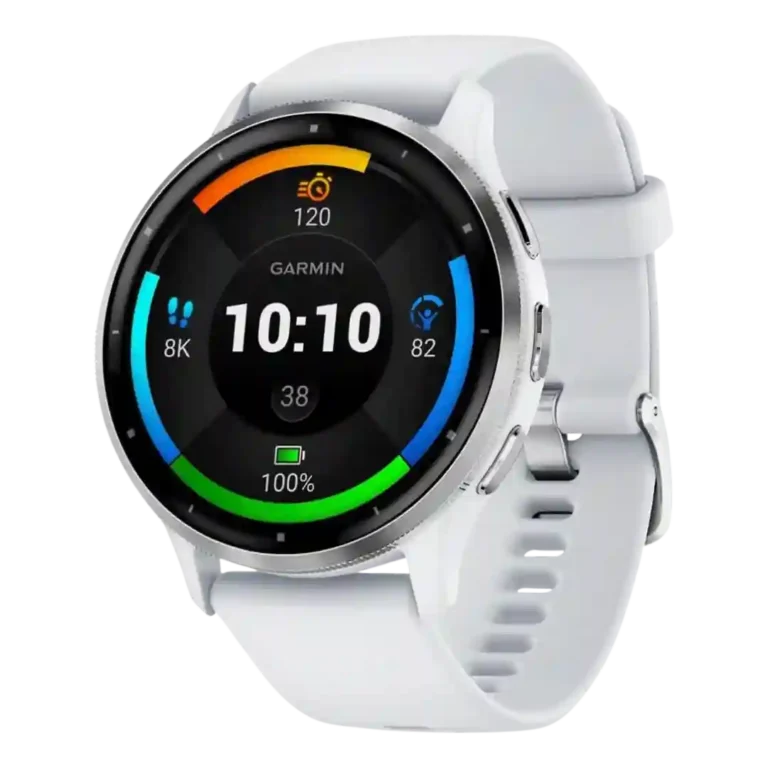
Choose the Garmin Venu 3 for long battery life, strong fitness accuracy, recovery insights, and a bright AMOLED display. Skip it if you need LTE, richer apps, advanced running analytics, or the lowest price.
Best for fitness-focused users who want accurate GPS and heart-rate tracking, long battery life, recovery guidance, sleep tools, and enough smartwatch convenience for daily wear.
Not ideal for users who want LTE, a large app store, full iPhone messaging, advanced route navigation, or the deepest running and training analytics Garmin offers.
Reviewers consistently frame the Garmin Venu 3 as a polished fitness-first smartwatch rather than a true app-heavy Apple Watch or Galaxy Watch rival. Its strongest evidence is around long battery life, accurate GPS and heart-rate tracking, a crisp AMOLED display, comfort, and useful recovery and wellness guidance. The tradeoff is focus: it handles calls, notifications, music, Garmin Pay, and voice assistant access, but reviewers repeatedly note limited third-party apps, no LTE, weaker messaging on iPhone, and fewer serious training/navigation tools than Garmin’s sportier models. Sleep tracking and coaching are generally useful, though not uniformly flawless, and blood oxygen testing drew skepticism. Overall, the evidence supports it as a premium health and fitness companion with enough smartwatch convenience, but not the most complete smartwatch or athlete watch at the price.
Compared with other Smartwatches, this product is above average in onboard music storage, size options, stress tracking, near average in smartwatch features, workout tracking variety, below average in durability, mapping and navigation, LTE connectivity.
| Attribute | This product | Category average | Difference |
|---|---|---|---|
| onboard music storage | 4.6 | 2.9 | +1.7 |
| durability | 2.5 | 4.2 | -1.7 |
| size options | 4.8 | 3.1 | +1.6 |
| mapping and navigation | 1.9 | 3.4 | -1.5 |
| LTE connectivity | 1.0 | 2.5 | -1.5 |
| blood oxygen tracking | 2.0 | 3.4 | -1.4 |
| stress tracking | 4.8 | 3.5 | +1.3 |
| activity auto-detection | 2.5 | 3.7 | -1.2 |
Choose Huawei Watch GT 6 Pro. It scores 4.6 vs 2.5 for durability, with a 4.0 overall score.
Choose Garmin Vivoactive 6. It scores 4.6 vs 3.7 for value for money, with a 3.9 overall score.
Choose Garmin Forerunner 965. It scores 4.6 vs 1.9 for mapping and navigation, with a 3.9 overall score.
Choose Garmin Forerunner 265. It scores 4.9 vs 4.5 for GPS accuracy, with a 4.0 overall score.
Products reviewers directly compared with this model, grouped into quick takeaways.
Yes. Reviewers consistently praised its GPS, heart-rate accuracy, broad workout modes, and detailed Garmin workout data, while noting that serious runners may still prefer a Forerunner for deeper training tools.
Battery life is one of the strongest points. Reviewers reported multi-day to week-plus use, with several emphasizing that it creates far less charging anxiety than Apple, Samsung, or Google smartwatches.
Not for everyone. It handles calls, notifications, Garmin Pay, music, and voice assistant access, but reviewers repeatedly noted limited third-party apps, no LTE, and weaker phone integration than mainstream smartwatches.
Most reviewers found both to be very strong. GPS was often described as accurate or precise, and heart-rate readings were frequently close to chest straps or other trusted devices.
Generally yes, especially for sleep reports, nap detection, and recovery guidance. However, reviewers also noted that sleep stages are hard to validate and that Garmin’s sleep detection can sometimes overcount time in bed.
The evidence is mixed. Reviewers liked the Venu 3’s premium health and fitness package, but the high price becomes harder to justify if you mainly want apps, LTE, advanced running analytics, or a cheaper Garmin alternative.
These are a few of the reviews included in our analysis.



Best for long battery life, accurate GPS and useful offline maps at a strong price. Skip it if you need payments, richer apps, a built-in LED flashlight or polished smartwatch...
Pros: mapping and navigation, value for money
Cons: smartwatch features, contactless payments

Best for accurate run tracking, deep Garmin coaching and phone-free Spotify in a light package. Skip it if you need full maps, triathlon mode, Apple Music support or the strongest...
Pros: value for money, GPS accuracy
Cons: mapping and navigation, third-party app support

Good if you want premium running features, long battery life, and maps for under $200. Skip it if you need flawless heart-rate data, multiband GPS, LTE, or richer app support.
Pros: value for money, battery life
Cons: heart rate accuracy, third-party app support

Best for accurate running metrics, excellent coaching tools, a bright AMOLED display, and dependable battery life. Skip it if you need offline maps, music storage, contactless payments, multi-band GPS, or...
Pros: battery life, value for money
Cons: mapping and navigation, smartwatch features