If you want better Bluetooth connectivity
Choose Garmin Forerunner 265. It scores 5.0 vs 2.0 for Bluetooth connectivity, with a 4.0 overall score.

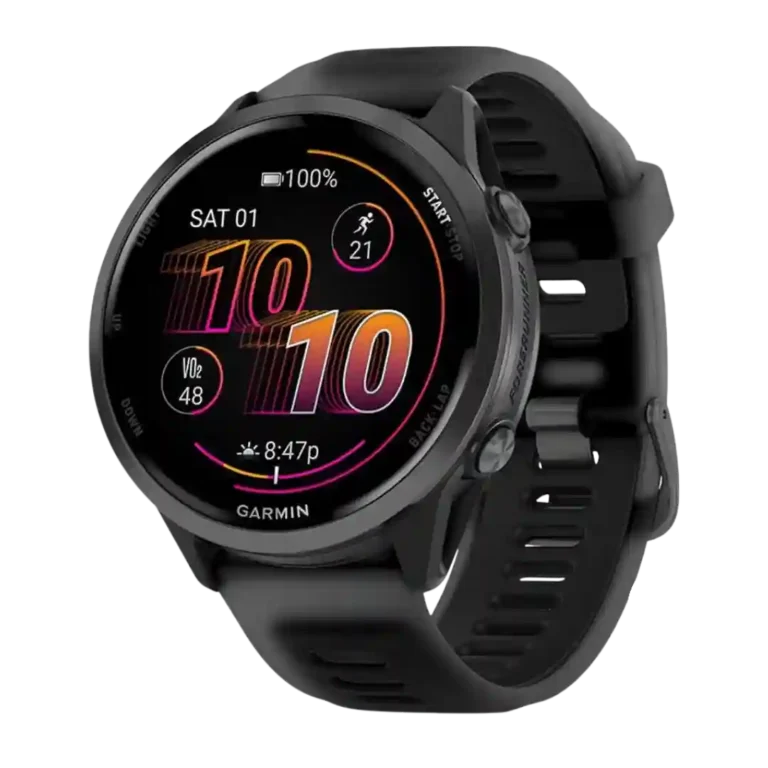
Choose the Garmin Forerunner 570 for a bright, stylish training watch with excellent GPS, heart-rate accuracy, and coaching. Skip it if value, offline maps, ECG, or long always-on battery life matter most.
Best for runners, triathletes, and Garmin users who want a stylish, bright, accurate training watch with rich coaching and recovery tools. It also suits buyers who value 42mm and 47mm size choices.
Not for shoppers prioritizing the lowest price, full offline mapping, ECG, or maximum always-on battery life. Casual smartwatch users may also find it too sports-focused and expensive.
Reviewers consistently framed the Garmin Forerunner 570 as an excellent sports watch with a more polished design, brighter AMOLED display, accurate GPS, and highly trusted heart-rate tracking. Its training tools, recovery guidance, workout variety, and improved smartwatch features make it feel more complete than earlier mid-range Forerunners. The tradeoff is value: many reviewers felt the higher price was hard to justify when battery life regressed with the brighter screen and Garmin still withheld offline maps and ECG. It works best as a premium-feeling runner and triathlon watch, not as the most feature-complete or budget-efficient Garmin.
Compared with other Smartwatches, this product is above average in size options, GPS accuracy, heart rate accuracy, near average in user interface, style and design, below average in Bluetooth connectivity, mapping and navigation, value for money.
| Attribute | This product | Category average | Difference |
|---|---|---|---|
| Bluetooth connectivity | 2.0 | 3.7 | -1.7 |
| mapping and navigation | 2.1 | 3.4 | -1.3 |
| value for money | 2.7 | 3.8 | -1.2 |
| smartphone notifications | 2.0 | 3.5 | -1.5 |
| size options | 4.4 | 3.1 | +1.3 |
| ECG functionality | 1.6 | 2.6 | -1.0 |
| health tracking accuracy | 2.8 | 3.9 | -1.2 |
| battery life | 3.3 | 4.2 | -0.9 |
Choose Garmin Forerunner 265. It scores 5.0 vs 2.0 for Bluetooth connectivity, with a 4.0 overall score.
Choose Huawei Watch Fit 4 Pro. It scores 4.7 vs 3.3 for battery life, with a 4.1 overall score.
Choose Garmin Vivoactive 6. It scores 4.7 vs 3.4 for pairing reliability, with a 3.9 overall score.
Choose Garmin Venu 3. It scores 5.0 vs 2.8 for health tracking accuracy, with a 4.1 overall score.
Products reviewers directly compared with this model, grouped into quick takeaways.
Yes. Reviewers repeatedly praised its GPS and heart-rate accuracy, with several comparing it favorably to chest straps and premium Garmin models.
No. It supports breadcrumb-style routing and routes from Garmin Connect, but reviewers consistently criticized the lack of full offline maps at this price.
It depends heavily on display settings. Some reviewers got around a week or more, while several reported only three to four days with always-on display and heavier training.
Yes. The brighter AMOLED screen was one of the most consistently praised upgrades, especially for sunlight visibility and day-to-day readability.
No. Reviewers repeatedly called ECG a disappointing omission because the watch uses Garmin’s newer heart-rate sensor and sits at a premium price.
Reviewer opinion was mixed to negative on value. They liked the watch itself, but many felt cheaper or slightly pricier alternatives offered better feature packages.
These are a few of the reviews included in our analysis.


Best for long battery life, accurate GPS and useful offline maps at a strong price. Skip it if you need payments, richer apps, a built-in LED flashlight or polished smartwatch...
Pros: mapping and navigation, value for money
Cons: smartwatch features, contactless payments

Best for accurate run tracking, deep Garmin coaching and phone-free Spotify in a light package. Skip it if you need full maps, triathlon mode, Apple Music support or the strongest...
Pros: value for money, GPS accuracy
Cons: mapping and navigation, third-party app support

Good if you want premium running features, long battery life, and maps for under $200. Skip it if you need flawless heart-rate data, multiband GPS, LTE, or richer app support.
Pros: value for money, battery life
Cons: heart rate accuracy, third-party app support

Best for accurate running metrics, excellent coaching tools, a bright AMOLED display, and dependable battery life. Skip it if you need offline maps, music storage, contactless payments, multi-band GPS, or...
Pros: battery life, value for money
Cons: mapping and navigation, smartwatch features