
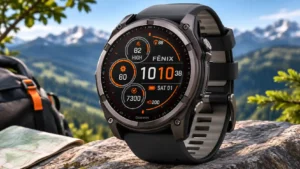
Garmin Fenix 8 Feature Scores
Overall Scorata score: 3.9/5
Based on 16 analyzed reviews · View source samples
Explore all 69 feature scores for Garmin Fenix 8, organized into pros and cons.
Scores by Feature
Summary
69 reviewed features-
Very positive 4.5-5.021 (30%)
-
Positive 3.5-4.429 (42%)
-
Neutral 2.5-3.417 (25%)
-
Negative 1.5-2.42 (3%)
Pros
Sort
-
The built-in flashlight is a standout everyday benefit, often used far more than expected. Quick button access and a useful red mode make it handy from nighttime household tasks to outdoor visibility.
-
GPS accuracy is consistently praised as excellent across urban streets, wooded routes, mountain terrain, and open water. Difficult tree cover and tight corners can still produce occasional deviations.
-
Battery endurance is a major strength, with many tests meeting or exceeding expectations even during regular GPS workouts. Size, Solar versus AMOLED, always-on display, music, and map use substantially change the result.
-
Sports coverage is exceptionally broad, with specialist profiles and deep metrics across many activities. The sheer volume can exceed what most owners realistically need.
-
AMOLED earns strong praise for vivid colors, sharp detail, and easier map reading. Solar/MIP favors clarity and endurance in a different way, while sapphire reflections can compromise the AMOLED experience for some outdoor users.
-
Wrist heart-rate readings are usually strong on steady runs and many cycling workouts. Fast intervals, lifting, and uneven long races can produce lags or errors, so precision-focused training may still benefit from a chest strap.
-
Workout measurement is generally strong, with accurate run distances and convincing cycling distance and elevation results. Manual starts are more dependable than automatic activity recognition.
-
Detailed offline maps, terrain information, and dynamic routing are major reasons to buy. Helpful new controls coexist with slow rendering and a navigation layout that some find cumbersome.
-
Touch works particularly well for maps, and temporary unlocking is a widely praised convenience. Some users find it responsive and smooth, while a MIP-model test reports missed taps and delays.
-
The rugged construction and sapphire lens hold up well to demanding use. Titanium bezels can still pick up visible scratches, even when the screen remains flawless.
-
Sealed buttons and recreational dive capability inspire confidence around water. Tested underwater operation is reassuring, and later use also welcomes speaker water ejection.
-
Premium case materials feel substantial, and sapphire gets particular praise for staying scratch-free. The added weight and the bezel’s ability to show marks temper the premium-material appeal.
-
Garmin Connect stands out for deep metrics, workout options, and increasingly useful phone-side adjustments. The detail rewards exploration, although some customization still has to happen on the watch.
-
Outdoor readability draws different reactions: many find AMOLED clear and excellent for maps, while one sapphire-model user finds glare troublesome. The revised Solar screen is praised for improved clarity without the old overlay.
-
Five buttons complement touch well during exercise, and the sealed design brings confidence around water. Their softer feedback and the control layout take adjustment, and some miss the old mechanical click.
-
Watch faces, colors, shortcuts, and data options offer extensive personalization. Fixed case accents and unfinished early Focus Modes are limits to that flexibility.
-
Body Battery, readiness tools, and customizable health logs help turn daily measurements into useful context. Their broad scope is a strength for users who want to understand energy, recovery, and wellbeing.
-
Training Readiness, recovery status, and load insights help manage effort and spot potential overtraining. Some users find the readiness score agrees well with how energetic they feel.
-
The case feels sturdy and carefully assembled. Reviewers consistently describe a rugged build that suits an expensive outdoor watch.
-
The AMOLED screen is bright and sharp enough to make detailed information pop. One side-by-side comparison finds the successor brighter, but the practical difference modest.
-
Firmware updates fix many early problems, and later comparisons welcome the prospect of new features reaching existing watches. Some future additions remain expectations rather than tested capabilities.
-
Everyday health functions receive positive practical assessments, including heart-rate tracking and useful cycle predictions. These impressions support wellness use rather than a claim of clinical accuracy.
-
The silicone band is practical, easy to clean, and generally comfortable, with a little welcome stretch. Some prefer nylon for finer adjustment and less irritation.
-
Useful route controls and offline directions make navigation practical, especially away from familiar streets. Missing audible or vibration turn alerts in some early tests are a meaningful limitation.
-
The rugged, technical look appeals to many, and some find it unusually stylish for Garmin. Bulk and permanent accent colors make it less versatile for those wanting a compact watch or flexible band styling.
-
Face editing and color choices can be extensive and increasingly intuitive. Opinions on stock designs and variety vary, and paid downloads are a concern for some.
-
The organized notification center, readable message text, and photo previews are useful. Reply capabilities depend on the connected phone and app, with iPhone workarounds less seamless than an Apple Watch.
-
Offline playlists are useful for leaving the phone behind, and one test reports impressively quick downloads. The tiny speaker is mainly suitable for quiet surroundings or occasional playback, while large music libraries can strain capacity.
-
Common workout accessories work well, with easy connections to heart-rate straps and headphones and broad sensor compatibility.
-
External heart-rate straps connect easily in the reported workout setup, providing a practical option when wrist readings are not enough.
-
The reported setup experiences are straightforward, with immediate service synchronization and easy accessory connections.
-
Offline commands are useful for timers and hard-to-find activities, with generally good recognition. Holding a button, restricted phrasing, and actions that still need confirmation make the benefit task dependent.
-
Comfort depends strongly on wrist size and case choice: some wear the 47mm around the clock without trouble, while others regularly need a break. The large case and stock strap can feel less comfortable than lighter watches or a nylon band.
-
Launch software can freeze, reboot, or lose an activity, but later firmware materially improves stability in follow-up use. Some reviewers still encounter frustrating behavior, while core tracking and dive tests are often dependable.
-
The redesigned interface makes some settings clearer and adds a more modern presentation. Opinions split over extra activity steps, confusing navigation lanes, and controls that are less intuitive than expected.
-
Sleep timing and overnight awakenings are accurate in several tests, but another user finds awake duration understated and stages unconvincing. It is more dependable as a timing tool than a universally trusted breakdown of sleep.
-
Third-party music and fitness integrations can work smoothly, and downloadable software extends the watch. The selection still feels limited beside Apple and Samsung for everyday smartwatch needs.
-
The vivid screen makes training metrics easier to absorb. Some redesigned navigation pages mix different kinds of remaining-distance and time information in a confusing way.
-
Map and music capacity is adequate for most users and a useful improvement over an older base Epix. Keeping an entire music library on the watch is a more demanding case where the newer generation’s extra room may matter.
-
Headphones and a heart-rate strap connect easily in the reported workout setup, making wireless accessories straightforward to use.
-
A full charge takes roughly an hour in the reported test, keeping recharge downtime manageable.
-
Training recommendations can identify an imbalance in workouts and suggest a useful change, such as adding higher-aerobic sessions to a routine of slower runs.
-
Elevation gain looks convincing in both road/gravel and mountain-bike comparisons. Agreement with other devices and corrected elevation data supports confidence in the climbing totals.
-
Sleep results appear promptly on the watch after waking, making it convenient to check the night without an extra phone-sync step.
-
Resume Later becomes more flexible by allowing access to other apps while an activity is parked. Starting another sport remains restricted.
-
The watch’s sports-focused platform is capable and becomes more stable with updates. Its extensive menus and more limited phone-like functions still make it feel less polished than leading general smartwatch systems.
-
Multi-activity journey grouping is a welcome addition through Garmin Connect, especially because existing owners can receive it too. The praise concerns access to the feature rather than a detailed test of creating and sharing a journey.
-
One overnight comparison finds HRV close to WHOOP and Oura despite an initially surprising result. That is encouraging agreement, with a limited basis for judging absolute accuracy.
-
Workout preparation and data configuration are flexible, with easier access to last-minute settings. The new navigation lanes can also duplicate pages that experienced users already configured.
-
The proprietary pin cable is dependable and charging is infrequent. It feels less convenient than a magnetic connection.
Cons
Sort
-
The standard model’s lack of independent cellular connectivity is a repeated disappointment. Reviewers particularly wanted phone-free communication and safety support.
-
Most reviewers struggle to justify the premium launch price when older Garmins deliver similar core tracking. Discounted units look considerably more compelling, especially beside a modest successor upgrade.
-
Some launch-era headline features feel incomplete, especially voice notes that lack convenient phone transfer. Manual USB retrieval undercuts the promise of a seamless new tool.
-
Automatic activity recognition can label the wrong exercise. Starting workouts manually produces more dependable records.
-
Wrist calls are convenient in a pinch, but speaker volume repeatedly disappoints. Some calls sound clear while others suffer crackling or clipped speech, so this is an uneven convenience feature.
-
Geotagged voice notes are appealing for capturing ideas outdoors. Their usefulness is held back by awkward file retrieval and a lack of convenient phone sync in the tested software.
-
The new activity interface gives music its own lane, but an early test criticizes being unable to remove that page when it is unwanted.
-
The small speaker is serviceable for occasional calls or playback in quiet surroundings, but low volume is a recurring complaint. Some find it acceptable, while others struggle to hear calls even at maximum volume.
-
The revised settings organization pleases some experienced users, but activity categories, extra confirmation steps, and navigation lanes frustrate others. Finding a simple function can take much longer than expected.
-
There is a substantial learning curve behind the huge feature set. Cleaner settings and voice shortcuts help, but nested activities and awkward strength-mode input can still slow simple tasks.
-
Subtle button haptics are pleasantly judged in one test. Another early test finds missing vibration before navigation turns, which is more consequential during course following.
-
Phone integration is uneven across platforms. Android supports convenient preset replies, while iPhone owners face restrictions and less direct workarounds.
-
Multiple case and display choices help different preferences, but the configuration range can be confusing. Losing a small Solar/MIP model is a recurring complaint, and even the smallest AMOLED can feel large.
-
Software smoothness is inconsistent across models and review periods. Updates help, but slow map rendering, delayed commands, and uneven interface motion remain common complaints.
-
Microphone results vary sharply: some callers hear clear speech, while others report clipping, missing words, or interrupted audio. It is worth treating wrist calling as an occasional convenience.
-
Downloadable add-ons broaden personalization, but the app ecosystem remains behind Apple and Samsung for everyday smartwatch tasks.
-
A carefully chosen size can fit well, and the smallest AMOLED option works well for some narrow wrists. Others still find it bulky, with heavier cases twisting or pressing on wrist bones.
-
Voice commands and phone-linked calling bring welcome convenience to a serious sports watch. The app range, assistant integration, and call quality still fall short for people expecting a phone on the wrist.
-
The flashlight and outdoor guidance add practical safety value. The missing standalone cellular connection remains a disappointment for users who want communication without carrying a phone.
Use Cases
Best for
Sort
-
Running is a strong fit thanks to accurate GPS, extensive training tools, useful mapping, and long endurance. Weight, price, and imperfect wrist heart rate may favor a lighter watch or an external sensor for some runners.
-
Serious multisport and endurance athletes get a deep set of training, recovery, and navigation tools. Long GPS endurance and extensive analytics are particularly valuable when those advanced functions will actually be used.
-
Built-in scuba tools suit recreational divers without a recurring dive-app subscription, and practical or simulated tests are reassuring. The 40-meter scope and specialist-function limits still leave a role for a dedicated dive computer.
-
Extended-use reports are encouraging about durability and continuing usefulness, particularly after firmware improvements. Later comparisons often favor keeping the watch because the core tracking remains capable.
-
Cycling benefits from accurate routes, useful climbing data, and generally strong workout measurement. Wrist heart-rate results can still wobble with road vibration or brief changes in effort.
-
Offline topographic maps, climb previews, and route recovery make the watch especially useful for hiking and backcountry exploration. The practical navigation strengths outweigh interface friction for many outdoor users.
-
Swimming is well served by strong open-water GPS results and buttons designed for underwater use. The sealed construction adds convenience compared with older designs that discouraged pressing buttons in water.
-
Interval suitability is mixed: several tests closely match reference heart-rate data, while another misses fast changes. A chest strap remains sensible when precise interval intensity drives training decisions.
-
The broad wellness toolset and customizable logs support detailed everyday tracking. That depth is useful for engaged users, though it can be more than casual tracking requires.
-
The extensive multisport toolset and long GPS runtime suit triathlon, including a full Ironman in one assessment. For long events, the heavy case can make a lighter running watch more comfortable.
-
Offline music is a clear strength for phone-free workouts. Independent calls and cellular safety communication are unavailable on the standard model, so leaving the phone behind remains a tradeoff.
-
Long GPS endurance, detailed maps, and geotagged notes are useful for ultra-distance running. Suitability depends on event duration and settings, and variable-effort ultra racing can expose wrist heart-rate errors.
-
Offline nearby-place searches and route generation are useful when visiting unfamiliar locations. Travelers can explore or plan a run without depending on a phone data connection.
-
The ability to dive with a general sports watch is a welcome benefit, with a stated recreational limit of 40 meters. More specialized dive watches remain available for needs beyond that scope.
-
Two users report comfortable sleep wear despite the substantial case. Overnight suitability still benefits from selecting a size that works on the wrist.
-
The contrasting AMOLED screen is particularly easy to read indoors, making the tested version a good match for gym use.
-
Enthusiasts who want a dense collection of advanced outdoor and training functions can find enough here to justify the premium. Many less engaged owners will use only a small share of that capability.
-
Dynamic routing adds a useful way to explore on foot while still working toward a planned distance or return point.
Conditional or not ideal for
Sort
-
Budget-conscious buyersFull-price units are a poor match for tight budgets, and discounted older Garmins often offer better value. Later comparisons are much more favorable to a discounted Fenix 8 than to paying for a small generational upgrade.
-
Upgrading from older Garmin watchesRecent Fenix 7 and Epix Pro owners usually gain too little core tracking capability to justify the premium. Moving from a much older or base model is more compelling when its smaller storage, older GPS, or software limitations matter.
-
Small wristsSmall-wrist suitability is mixed: one reviewer praises the 43mm fit, while others still find the smallest model bulky or the 47mm near their comfort limit. Losing a small Solar/MIP option further restricts the choice.
-
Upgrading from Fenix 8Replacing a Fenix 8 with its successor usually offers too little benefit to justify the expense. Standalone messaging or exceptionally long Pro Solar endurance are the main conditional reasons raised for moving on.
-
Smartwatch replacementReplacing a general smartwatch gains battery endurance and sports depth while giving up a richer app ecosystem and more seamless phone-like functions. Users prioritizing those everyday smarts are usually better served elsewhere.
-
First premium sports watchA first premium sports-watch purchase makes most sense when the extensive maps, music, and training functions will actually be used. Discounted older models or a similarly priced successor can be a better starting point than a full-price Fenix 8.
-
Strength trainingStrength tracking is usable but imperfect: optical heart rate can stumble during sets, and one reviewer strongly dislikes the new weight-entry interface. Touch input may be necessary to make logging less tedious.
-
Desktop productivityThe large, heavy case can interfere with keyboard work, making it an awkward desk companion for someone with a smaller wrist.
-
Fitness beginnersBeginners and less demanding exercisers may find the feature load overwhelming and poor value. Simpler watches can cover their needs with less learning and expense.