If you want better comfort
Choose Garmin Venu X1. It scores 4.9 vs 3.5 for comfort, with a 3.9 overall score.

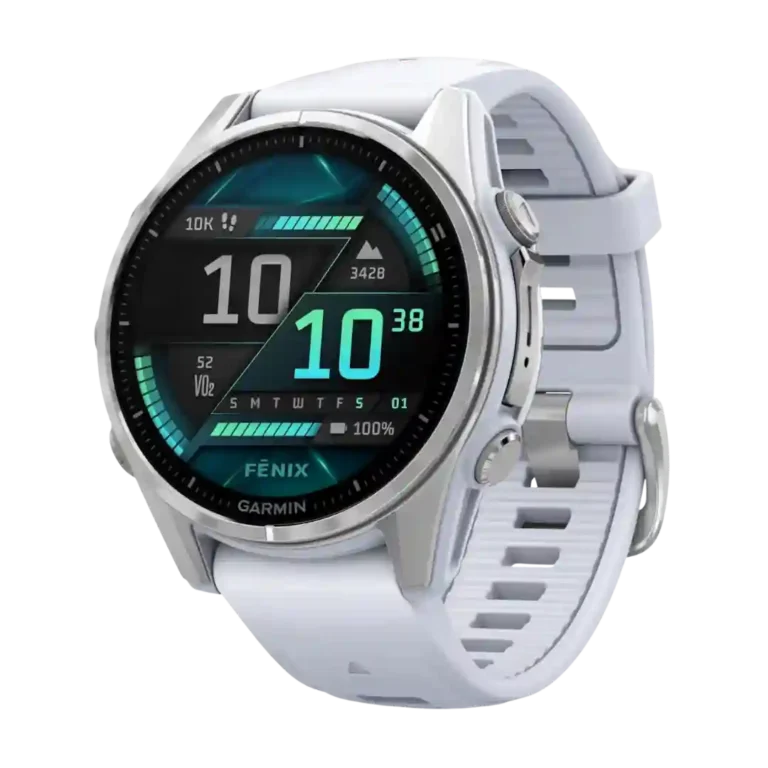
Choose the Garmin Fenix 8 if you want top-tier GPS, battery life, maps, rugged build and deep training tools. Skip it if the high price, bulky fit, missing LTE or weaker smartwatch ecosystem outweigh those strengths.
Best for serious outdoor athletes, endurance users, backcountry hikers, divers, and Garmin power users who will use the maps, battery life, GPS accuracy, recovery data, and broad activity profiles.
Not for shoppers who mainly want a polished phone-like smartwatch, LTE, a compact lightweight fit, a large third-party app catalog, or the best value versus discounted older Garmins.
Across the reviews, the Garmin Fenix 8 comes across as a superb outdoor and multisport watch with excellent GPS accuracy, long battery life, strong mapping, rugged construction, and unusually deep training and wellness tools. The main tradeoff is that Garmin added dive support, voice features, and a redesigned interface while also raising the price sharply; several reviewers felt the new features did not justify the premium for existing Fenix or Epix owners. The AMOLED display impressed most reviewers, but outdoor glare, bulk, call quality, app support, and software smoothness kept it from feeling like a fully polished smartwatch. It is strongest as a fitness, adventure, and navigation tool rather than a phone-like wearable.
Compared with other Smartwatches, this product is above average in onboard music storage, Wi-Fi connectivity, mapping and navigation, near average in operating system experience, customization options, below average in value for money, activity auto-detection, user interface.
| Attribute | This product | Category average | Difference |
|---|---|---|---|
| value for money | 2.1 | 3.8 | -1.7 |
| onboard music storage | 4.7 | 2.9 | +1.8 |
| Wi-Fi connectivity | 4.2 | 2.8 | +1.4 |
| mapping and navigation | 4.5 | 3.4 | +1.1 |
| contactless payments | 4.0 | 2.8 | +1.2 |
| activity auto-detection | 2.5 | 3.7 | -1.2 |
| voice assistant quality | 4.1 | 3.1 | +1.1 |
| user interface | 2.9 | 3.9 | -1.0 |
Choose Garmin Venu X1. It scores 4.9 vs 3.5 for comfort, with a 3.9 overall score.
Choose Garmin Epix Pro (Gen 2). It scores 4.6 vs 4.0 for button controls, with a 4.2 overall score.
Choose Garmin MARQ Gen 2. It scores 4.7 vs 3.8 for menu navigation, with a 4.2 overall score.
Choose Huawei Watch GT 6 Pro. It scores 4.7 vs 4.3 for heart rate accuracy, with a 4.0 overall score.
Products reviewers directly compared with this model, grouped into quick takeaways.
Yes. Reviewers repeatedly praised its GPS accuracy across city runs, mountains, open-water swimming, and cycling, with only minor caveats in especially difficult conditions.
Battery life was one of the strongest points. Reviewers reported multi-day to multi-week use depending on model and settings, while always-on AMOLED use reduced staying power.
Reviewers were cautious. The Fenix 8 adds dive support, speaker/microphone features, UI changes, and strong battery gains, but several reviewers said the price jump is hard to justify over recent Fenix or Epix models.
Yes. Reviews praised topo maps, rerouting, climb data, route guidance, and backcountry usefulness, though one reviewer noted lag when drawing maps.
Voice commands were mostly useful for timers, activities, and quick actions. Call handling was more mixed, with several reviewers saying the speaker was quiet or call quality was weak.
Comfort depends on wrist size and model. Some reviewers wore it comfortably every day, while others found the larger or heavier models bulky, obtrusive, or too large for smaller wrists.
These are a few of the reviews included in our analysis.



Best for long battery life, accurate GPS and useful offline maps at a strong price. Skip it if you need payments, richer apps, a built-in LED flashlight or polished smartwatch...
Pros: mapping and navigation, value for money
Cons: smartwatch features, contactless payments

Best for accurate run tracking, deep Garmin coaching and phone-free Spotify in a light package. Skip it if you need full maps, triathlon mode, Apple Music support or the strongest...
Pros: value for money, GPS accuracy
Cons: mapping and navigation, third-party app support

Good if you want premium running features, long battery life, and maps for under $200. Skip it if you need flawless heart-rate data, multiband GPS, LTE, or richer app support.
Pros: value for money, battery life
Cons: heart rate accuracy, third-party app support

Best for accurate running metrics, excellent coaching tools, a bright AMOLED display, and dependable battery life. Skip it if you need offline maps, music storage, contactless payments, multi-band GPS, or...
Pros: battery life, value for money
Cons: mapping and navigation, smartwatch features