
Creative XF1 Feature Scores
Explore all 103 feature scores for Creative XF1, organized into pros and cons.
Scores by Feature
Summary
103 reviewed features-
Very positive 4.5-5.034 (33%)
-
Positive 3.5-4.456 (54%)
-
Neutral 2.5-3.413 (13%)
Pros
Sort
-
Precise parametric EQ is one of the strongest attractions and can substantially improve the sound. Some users find the controls daunting, while others call the interface exceptionally approachable.
-
Sound quality is usually praised relative to size and price, especially after EQ. Limited deep bass and inconsistent high-volume refinement temper the enthusiasm.
-
Nexus offers extensive sound adjustment, especially welcome through its Windows app. It is less useful as a full music remote because playback still requires the streaming app.
-
USB-C, auxiliary input, and Bluetooth are consistently valued for flexible device use, with subwoofer output adding room for expansion.
-
The software is liked for useful sound tools, responsive operation, and effective desktop tuning. Its basic presentation and lack of full playback control leave room for improvement.
-
The subwoofer output is repeatedly singled out as useful for adding bass depth without discarding the compact pair.
-
Most sources welcome the small footprint beside a monitor. One video points out that even smaller desktop speakers can use less space.
-
Small cabinets fit desks comfortably while preserving impressive output for their size. Their physical limits remain audible in bass depth and untuned sound.
-
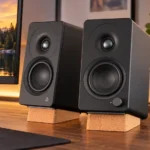
Close desk listening is the strongest use case, with natural voices, clean imaging, and useful aiming from the cork stands.
-
The package is widely recommended as a useful compact desktop upgrade with thoughtful features. Some find it competitive rather than distinctive, and many articles assess its launch features rather than tested performance.
-
Clarity is a recurring strength, especially for nearby listening and distinct voices or instruments. More expensive speakers can still offer greater refinement.
-
Bluetooth is repeatedly welcomed within a flexible desktop connection package, particularly for switching between a computer and phone.
-
Ready-made profiles offer useful shortcuts for games, music, and movies, particularly when manual tuning feels complex. The huge selection can also become unwieldy or seem excessive.
-
USB-C offers convenient digital computer audio, with positive assessments of cleaner reproduction. One listening test finds its advantage over wireless modest.
-
Wired connections are generally liked for flexibility and dependable operation, with USB-C offering digital playback and auxiliary input accommodating analog sources.
-
Most impressions favor the understated bookshelf styling and warm cork accents. One listener dislikes the base color and would prefer black.
-
Separate amplification is credited with clearer, more controlled output, and the integrated electronics keep extra audio boxes off the desk.
-
Natural balance is a frequent strength, especially after tuning and at close range. Default tuning generally makes good use of the small cabinets.
-
LDAC-capable playback is valued for higher wireless quality, while one listening comparison finds only a small advantage from going wired. Benefits depend on the source device and codec.
-
LDAC is a recurring attraction for compatible sources. Apple devices fall back to AAC, so those users miss a promoted part of the wireless feature set.
-
The included cork stands are repeatedly welcomed for aiming and supporting the speakers. One video criticizes the absence of an auxiliary cable.
-
Higher-quality wireless codec support is treated as a strength, particularly when LDAC can be used with a compatible source.
-
Treble is often clear and detailed, and can compare favorably with a bassier model. Some listeners instead find the upper frequencies shrill or harsh.
-
Adding a powered subwoofer is repeatedly welcomed as an easy path to a fuller 2.1 system without replacing the main speakers.
-
The interface is often praised as quick and understandable, with especially enthusiastic reactions to parametric tuning. One initial pairing sequence prevented discovery until the phone was disconnected and found through the app.
-
Instrumental detail and small atmospheric sounds are frequently praised. Pricier systems can reveal more nuance, but resolution is considered strong for the size and cost.
-
Mids are commonly praised for clear detail and natural voices. Forward upper mids can sound harsh with some mixes and may benefit from EQ.
-
Cork stands and sturdy cabinets are credited with reducing desk vibration and resonance, while also aiming the sound more usefully.
-
Output is strong for such small speakers and ample for ordinary desktop use. It does not deliver the force of substantially larger systems.
-
Distinct instruments and broadly useful tonal balance suit varied music. Personalized EQ helps some listeners prefer the pair over a bassier alternative.
-
Room-filling output is praised for bedrooms and home offices. Larger spaces and demanding bass material expose the limits of the small system.
-
USB audio is valued as a reliable computer connection and an effective route to high-resolution playback.
-
Most assessments find strong value in the sound, features, and size. Price criticism comes from budget-focused shoppers and one listener who considers the pair a little expensive.
-
Bedrooms, dorms, and home offices are favorable settings; close listening in a study brings especially pleasing balance. Larger rooms reveal weaker bass substance.
-
A self-contained plug-in setup and straightforward expansion are valued for avoiding separate audio equipment or replacing the pair later.
-
The auxiliary input adds useful flexibility alongside USB-C and Bluetooth. Front access is less convenient than on speakers with a readily accessible jack.
-
Construction draws favorable comments about a solid feel and careful assembly. The pair still feels less premium than some substantially pricier speakers.
-
The cabinet surface, sturdy enclosure, and rear-plate integration earn praise for tactile quality and reducing unwanted vibration.
-
Several articles praise wide frequency coverage as useful for detail and varied desktop content. A tuned listening test also finds accurate reproduction.
-
Clear directional cues, distinct environmental details, and satisfying effects make the pair appealing for desktop gaming. Stereo immersion is useful even without a surround system.
-
Basic hardware setup and app installation are usually straightforward. One app discovery failure required changing the Bluetooth pairing sequence.
-
The customized woofers are credited with useful punch, clarity, and lower distortion within the limitations of their small size.
-
Clean output at substantial volume impresses some listeners. Others hear congestion or unpleasant sound near the top of the range, and protective compression can reduce fullness.
-
Windows app support receives unusually enthusiastic praise for making speaker settings available directly on the PC.
-
The front knob makes source changes quick and convenient, allowing easy transitions among a PC, phone, and laptop.
-
Front-facing controls are praised for convenient volume adjustment and one-press source switching.
-
Protective speaker wrapping and easy removal from the box make favorable first impressions.
-
The front dial gives convenient volume access and doubles as an effective source-switching control.
-
Movies benefit from clear speech and tailored EQ, but the stereo presentation can feel contained. Extra bass weight requires a separate subwoofer.
-
Small bass adjustments and Desktop mode can improve fullness and control. Heavy boosts may sound oppressive, reduce clean volume, or interact poorly with the room.
-
The pair offers substantial loudness for desk and small-room use. Approval becomes less consistent at higher settings, where some listeners hear strain or find the sound unbearable.
-
Maximum output is impressive for such small cabinets, but pushing toward the top can reveal compression, congestion, or harshness.
-
Parametric EQ is valued for targeting specific room resonances and desktop placement problems with more precision than broad tone controls.
-
The EQ tools are praised for letting music listeners reshape the tonal balance toward a warmer or more detailed presentation.
-
The compact cabinets and optional stands offer useful placement choices. The main speaker’s fixed right-channel assignment can frustrate alternative layouts.
-
Directional cues and a precise center image are praised at close range. One listener needs more careful positioning to achieve the stereo sweet spot.
-
Stereo separation helps distinguish movie and game sounds, with clean imaging at the desk. Achieving the ideal image can require some positioning work.
-
The dense, silky surface and careful assembly are liked, although more expensive models can feel more premium.
-
The optional angled cork stands are appreciated for directing sound toward the listener without an extra accessory purchase.
-
High-resolution support is welcomed for high-quality music files and streaming, giving the system appeal beyond basic computer audio.
-
The defeatable power-saving mode earns praise for letting PC users avoid unwanted automatic sleep during quiet periods.
-
Wireless operation is described as reliable, with fixed desk distances presented as favorable for maintaining high-bitrate playback.
-
The simple cabinets are easy to wipe down and keep clean. Take care around the volume knob, which can be moved accidentally during cleaning.
-
The active crossover receives favorable assessments for splitting frequencies before amplification and keeping the compact system controlled.
-
Light, manageable cabinets make moving the speakers around a workstation easy.
-
The stationary Bluetooth connection is positively assessed as reliable and favorable for consistent wireless playback.
-
Bass is often described as controlled and clear, yet deeper weight and physical impact remain recurring limitations. A separate subwoofer is the favored remedy for demanding music and cinematic effects.
-
Voices are praised for natural, neutral definition and clear positioning. Forward upper mids can need adjustment with some music.
-
The matte cabinet surface is liked for its smooth finish and silky, dense feel.
-
The separate tweeters are credited with pleasing high-frequency warmth and improved detail in the compact design.
-
The compact stereo pair suits a clean PC setup, but it cannot deliver the room-shaking bass of a system with a dedicated subwoofer.
-
Compatible mobile devices can obtain higher-quality wireless playback, while iPhone and iPad users face the less capable AAC path described in the supplied coverage.
-
The small pair is convenient to relocate around a workspace. Mains power makes it unsuitable as a battery-powered outdoor speaker.
-
The simple speaker link and power arrangement are appreciated for keeping a desktop setup tidy with few wires.
-
The sound is praised for a coherent tonal presentation that stays well balanced despite compact-speaker limitations.
-
The exposed drivers are liked for a clean, uncovered appearance without fabric grilles.
-
Quiet listening retains clear, convincing sound rather than losing the detail that some competing speakers struggle to preserve.
-
Low-volume reproduction earns direct praise, making the pair suitable for listening without constantly turning it up.
-
The multifunction knob is reported to work well in practice, making device changes a simple button press.
-
The angled stands are credited with a wider, more immersive sound stage by one video assessment.
-
The screw-secured cork coasters are credited with creating a stable supporting base.
-
The ability to disable startup and source-change tones is welcomed for avoiding unwanted audible status cues.
-
Automatic low-frequency routing to a connected subwoofer is credited with easing the workload on the small main woofers.
-
Movie dialogue is judged clear enough with the Movies preset despite the lack of a dedicated dialogue-boost feature.
-
The separate woofer and tweeter arrangement is positively assessed for improving clarity, detail, and overall balance across content.
-
The energy-saving setting is positively recommended in the introductory setup video.
-
Subwoofer expansion is considered sensible for a small desktop home theater or TV-based listening arrangement.
-
The driver size offers useful output for a compact computer speaker, but small drivers also impose audible limits on impact and fullness.
-
The two-metre speaker cable is considered sufficient for most desks, though wider shelf or sideboard placements may stretch its reach.
-
The supplied interconnect makes desk placement straightforward, but its reach can become restrictive on wider furniture.
Cons
Sort
-
TV users needing HDMI ARC are poorly served, and one listener specifically wishes for eARC in a future model.
-
Missing HDMI eARC is a repeated reason to favor PC use or consider another speaker for a television.
-
Several listeners miss a headphone output, particularly a convenient front socket for switching to private listening.
-
Powerful peaks lose richness as protective compression intervenes, and the pair cannot match the impact of a much larger KEF system.
-
The lack of HDMI limits appeal for TV-based setups, where that connection would simplify integration.
-
The pair can provide enjoyable stereo entertainment, but some assessments criticize the absence of a true surround or expansive spatial experience.
-
The lack of HDMI ARC and optical connections weakens the case for a TV-centered setup.
-
At greater listening distances, compression of powerful pulses limits dynamic impact and gradually thins the sound.
-
The supplied USB-A cable requires an adapter for the Mac Mini setup shown in the unboxing video.
-
The lack of a true surround system is presented as a limitation for buyers seeking multichannel immersion.
-
The absence of optical input makes the system less appropriate for television users who need that connection.
-
One movie-listening assessment finds the sound fairly contained and lacking a spatial effect.
-
At greater distances, the useful volume range narrows as bass struggles and protective compression reduces richness.