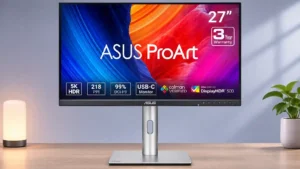

ASUS ProArt Display 6K PA32QCV
Where It Has the Edge
- brightness is 4.6 vs 4.3. Brightness is a consistent strength, with measurements and hands-on impressions describing a remarkably luminous SDR image. A few...

Scorata scores summarize analyzed review evidence on a 1–5 scale; they are not laboratory measurements or a simple average of customer star ratings. Feature scores summarize the reviews covering that feature. The overall score averages feature scores within each review, then combines review averages. When both expert and customer evidence are available, those two groups receive equal weight. Products can have different review coverage, so small score gaps do not establish a winner.
Recommendations prioritize important features for the category, with a score of at least 3.5, a gap of at least 0.25 points and at least two supporting reviews per product. Features with widely varying scores or broad connectivity contexts are excluded from recommendations. These safeguards do not establish statistical significance.
Quick verdict
The review evidence points to a tradeoff: brightness versus refresh rate and adaptive sync performance. Choose according to which strengths matter more to you; the overall score alone does not settle that choice.
Choose ASUS ProArt Display 6K PA32QCV for brightness.
Choose Dell U4025QW for refresh rate and adaptive sync performance.
Scores are out of 5. Missing scores mean missing review evidence, not a missing feature.
Initial image display can take longer than competing high-end monitors, and the slower wake-up becomes inconvenient when reconnecting laptops repeatedly.
One owner reports a quick one-to-two-second wake-up, keeping laptop desk use responsive.
Opinions split between solid, professional construction and an obviously plastic, less luxurious finish. It does not mimic Apple's aluminum-and-glass feel.
Clean construction, practical details, and a tidy integrated power supply help the monitor feel like a high-end workstation product.
A 60Hz cap is acceptable for traditional creative timelines and normal office work but disappointing for fast games or people accustomed to 120Hz-plus displays.
The 120Hz refresh rate consistently improves scrolling, window movement, and perceived fluidity over 60Hz work displays.
An internal power supply helps eliminate a bulky brick, but the stand's low cable opening leaves some wires visible. Tidier setups may benefit from a monitor arm.
The built-in hub, retractable front ports, and stand pass-through can simplify a desk, though the number of rear connections can still make cable routing awkward.
The matte coating is divisive: some see crisp, unobstructed detail while others notice haze, shimmer or grain that undermines 6K text clarity.
The lightly matte finish keeps reflections manageable without noticeably muddying text and images.
Static or slower-paced games look detailed, but the fixed 60Hz ceiling and resolution load limit its usefulness for demanding PC play.
Connected gaming PCs can benefit from the high resolution and refresh rate, but truly fast play is not its primary strength.
Results are mixed: some see wide, dependable IPS angles, while others report more off-axis change due to the matte coating.
Its IPS-style wide viewing angles keep images fairly consistent when seen from off-center positions.
The IPS panel offers reasonable blacks for general editing, but they look gray compared with OLED or Mini LED, especially in dark scenes.
IPS Black produces darker, more convincing blacks than ordinary IPS panels. Dark scenes still look gray beside OLED or effective local-dimming displays.
Motion is noticeably less crisp than on modern high-refresh screens. Standard video still looks smooth enough, but rapid gaming exposes blur.
Movement looks smoother than on 60Hz office panels, but blur and smeared fine details still trail the quickest gaming monitors; impressions vary by game.
Thunderbolt 4, DisplayPort, HDMI and USB provide above-average versatility. Users with numerous peripherals or multiple HDMI devices may still want more ports.
The collection of Thunderbolt, USB, HDMI, DisplayPort, audio, and Ethernet connections is exceptionally complete for a monitor.
A broad base occupies meaningful desk space, though its flat surface remains usable. Some appreciate that the updated stand is more compact than earlier designs.
The display and chunky stand demand considerable desk space, and smaller workstations may struggle to accommodate the base.
Useful cables, the stand and a cleaning cloth are included, helping buyers set up without immediately shopping for extras.
The useful selection of supplied video, power, and Thunderbolt cables makes it easy to get a workstation connected immediately.
Its stated 5ms response is serviceable for a professional monitor but unremarkable next to modern gaming and OLED alternatives.
Pixel response is serviceable for occasional play but can obscure fine moving details, making dedicated gaming displays faster and cleaner.
Slow or static games benefit from highly detailed 6K scenery. Motion-heavy titles do not receive the same recommendation.
The large curved image and smooth 120Hz feel especially satisfying for slower cinematic games rather than competitive play.
A KVM limitation can prevent switching to a sleeping computer until it has been awakened another way, undermining smooth device handoffs.
A Mac owner finds monitor sleep and wake inconsistent, occasionally requiring time or a laptop-lid adjustment.
Integrated peripheral ports make the monitor a practical desk hub, although power users may find the usable USB count insufficient.
The integrated hub supplies more useful USB connections than typical work monitors, reducing the need for separate accessories.
A standard 100×100mm mount provides flexibility for monitor arms, an attractive option when the included base or cable opening is inconvenient.
Standard 100×100 mounting is helpful, but the large heavy panel may exceed lightweight arms and make installation awkward.
The included stand is a standout: height, swivel, tilt and pivot adjustments let users dial in many professional desk positions.
Height, tilt, and swivel ranges are useful, but the heavy screen may wobble or fail to rise high enough for some standing-desk setups.
Unit consistency is a real concern. Some screens show noticeable corner brightness or white-balance variation; others, including one replacement, look far better.
Most units look reasonably even for a large panel, yet some show darker edges, corner variation, or dirty-screen effects; uniformity compensation trades off some contrast.
Most find the stand reassuringly stable, but the large plastic design attracts occasional complaints about desk wobble or play.
Reports split between solid day-to-day support and noticeable wobble or creaking when adjusting or touching the screen.
The panel covers sRGB and most of DCI-P3 very well for digital content. Adobe RGB coverage is noticeably narrower, limiting confidence for some print-focused workflows.
Coverage of sRGB and wide P3-style color spaces is consistently strong, bringing rich colors to creative apps and everyday content.
Most praise the exceptionally fine lines and text, but the aggressive matte finish creates a softer impression for some buyers.
Crisp lettering and fine image detail are major strengths, particularly compared with lower-density 38-inch ultrawides.
The downstream Thunderbolt connection is not as fast as a direct Mac connection for one high-speed external SSD.
Thunderbolt docking is broadly capable, but some owners encounter reduced accessory throughput versus a dedicated full-speed dock.
The big, detailed canvas and reliable SDR color help with high-resolution photo adjustments. Deep-shadow judgment and limited Adobe RGB coverage are the main qualifications.
A large accurate screen leaves room for images and editing tools at once, especially for photography headed to digital screens.
Gaming at the full native 6K resolution is demanding, so lowering render resolution is recommended for more playable performance.
Driving 5120×2160 at 120Hz can strain gaming PCs and busy laptops, so the monitor works best with hardware suited to that workload.
A 60Hz refresh ceiling and visible motion blur make this a poor fit for competitive shooters and other fast-paced esports games.
Its huge resolution, 120Hz ceiling, and relatively slow pixel response put it behind esports-focused screens for the fastest shooters.
The overall reaction is positive for high-resolution professional work and value. Buyers prioritizing perfect panels or glossy OLED-style impact are more cautious.
The overall response is enthusiastic among productivity and creative users, with high cost and a few specialist limitations preventing universal appeal.
About 218–219 pixels per inch gives this large screen Retina-class detail and fine text. The coating can slightly reduce perceived sharpness despite the high underlying density.
Roughly 140ppi produces impressively fine text and images for a screen this large, although compact 6K displays can look sharper.
The 32-inch 6K canvas is the headline advantage, bringing far more usable pixels than 4K and providing beautiful detail for creative applications.
Its 5120×2160 ultrawide canvas allows dense, detailed multitasking; the unusual 5K2K format is less straightforward for native video content and gaming hardware.
Lower-edge USB access makes connecting small devices easier than reaching behind the full-size display.
A concealed pop-out front bay makes it easy to attach temporary drives, accessories, and charging cables while keeping the desk clean.
The LuxPixel matte finish is consistently excellent at suppressing bright lights and reflections. That benefit comes with a possible grainy or softened image.
The understated matte coating cuts glare without obvious grain, though curved geometry can make reflections appear at unexpected angles.
Thunderbolt 4 provides capable Mac and Windows laptop connections, high-resolution video and useful downstream options.
The Thunderbolt 4 hub is a principal reason to buy, collapsing a complex laptop workstation into the monitor itself.
The familiar 16:9 canvas works comfortably with mainstream creative applications and side-by-side windows rather than demanding ultrawide-specific layouts.
The 21:9 canvas is excellent for wide timelines, side-by-side windows, and supported ultrawide entertainment without feeling as extreme as a super-ultrawide.
The power supply fits inside the cabinet, eliminating an external brick and making cable runs less cumbersome.
A built-in power supply eliminates the bulky external brick and makes the desk feel tidier.
Thunderbolt-out simplifies linking a second display, which is useful for Mac and laptop desks. A faster second monitor may be restricted to 60Hz through the chain.
Connecting a second display through the downstream Thunderbolt connection can simplify expansion and reduce cabling back to the computer.
The 32-inch cabinet and robust stand are heavy, so this is best treated as a stationary desk display rather than one moved often.
This heavy 40-inch display is cumbersome to lift, position, or mount, and may require assistance or a stronger arm.
Window-organization features work well for arranging a broad range of desktop tasks across the large display.
From spreadsheets to editing timelines and complex multi-machine desks, the monitor handles many professional workflows on one canvas.
Up to 96W charging helps power MacBooks and many Windows laptops while keeping the desktop to one main cable.
Up to 140W through the main Thunderbolt connection can power many demanding laptops without a separate charger.
Adaptive-Sync is present, but its narrow operating range and incompatibility with overdrive limit the benefit for action games. It is more useful for modest media playback smoothness.
Adaptive refresh has worked reliably over tested connections, keeping compatible games free of tearing and stutter.
Opinions vary on its IPS contrast: several find it respectable for LCD technology, but others find the blacks and overall depth disappointing beside OLED or Mini LED.
IPS Black gives the image more depth than typical IPS displays and helps still images and SDR content, without matching OLED's near-black performance.
The ambient-light sensor can reduce manual brightness adjustments, but reactions are mixed. Preset restrictions and overly dim results in certain color modes undermine its convenience.
Ambient-light adaptation is convenient and may ease eye strain, but some users turn it off because it dims the screen more than they like.
The built-in KVM is handy for sharing input devices across two machines and often works smoothly. One hands-on account describes troublesome wake switching and too few usable peripheral ports.
Sharing a keyboard and mouse across multiple connected computers is a meaningful strength, especially for complicated desk setups.
Front-facing buttons and a logical menu are widely praised for easy access. Some find the layered controls or restrictions within particular modes frustrating.
Joystick navigation and clearly arranged menus make it straightforward to find inputs, color modes, and multi-screen features.
The display delivers bright, highly detailed SDR images with convincing colors. Rich OLED-like blacks and dramatic HDR highlights are not its strengths.
Sharp detail, rich color, and improved IPS contrast give an excellent SDR picture. The lack of sophisticated HDR dimming remains the standout visual weakness.
Brightness is a consistent strength, with measurements and hands-on impressions describing a remarkably luminous SDR image. A few color presets limit adjustment, however.
Day-to-day SDR brightness generally satisfies office work, but opinions differ in sunny rooms and the peak brightness falls short of a standout HDR display.
Flexible PIP and PBP layouts allow simultaneous display of multiple inputs, a useful option for professional multi-source desks.
Multiple input windows and virtual display divisions let owners work across machines or keep a game and desktop visible together.
HDR is the primary image-quality compromise: decent brightness cannot make up for limited dimming and modest contrast. It is more suitable for occasional previewing than final reference grading.
HDR is widely considered the clearest picture-quality weakness: insufficient local control leaves bright highlights less dramatic and dark backgrounds gray.
Accurate, well-calibrated color is a major attraction for web, photo and video work. Some test samples show modest errors or benefit from further calibration for exacting jobs.
Color reproduction is a standout strength, frequently praised straight from the factory. One Mac user cautions that choosing the right color mode matters for consistent output.
Its simple edge-based dimming is widely criticized for weak black control and visible unevenness. One test saw measurable contrast gains, but the overall HDR presentation remains limited.
Without fine-grained backlight zones, illuminated areas lift surrounding blacks and weaken HDR contrast.
This is one of the most affordable ways to get a large 6K panel with serious creative features. The savings require accepting plastic construction and limited HDR.
The price is a serious hurdle; buyers who use its full workspace and dock may justify it, while simpler alternatives provide better economy.
Several months of daily professional use earned praise in one long-form account. It is too soon to draw a universal conclusion about every panel's lifespan.
Longer-term owners remain satisfied after one to eighteen months, but that experience cannot establish durability over many years.
Tool-free assembly, straightforward cabling and quick first use make initial setup refreshingly simple for a large professional monitor.
Tool-free assembly and included cables generally make installation simple, with the size and weight the main physical obstacles.
Its thin bezels and restrained professional styling suit an office. The plastic case, noticeable lower chin and exposed front controls divide preferences.
The restrained silver-and-black styling suits professional desks and avoids flashy gaming lights, though some find it plain.
The screen and stand generally feel solid and carefully assembled. Its mostly plastic shell and some reports of wobble keep it from feeling as luxurious as metal-bodied alternatives.
The rigid plastic housing feels solid and well finished, with minimal flex or creaking during ordinary handling.
One extended user found no significant eye strain across long workdays and credited the flicker-free, low-blue-light approach as a possible factor.
Low-blue-light and flicker-conscious features, plus smooth scrolling, are appreciated for long desk sessions; individual comfort still depends on settings.
The 31.5-inch display creates substantial workspace for timelines, design tools and multiple windows without forcing a dual-monitor setup.
Forty inches of curved ultrawide space can replace multiple displays and improve workflow visibility, but requires a deep, spacious desk.
Detailed presets, custom color modes, gamma settings and software control are broadly appreciated. Hardware self-calibration is missing, and certain presets lock useful adjustments.
Presets and fine-grained adjustments make it flexible for color workflows, even though most buyers won't need extensive correction of the already accurate factory setup.
Several tests find gamma and color temperature close to target, though individual samples or presets can deviate slightly.
The default gamma curve was on target, keeping everyday tones natural without elaborate setup.
Some units reveal glow near the edges, although another assessment found little obvious edge bleed. Panel-to-panel behavior is worth checking after purchase.
Faster dynamic dimming can make bright-object halos more apparent; this is not a display that can produce tightly controlled HDR highlights.
Built-in sound is adequate for calls and podcasts in some setups, but others find it quiet, thin, or unreliable; external speakers remain the better choice for music and movies.
The gentle 2500R curve draws the edges into a comfortable viewing position without dramatic distortion; even users skeptical of curved screens often warm to it.
Reviewers report useful operation with Macs and Windows PCs through Thunderbolt, HDMI and DisplayPort. Older machines may not support the full 6K signal.
Recycled materials add appeal for buyers who value a less wasteful construction, alongside the monitor's functional strengths.
The built-in 2.5Gb Ethernet jack is valued for giving connected laptops wired networking without a separate adapter.
Presets are straightforward, but the standard mode may look better than the less appealing movie preset for users who mix work and games.
HDR can reveal more highlight structure than SDR, but peak brightness and dimming precision are below reference-grade levels.
The headphone output is described as clean and convenient for calls or casual listening, offering an easy alternative to the weak internal speakers.
A fanless design stays quiet through lengthy editing sessions, although the panel can become warm during use.
Long-running static desktop content has not produced persistent retention for one owner, a welcome reassurance compared with OLED burn-in concerns.
The native 6K resolution maps neatly to macOS's 2× scaling, retaining sharp UI elements. Windows scaling also works well with suitable hardware.
Several testers report low perceived delay at 120Hz, helping desktop interaction and casual gaming despite slower pixel transitions.
Single-cable Mac workflows generally work well, although fractional scaling, third-party brightness controls, and occasional sleep/wake quirks can require attention.
Fast overdrive and stable high frame rates can help conceal blur, although the underlying panel cannot match top gaming screens.
Protective packaging earns praise, including recyclable material and reassuring care for a large screen in transit.
IPS Black is praised for better contrast and practical long-session use, with the expected compromise against OLED black depth.
One test found noticeably higher consumption than comparable 32-inch 4K screens, a drawback for efficiency-conscious use.
On-screen framing guides are praised for document layouts and production monitoring, saving time when aligning crops and composition.
Early demand reportedly outpaced supply, making this budget-friendly 6K option harder to find at launch.
Switching to HDR can require manual settings changes and refreshing the content instead of seamless automatic detection.
Raised IPS black levels make deep-shadow editing harder to judge by eye, sometimes requiring reliance on histograms and exposure readings.
Built-in sound is consistently a weak link, with thin or mediocre output; external speakers or headphones are recommended.
Speaker level cannot be adjusted through the desktop utility in one account, forcing clumsy use of the display buttons.
Fine text appears crisp and free from color fringing in a writing-focused workflow.
Supported games benefit from an immersive field of view and a dramatic curved canvas, though the pixel count and response limitations remain.
Standard 24–30fps editing and video playback sit comfortably within 60Hz limits, though the display is not intended for high-frame-rate gaming.
FreeSync/G-Sync-style variable refresh operation has worked well in several setups, reducing tearing for casual gaming.
Cinematic 21:9 material takes advantage of the extra width, while ordinary video formats may leave unused space.
HDMI 2.1 is a welcome part of the unusually flexible input selection, especially beside the Dell's Thunderbolt and DisplayPort connections.
A three-year coverage plan and available exchanges bring peace of mind, with an extended registration-based option discussed in one account.
A tested DisplayPort connection started promptly and ran at the expected high refresh rate without flicker.
At full resolution and refresh rate, the compression needed to carry the signal produced no visible artifacts during the long-term owner's use.
Reports conflict: one editing-focused test praises the quiet fanless operation, while another owner complains of a noticeable hum.
Several luminance curves and dimming settings provide creative flexibility. The underlying backlight limits how much those controls can improve the HDR result.
The PQ Optimized setting offers credible tone mapping within the screen's limited luminance range, but it cannot overcome the hardware's contrast ceiling.
Dell Display Manager adds practical window layouts and KVM controls beyond the monitor's hardware menus.
DisplayWidget Center makes detailed monitor settings accessible from macOS and Windows, often more convenient than navigating physical controls.
The optional voice/text control can execute monitor commands, including switching presets, successfully in one report.

This 360Hz QD-OLED ultrawide delivers exceptional gaming motion, vibrant HDR and dramatically cleaner text. Its high price, less-than-perfect bright-room blacks and occasional HDR dimming are the main reasons to hesitate.
Pros: color gamut, contrast
Cons: value for money, Resolution

The 360Hz QD-OLED panel delivers exceptional HDR gaming, responsive motion, and cleaner text than earlier ultrawides. Its 3440×1440 resolution is less sharp than 4K, and premium pricing remains a hurdle.
Pros: refresh rate, Text fringing
Cons: Resolution, GPU demands

Lightning-fast 360Hz OLED gaming, rich color and an unusually flexible USB-C/KVM setup are the big draws. Strong room lighting, limited full-screen HDR brightness and static-content burn-in concerns keep it from...
Pros: color gamut, overall satisfaction
Cons: reflection handling, VRR flicker

The 27-inch 4K OLED picture is exceptionally crisp and responsive, with useful USB-C and KVM extras. Its high price, oversized stand, and bright-room compromises limit its appeal.
Pros: sharpness, overall satisfaction
Cons: value for money, VRR flicker