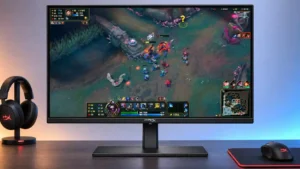
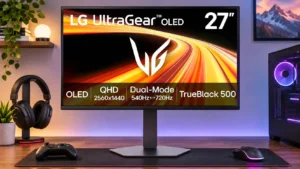
HyperX OMEN OLED 27q
Where It Has the Edge
- color accuracy is 4.8 vs 3.5. Factory color calibration wins especially high praise, with natural-looking hues and unusually strong out-of-box results.

Scorata scores summarize analyzed review evidence on a 1–5 scale; they are not laboratory measurements or a simple average of customer star ratings. Feature scores summarize the reviews covering that feature. The overall score averages feature scores within each review, then combines review averages. When both expert and customer evidence are available, those two groups receive equal weight. Products can have different review coverage, so small score gaps do not establish a winner.
Recommendations prioritize important features for the category, with a score of at least 3.5, a gap of at least 0.25 points and at least two supporting reviews per product. Features with widely varying scores or broad connectivity contexts are excluded from recommendations. These safeguards do not establish statistical significance.
Quick verdict
The review evidence points to a tradeoff: color accuracy versus brightness and Stand stability. Choose according to which strengths matter more to you; the overall score alone does not settle that choice.
Choose HyperX OMEN OLED 27q for color accuracy.
Choose LG 27GX790B-B for brightness and Stand stability.
Scores are out of 5. Missing scores mean missing review evidence, not a missing feature.
The basic software and straightforward menus make common adjustments approachable without a steep learning curve.
Controls and setup are broadly intuitive, with convenient adjustment once the menu layout is familiar.
The internal power supply removes the bulky external brick that often clutters a gaming desk.
An external adapter adds another object to manage on or beneath the desk.
There is no USB hub, so peripherals need to connect to a PC or a separate dock instead.
The built-in USB ports add convenience for peripherals alongside the display inputs.
Avoiding a separate power brick leaves a tidier set of cables behind the monitor.
Some testers miss an opening through the stand, although one found the included rear clip effective for bundling cables.
Long periods of static HUDs and interface elements remain a concern. The coverage discusses burn-in risk rather than proving a failure on the tested unit.
Screen savers and OLED cleaning features offer useful precautions, but short tests cannot guarantee long-term protection from static-image wear.
The stand generally feels sturdy but may wobble on a less-solid desk and can lean back awkwardly when placed close.
The weighted, flat metal base remains stable while the screen moves and can hold small desk items.
Two HDMI 2.1 inputs and DisplayPort cover typical display connections, but the absence of USB hub functions feels restrictive.
Two HDMI inputs, DisplayPort, USB-C, and USB-A provide welcome flexibility, although some would like another HDMI or easier physical access.
Reflections and bright windows can be a problem, although one demonstration finds the coating softens indoor light reflections effectively.
The matte surface is effective against ordinary reflections, although direct window glare can still overpower it.
Indoor lighting reflections are softened enough to keep the image looking clear in one hands-on demonstration.
The matte coating cuts reflections but looks less crisp and punchy than glossy rivals to some viewers; preferences are sharply divided.
QHD is a productive compromise for high-frame-rate gaming, but it cannot supply the fine detail of a 27-inch 4K panel.
Native 1440p looks good at 27 inches, but enabling 720Hz reduces the image to a very soft 720p; detail-focused buyers may want 4K.
1440p is less taxing than 4K, but taking full advantage of 240Hz in demanding AAA games can still require an extremely fast GPU.
Even expensive gaming systems often fall well short of 540–720 fps in modern games, restricting the benefit of the highest modes.
Height, rotation, and tilt adjustments provide good versatility, though limited forward tilt can make close viewing awkward.
Height, tilt, swivel, and portrait rotation make it easy to set a comfortable position.
The absence of RGB appeals to fans of understated desks but disappoints buyers seeking decorative lighting.
Rear RGB is customizable and subdued enough not to dominate the desk.
Deep shadows, vivid scenery, and smooth camera motion suit atmospheric adventures, racing, and RPGs very well.
Deep blacks, vivid colors, and bright HDR make cinematic games attractive, though glossy or higher-resolution alternatives may be more immersive for solo play.
Fine fonts can look fringed or slightly blurry because of the OLED subpixel layout, making close text work less appealing.
Experiences vary from crisp, perfectly usable fonts to visible fringing on dark text over light backgrounds, especially during prolonged office work.
Despite its budget positioning, the materials feel more substantial than a typical cheap gaming monitor.
Slim bezels and restrained styling give the display an upscale front appearance, even though much of its housing is plastic.
Games and movies generally look crisp at 1440p, while small text and fine details reveal the limitations versus 4K.
Native 1440p delivers crisp graphics, but the optional 720p mode produces conspicuous softness.
The display pairs well with gaming PCs, producing polished results from fast shooters to graphically rich adventures.
High-bandwidth ports, variable refresh, and spectacular motion make it well suited to fast gaming PCs that can push high frame rates.
The 240Hz panel gives gameplay responsive, fluid motion. Faster flagship OLEDs exist, but the speed is ample for most buyers.
Native 540Hz QHD feels extraordinarily fluid and crisp. The 720Hz option is less universally useful because it drops to 720p and demands extremely high frame rates.
Colors are generally vibrant, with wide gamut coverage useful for gaming and creation. One comparison finds them slightly less vivid than some other QD-OLED rivals.
The wide color gamut gives games vivid, rich color; color purity is a frequent highlight of the newer Tandem OLED panel.
Quick OLED response, 240Hz refresh, and compact 27-inch framing suit competitive shooters and esports exceptionally well.
Serious esports players get exceptionally clear motion and responsive control, especially in lightweight shooters that can run at hundreds of frames per second.
The included presets strike a reasonable balance between FPS/RPG settings and color-oriented creator profiles.
Genre presets and personalized adjustments make tuning easy; several modes look similar, and color fidelity varies between them.
Fast-moving scenes look exceptionally clear thanks to OLED pixel transitions. Racing, shooters, and even desktop scrolling benefit.
Fast-moving objects show remarkably little blur or trailing, helping target visibility and making rapid camera movement feel precise.
Most assessments recommend it as a rewarding, stripped-back OLED gaming monitor, with brightness and feature omissions being the clearest reservations.
A standout specialist for high-frame-rate PC gaming rather than a universally ideal monitor; image compromises and value depend heavily on how you play.
Dark scenes reveal rich, inky blacks that LCD monitors struggle to match, particularly in dim rooms.
OLED produces exceptionally deep blacks, making night scenes and highlights more convincing.
HDMI 2.1 and 1440p/120Hz capability make the monitor an appealing match for PlayStation and Xbox consoles.
A PS5 Pro worked well in hands-on play, with smooth motion and appealing OLED visuals.
A compact 27-inch display fits normal gaming desks more easily than super-ultrawide alternatives.
The base occupies a moderate amount of desk space, and its screen can sit farther forward than expected.
Rapid OLED response largely eliminates trails and smearing during sudden camera movement.
Very fast OLED response keeps trailing and smearing minimal in rapid action.
Rich, reasonably accurate colors make photo editing a realistic second use, though it is primarily a gaming display.
The colorful QHD panel can handle everyday photo edits, though color-critical work calls for carefully chosen presets.
Near-instant pixel response virtually removes smearing, making the display especially responsive in action-heavy play.
Near-instant OLED pixel transitions keep fast motion clear and avoid the smearing associated with slower panels.
Colors arrive impressively tuned, but the lack of manual gamma adjustment limits advanced calibration.
The extensive color menus and personalized picture mode allow meaningful adjustment when stock presets look too saturated.
Brightness is the most persistent weakness: adequate for many indoor desks but underpowered beside brighter OLED and mini-LED competitors.
The Tandem OLED reaches impressive HDR brightness for its class, although sustained brightness can fall and direct sunlight remains demanding.
HDR can still make colorful scenes impressive, but highlights lack the intensity of stronger HDR monitors. It is not the best choice for HDR enthusiasts.
Bright highlights and perfect blacks create striking HDR games; some evaluations note inaccurate overbrightening and the matte finish softening the visual pop.
Factory color calibration wins especially high praise, with natural-looking hues and unusually strong out-of-box results.
The sRGB mode improves on older LG models, but standard gaming modes can appear oversaturated; calibration may be worthwhile.
Adaptive sync works across the two major graphics ecosystems in direct testing, even though the monitor menu labels are somewhat confusing.
Smooth, tear-free play is reported in real-world testing, though there are some cautions about flicker with variable refresh.
Physical controls and menus are easy to navigate, so brightness and input changes require little effort.
A compact joystick and straightforward menus make settings easy to find and change.
Self-lit OLED pixels create striking separation between bright objects and deep shadows, especially in atmospheric games.
Excellent OLED contrast keeps dark areas black while bright highlights pop, especially in atmospheric games.
DisplayPort can carry the full 240Hz refresh rate, so PC gamers are not confined to HDMI.
DisplayPort 2.1 is a useful match for powerful PCs trying to get the most from the panel’s demanding refresh rates.
Deep blacks, saturated colors, and remarkably sharp motion make games visually engaging. Limited peak luminance prevents it from leading the OLED field.
Rich OLED colors, superb contrast, and sharp native QHD images make games look excellent. Some testers dislike the matte finish and uneven gray-screen texture.
Rigid construction and a solid metal stand help the hardware feel reassuringly well made.
The flat metal stand adds substance, but the main chassis is ordinary plastic and not especially premium for the price.
Styling is restrained and desk-friendly rather than flashy. Some like the professional look, while others find it a little dull.
The minimalist silver-and-black design fits both gaming rooms and workspaces, with subdued rear lighting rather than excessive decoration.
The 27-inch format is regarded as a gaming sweet spot: large enough for detail yet compact enough for esports.
The compact, thin-bezel 27-inch form fits common desktop setups without demanding an oversized desk.
It delivers genuinely impressive OLED color and speed at a relatively approachable price. The value is strongest when discounted, though budget LCDs remain much cheaper.
At a steep discount, its 540Hz OLED performance compares favorably with pricier rivals; at full price, many gamers can spend far less without giving up much.
High-bandwidth HDMI 2.1 is a practical strength for supported PCs and 1440p/120Hz console gaming, and gives it an edge over some cheaper rivals.
High-bandwidth HDMI ports support current gaming devices and offer flexibility alongside DisplayPort.
Assembly is straightforward, with a simple stand connection and no tools needed in one hands-on setup.
Tool-light assembly and straightforward stand attachment make initial setup simple.
The traditional widescreen format works well for competitive games, though it offers less lateral immersion than ultrawide screens.
Self-emissive pixels eliminate the visible backlight glow associated with conventional LCD panels.
Bright objects remain crisp against darkness without the glowing halos associated with backlit displays.
No internal speakers are included; external speakers or a headset are necessary for sound.
PC and current-console use are both appealing, especially when an HDMI 2.1 input is available for 1440p high-refresh play.
Switching between 540Hz QHD and 720Hz HD creates choice, but several testers found the softer 720p image too costly for the modest speed benefit.
The tested firmware could not be updated, leaving fewer options for future feature or compatibility fixes.
The basics are present, including gaming aids and adaptive sync, but extensive customization and additional hardware conveniences are limited.
A speedrun and countdown timer are handy extras for players who measure attempts or challenge completion times.
Audio presets through the headset jack sound pleasing, with choices for different listening needs.
Fast responses and negligible perceived delay help games feel connected and snappy, including when frame rates are below the monitor’s peak.
The newer Tandem OLED architecture delivers unusually bright, vibrant imagery while retaining fast OLED response.
The lighter plastic chassis makes moving or mounting the monitor easier.
It wakes or powers on promptly in hands-on use.
Good QHD clarity and easy setup suit general work for some users, but OLED text artifacts are noticeable for others.
Findings differ: one tester saw mostly even color and brightness, while another sample had conspicuous gray-screen texture.
HDR operation is straightforward but starkly limited to on or off, without much scope to tune the image.
The USB-C port supplies only 5W, far too little to charge most laptops adequately.
The rear-facing connectors are handy for some setups but require turning the display around in others.
Arm mounting offers a practical way around desk wobble or an awkward stand angle.
Colors hold up well when viewed from the side, making the picture less sensitive to seated position.
FreeSync and G-SYNC support generally work well, though one embedded user comment reports G-SYNC trouble over HDMI.
Flicker is a concern in variable-refresh use, though an OLED flicker mitigation control can help in some scenarios.
Peak luminance can reduce after sustained output, making short highlights more impressive than prolonged bright scenes.
Switching between refresh profiles worked smoothly in one test, but automatic switching between devices was less dependable.
An optional smaller-screen competitive view is available, but its practical value is limited for players who prefer the full QHD image.
Headphone processing and sound presets are well liked in one hands-on assessment.
Factory gamma lands very close to its intended target, preserving natural content brightness without extra calibration.
HDR offers almost no manual adjustment; shoppers wanting fine control over HDR brightness will be disappointed.
HDR can render scenes brighter than intended, so the panel’s luminous highlights do not always translate into the most accurate presentation.
The companion software makes existing controls easy to reach, but it does not add the advanced features found on more elaborate monitors.
OMEN Gaming Hub is attractive and easy to navigate, although the monitor offers relatively little to customize.
There is confidence in the HP name, but no sustained durability test establishing how well this panel ages.
A two-year OLED warranty looks weak beside some competitors offering three years or more.

This 360Hz QD-OLED ultrawide delivers exceptional gaming motion, vibrant HDR and dramatically cleaner text. Its high price, less-than-perfect bright-room blacks and occasional HDR dimming are the main reasons to hesitate.
Pros: color gamut, contrast
Cons: value for money, Resolution

Lightning-fast 360Hz OLED gaming, rich color and an unusually flexible USB-C/KVM setup are the big draws. Strong room lighting, limited full-screen HDR brightness and static-content burn-in concerns keep it from...
Pros: color gamut, overall satisfaction
Cons: reflection handling, VRR flicker

The 27-inch 4K OLED picture is exceptionally crisp and responsive, with useful USB-C and KVM extras. Its high price, oversized stand, and bright-room compromises limit its appeal.
Pros: sharpness, overall satisfaction
Cons: value for money, VRR flicker

Best for exceptional 4K HDR, accurate color, fast 240Hz gaming, and strong work connectivity. Skip it if you need built-in speakers, ultrawide immersion, television-level HDR brightness, or a budget-friendly upgrade.
Pros: brightness, reflection handling
Cons: cable management