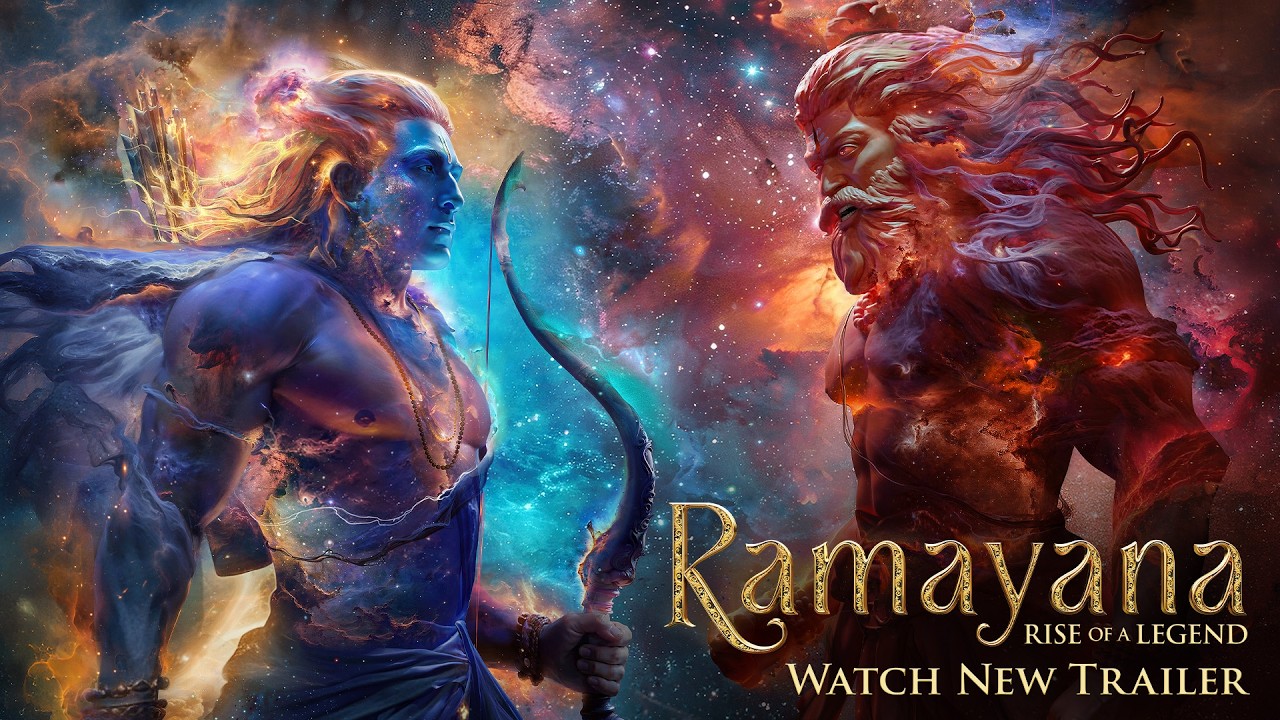
Large-scale fantasy combat includes frightening giant demons, violent conquest, abduction and a fatal battle involving a bird-like character. Intense peril and emotionally distressing deaths make this better suited to teens.
Official ratingPG-13
Bottom Line
Majestic music, colossal battles and a magnetic Ravana give this epic its strongest appeal. Thin characterization, uneven effects and a divisive AI-assisted English version make it a less dependable choice for emotional depth or a complete story.
Fantasy and action-adventure fans seeking colossal spectacle, especially on a large screen. It can also reward viewers curious about Indian culture who are willing to follow a dense, unfinished mythic story.
Viewers seeking a complete, resolved story should expect frustration at the part-one cutoff. Newcomers who struggle with dense exposition may also find the introduction demanding.
Verdict
Ramayana offers an enormous mythic canvas, a frequently admired score and a villain whose charisma often eclipses the hero. Its most enthusiastic viewers describe immersive battles, vivid world building and moving devotion, making a large-screen viewing especially appealing. The response is sharply divided, however: other assessments find rubbery CGI, frantic editing and idealized leads without enough emotional depth. The English version adds another major variable, with AI lip matching praised as seamless by some and criticized as uncanny by others. The original Hindi presentation is explicitly preferred in several assessments. This is also an opening chapter rather than a resolved adventure, so the strongest recommendation is for fantasy viewers willing to embrace spectacle and wait for the story’s continuation.
The battles offer colossal, imaginative highlights that thrill admirers. Negative assessments find them weightless or overedited, though even a mixed response singles out the late aerial clash.
Ravana is the most consistently admired character, combining menace, charisma and internal conflict. His magnetic presence often makes the villain more involving than the ostensibly heroic lead.
The orchestral and Indian musical elements are widely praised for adding majesty, emotion and force to the battles. One mixed assessment finds that even booming compositions cannot give poorly paced scenes their missing rhythm.
entertainment value: 4.0, 9 reviews, low consensus
Enjoyment ranges from a thrilling, immersive ride to an exhausting spectacle. Admirers are swept along by the action, while detractors find the experience hollow or tiring.
Kapoor’s calm, restrained Rama draws both exceptional praise and strong criticism. Admirers see majesty and grace; detractors find solemnity without enough emotional life.
The mythic journey can feel rousing and engrossing, particularly in its strongest early passages. Dense setup, weaker later momentum and limited individual perspective prevent a consistent endorsement.
CGI is one of the most divisive elements: some see world-class spectacle, while others describe rubbery creatures, weightless battles and dated game-like imagery. Several positive responses still identify isolated weak effects.
Pacing is a persistent point of disagreement: one viewer finds the long English cut flies by, while many others describe prolonged setup, rushed climaxes or stretches that drag.
The AI lip matching in the English version inspires unusually polarized reactions. Some praise seamless immersion, while others find the altered mouths distracting, uncanny or emotionally sterile.
Exile, devotion and the late bird battle move some viewers deeply. Others find the same major events emotionally thin because the characters have too little quiet time to develop.
The English version preserves the experience for some viewers and receives praise for its synchronization. Others prefer subtitles because clunky dialogue and digitally altered mouths weaken the performances and drama.
character development: 2.3, 7 reviews, low consensus
Ravana’s conflicting motives provide the richest characterization. The leads are often judged too idealized or underdeveloped to make their turning points fully involving.
The strongest recommendations favor the largest available screen, where battles, color and scale can feel immersive. The film’s spectacle is repeatedly cited as a reason for a theatrical visit.
Fantasy enthusiasts have strong endorsements for the film’s gods, monsters and enormous spectacle. Its mythic adventure is repeatedly positioned alongside familiar screen epics.
The original Hindi presentation is explicitly preferred by viewers dissatisfied with the English version’s AI-assisted lip matching. Subtitles are regarded as a worthwhile tradeoff for a more natural experience.
Viewers wanting a complete, resolved story are poorly served by the stopping point. The central confrontation is deferred, leaving much of this film feeling like groundwork.
Yash is repeatedly singled out for a magnetic, menacing and charismatic Ravana. His swagger and inner conflict make the villain the most compelling presence for many viewers.
Zimmer’s collaborative score is repeatedly praised for majestic scale and emotional lift. One mixed response finds that its booming force cannot compensate for scenes without a rhythm of their own.
Kapoor’s restrained Rama divides opinion between sublime, dignified calm and dramatically dull solemnity. His action work and majestic presence fare better than the emotional depth available to him.
Pallavi is praised for natural grace, dignity and capable action work. More qualified reactions find hints of a stronger character without enough depth to make Sita fully human.
Rahman’s collaborative music earns praise for giving the epic grandeur and elevating both battles and emotional scenes. A dissenting assessment finds the compositions let down by the scenes they accompany.
Malhotra’s production contribution is praised for bringing extraordinary visual ambition to the screen. Admirers credit his effects studio with driving the film’s spectacle.
Compared with other Movies, this product is above average in Gender and sexism portrayal, villain quality, cultural representation, near average in entertainment value, Religious messaging, below average in lighting quality, Vocal characterization, editing quality.
Comparison summary
57 compared features
Above average0.4+ pts higher
15(26%)
Same as averagewithin 0.3 pts
19(33%)
Below average0.4+ pts lower
23(40%)
Largest category differences
Attribute
This product
Category average
Difference
lighting quality
1.5
3.8
-2.3
Vocal characterization
2.0
4.2
-2.2
editing quality
1.3
3.5
-2.2
creature design
2.2
4.3
-2.1
narrative repetition
1.5
3.6
-2.1
Gender and sexism portrayal
4.5
2.6
+1.9
villain quality
4.8
3.2
+1.6
dialogue quality
1.5
3.1
-1.6
Consider This Instead
If you want better ending satisfaction
Choose Tenzing. It scores 4.8 vs 2.1 for ending satisfaction, with a 4.0 overall score.
Similar: Fight spectacleThe epic fight scenes evoke a scene in the other mythic epic.
Compared: Effects craft and cultural perspectiveThe reviewer admires these effects-heavy films and especially values seeing comparable craft applied to Indian culture.
Similar: Epic storytelling and craftIts epic qualities are compared favorably with Nolan’s film.
The Lord of the Rings
Similar: Fantasy-epic appealFans of these fantasy epics are told to expect similar enjoyable qualities.
Better: Character depthThe fantasy trilogy is judged more emotionally engaging because of its character depth.
Similar: Epic storytelling and craftThe film’s acting, spectacle and music are likened to Tolkien’s screen epics.
Game of Thrones (2011)
Similar: Fantasy-epic appealFans of these fantasy epics are told to expect similar enjoyable qualities.
Similar: CGI and battlesThe battle and creature effects are considered comparable to the television fantasy.
Compared: Narrative spaceA television adaptation on this scale is proposed as a way to give the crowded story room.
FAQ
Is this a complete story?
No. It is the opening half of a larger story and stops before the central conflict is resolved.
Should I watch it on a big screen?
The theatrical recommendations are strong, with scale, battles and visual immersion repeatedly cited as reasons to seek a large screen.
Is the English version recommended?
Opinions are sharply divided. Some viewers find its lip matching seamless, while others find the AI-altered mouths distracting and prefer the original Hindi presentation.
Do I need to know the Ramayana first?
Not necessarily: several newcomers find the story accessible and engrossing. Others encounter a steep learning curve because of the dense world building and exposition.
What stands out most?
The vast scale, the collaborative score and Yash’s charismatic Ravana receive repeated praise. The effects and emotional depth are much more divisive.
Is 3D worthwhile?
Several viewers strongly recommend it for the spectacle. One enjoys the effect but reports a headache and finds the movie still works without it.
Is it suitable for younger children?
Frightening demons, intense fantasy combat, abduction and fatal peril make teens a more appropriate general audience. The verified U.S. rating is PG-13.
Sample Expert Reviews We Analyzed
These are a few of the reviews included in our analysis.
Choose this inventive, unsettling documentary for fearless questioning, dark humor, and unpredictable storytelling. Skip it if you want a short, straightforward exposé with definitive answers.
Extraordinary performances and richly observed relationships make this a rewarding, emotionally forceful drama. Its nearly three-hour length and slow opening demand patience and undivided attention.
Best for a hypnotic, bookish mystery with tactile visuals and cerebral chills. Skip it if reading-heavy, attention-demanding storytelling sounds more exhausting than exciting.
Best for an intimate, searching documentary that rewards focused attention and invites discussion. Skip it when devastating grief, addiction footage, and unresolved family tensions would be too much.