If you want better battery life
Choose OnePlus Watch 3. It scores 4.7 vs 4.3 for battery life, with a 4.0 overall score.

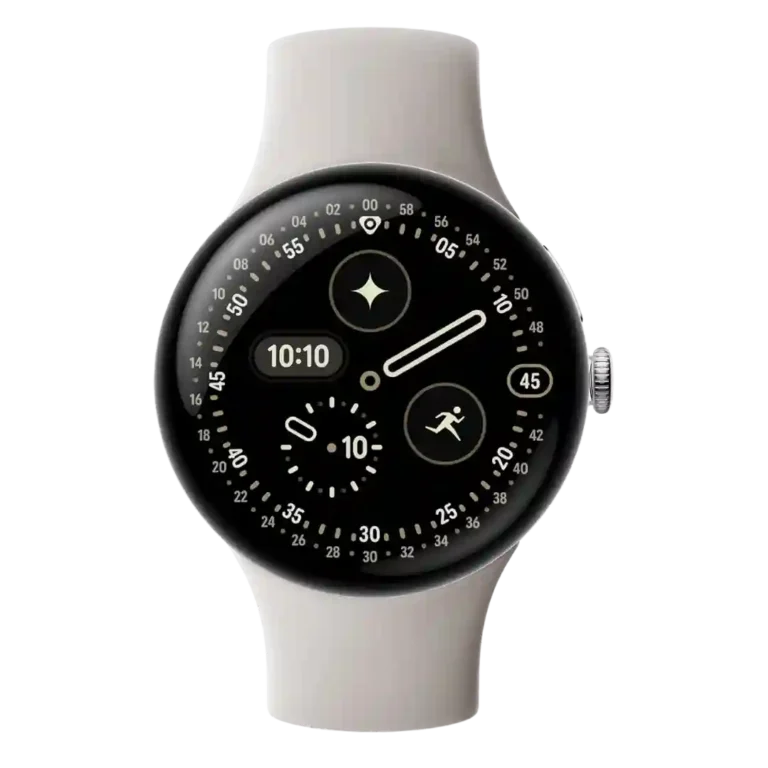
Choose the Pixel Watch 4 for a polished Android watch with a standout display, fast charging, Fitbit insights, and Gemini. Skip it if you need rugged durability, iPhone support, no paywalls, or multi-day endurance beyond typical smartwatch use.
Best for Android users who want a polished everyday smartwatch with a distinctive bright display, strong Fitbit health tracking, fast charging, useful Gemini access, and safety features such as satellite SOS.
Not for iPhone users, rugged-watch shoppers, people who dislike Fitbit Premium, or athletes who need deep sport routing, long endurance battery life, and highly customizable workout data pages.
The Pixel Watch 4 lands as Google’s most complete wearable because reviewers repeatedly praised its domed Actua 360 display, smoother Wear OS 6 interface, quick charging dock, and improved Fitbit-backed tracking. The tradeoff is that refinement matters more here than reinvention: battery life is much better for many reviewers but still not class-leading against endurance-focused rivals, and advanced Fitbit guidance can run into Premium limits. Sports accuracy was often strong, especially heart rate and improved GPS, yet one in-depth review found GPS bugs in specific cycling/walking scenarios. Gemini and Raise to Talk made the watch feel smarter, but false triggers and limited Fitbit integration kept it imperfect.
Compared with other Smartwatches, this product is above average in LTE connectivity, ECG functionality, contactless payments, near average in outdoor visibility, safety features, below average in stress tracking, band quality, watch face quality.
| Attribute | This product | Category average | Difference |
|---|---|---|---|
| LTE connectivity | 4.5 | 2.4 | +2.1 |
| ECG functionality | 4.5 | 2.6 | +1.9 |
| contactless payments | 4.5 | 2.8 | +1.7 |
| stress tracking | 2.0 | 3.5 | -1.5 |
| band quality | 2.4 | 3.9 | -1.5 |
| charging convenience | 4.6 | 3.3 | +1.3 |
| size options | 4.5 | 3.1 | +1.4 |
| watch face quality | 2.5 | 3.8 | -1.3 |
Choose OnePlus Watch 3. It scores 4.7 vs 4.3 for battery life, with a 4.0 overall score.
Choose Apple Watch Ultra 2. It scores 4.8 vs 2.5 for music controls, with a 3.9 overall score.
Choose Garmin Vivoactive 6. It scores 4.7 vs 3.3 for pairing reliability, with a 3.9 overall score.
Choose Garmin Forerunner 265. It scores 4.8 vs 3.3 for customization options, with a 4.0 overall score.
Products reviewers directly compared with this model, grouped into quick takeaways.
Yes. Reviewers repeatedly described it as one of the best Wear OS or Android smartwatch options thanks to its display, software polish, Fitbit integration, and Gemini features.
Most reviewers saw a meaningful improvement, often around 1.5 to two days or more on the 45mm model. Heavy GPS use or the smaller 41mm model reduced that confidence.
Yes. The side-mounted dock was widely praised for fast top-ups and better reliability, though a few reviewers disliked another charger change or wanted a heavier dock.
Heart-rate accuracy was usually strong and often close to chest straps or rival watches. GPS was much improved, but one in-depth reviewer found a serious bug in certain cycling and walking scenarios.
Generally yes. Reviewers liked Raise to Talk and hands-free commands, but several noted false activations, online dependence, or limited integration with Fitbit data.
Very much. The domed Actua 360 display, smaller bezels, and high brightness were among the most consistently praised upgrades across the reviews.
The main drawbacks were Fitbit Premium limits, durability concerns around exposed Gorilla Glass, proprietary or dull bands, notification quirks, and incomplete advanced sport navigation.
These are a few of the reviews included in our analysis.

If you're on the fence between the Pixel Watch 5 and Pixel Watch 4, let us make the decision easier.
Google's latest smartwatch costs the same as the previous generation for now, but the upgrade could be worth it for a certain user.

Best for long battery life, accurate GPS and useful offline maps at a strong price. Skip it if you need payments, richer apps, a built-in LED flashlight or polished smartwatch...
Pros: mapping and navigation, value for money
Cons: smartwatch features, contactless payments

Best for accurate run tracking, deep Garmin coaching and phone-free Spotify in a light package. Skip it if you need full maps, triathlon mode, Apple Music support or the strongest...
Pros: value for money, GPS accuracy
Cons: mapping and navigation, third-party app support

Good if you want premium running features, long battery life, and maps for under $200. Skip it if you need flawless heart-rate data, multiband GPS, LTE, or richer app support.
Pros: value for money, battery life
Cons: heart rate accuracy, third-party app support

Best for accurate running metrics, excellent coaching tools, a bright AMOLED display, and dependable battery life. Skip it if you need offline maps, music storage, contactless payments, multi-band GPS, or...
Pros: battery life, value for money
Cons: mapping and navigation, smartwatch features