Scorata scores summarize analyzed review evidence on a 1–5 scale; they are not laboratory measurements or a simple average of customer star ratings. Feature scores summarize the reviews covering that feature. The overall score averages feature scores within each review, then combines review averages. When both expert and customer evidence are available, those two groups receive equal weight. Products can have different review coverage, so small score gaps do not establish a winner.
Recommendations prioritize important features for the category, with a score of at least 3.5, a gap of at least 0.25 points and at least two supporting reviews per product. Features with widely varying scores or broad connectivity contexts are excluded from recommendations. These safeguards do not establish statistical significance.
Quick verdict
What each product is best for
The review evidence points to a tradeoff: sleep and wake behavior and color gamut versus screen size and cable management. Choose according to which strengths matter more to you; the overall score alone does not settle that choice.
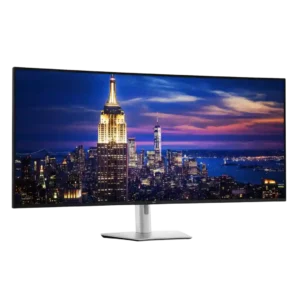
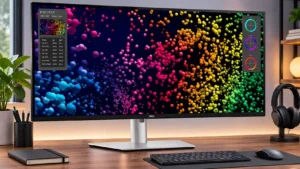
Choose Dell UltraSharp 52 Thunderbolt Hub Monitor, U5226KW for sleep and wake behavior and color gamut.
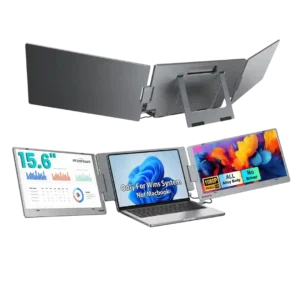
Choose KYY X90E for screen size and cable management.
sleep and wake behavior is 5.0 vs 1.0. Sleep mode drops power use to only a few watts, while Power Sync can start a closed-lid compatible...
color gamut is 4.8 vs 2.8. The display covers essentially all sRGB and nearly all DCI-P3, producing vivid color suitable for editing, design, and...
overall picture quality is 4.7 vs 4.3. The SDR picture is widely praised as sharp, colorful, accurate, and unusually strong for professional work. Weak HDR...
KYY X90E
Where It Has the Edge
screen size is 5.0 vs 3.9. The dual 15.6-inch panels are a major attraction for buyers who want more workspace. Customers especially appreciate the...
cable management is 5.0 vs 4.4. The single-cable USB-C setup is one of the X90E’s clearest wins. Reviewers repeatedly praise the cleaner desk, fewer...
viewing angles is 4.8 vs 4.2. Viewing angles are consistently strong. IPS panel behavior keeps colors stable from the side, which reviewers say works...
Sleep mode drops power use to only a few watts, while Power Sync can start a closed-lid compatible laptop from the monitor's power button. Both behaviors were viewed as convenient and efficient.
KYY X90E
1.0
Power-state behavior is a serious concern in the small amount of feedback available. Two customers report unwanted shutoffs, power loss, or entry into power-saving mode during use.
Console support is compromised by unusual aspect ratios and inconsistent resolution or refresh options. Some consoles may stretch the image or fail to recognize available 4K modes correctly.
KYY X90E
5.0
Console gaming gets one enthusiastic customer endorsement. That user reports successful PS5 use and says Call of Duty looked excellent on the screens.
Connectivity is exceptionally comprehensive, with Thunderbolt 4, dual HDMI, dual DisplayPort, numerous USB-A and USB-C ports, Ethernet, and easy-access front connections. It functions as a true connectivity powerhouse.
KYY X90E
2.5
Port selection is restrictive. The expert review notes that the two USB-C ports are effectively split between connection and power, limiting multi-device use and leaving no HDMI input.
The 120Hz refresh rate is one of the most celebrated upgrades over typical 60Hz office monitors, making scrolling, cursor movement, and window handling feel noticeably smoother. It also supports enjoyable casual gaming, though gaming specialists may want 240Hz.
KYY X90E
2.5
The 60Hz refresh rate is acceptable for productivity but a clear limitation for gaming. The one direct evaluation calls it a little unfortunate.
The display covers essentially all sRGB and nearly all DCI-P3, producing vivid color suitable for editing, design, and mixed professional use. Adobe RGB coverage is broad but not class-leading for specialized print workflows.
KYY X90E
2.8
Color gamut is adequate for normal office work but limited for demanding creative use. Expert testing and commentary both point to coverage that falls short of professional photo or video needs.
IPS Black is widely viewed as the right panel technology for long professional sessions, combining dependable color and brightness with better contrast than ordinary IPS. It does not match OLED for deep blacks or instantaneous motion.
KYY X90E
3.0
The inexpensive IPS panels are considered serviceable for productivity, but they do not match OLED or MicroLED for contrast and color performance. The panel choice is practical rather than premium.
Uniformity varies by sample and measurement method. Several units were reasonably consistent for such a huge panel, while one showed a pronounced brightness difference and others had weaker corners.
KYY X90E
2.0
Luminance uniformity is a weak point. The expert test found noticeably darker corners, making the backlighting less even than the rest of the picture-quality results.
The tall ultrawide shape preserves more vertical room than super-ultrawides, which editors and multitaskers value. Some users still prefer standard 16:9 or wider 32:9 layouts, and the extreme width can feel awkward in certain apps.
KYY X90E
2.5
Aspect-ratio control has one mixed customer assessment. The adjustment is said to need work, though the reviewer also says it can be worked around.
The dual 9W speakers are louder and fuller than many monitor speakers and work well for meetings or temporary setups. Opinions split sharply for entertainment, with some users satisfied and others recommending even basic external speakers.
KYY X90E
2.8
Speaker feedback is weak overall. One customer says the built-in audio is barely worth having, while another only notes that sound is somewhat louder than an older version.
One-cable operation and stand routing can make a complex workstation much cleaner than a multi-monitor setup. The huge number of possible connections can still create visible clutter, and the stand does not fully conceal wiring.
KYY X90E
5.0
The single-cable USB-C setup is one of the X90E’s clearest wins. Reviewers repeatedly praise the cleaner desk, fewer adapters, and ability to run both extra screens from one connection.
Viewing angles are generally strong, with limited color or contrast loss from the side. The mild curve can leave the far edges less comfortable, but off-axis image quality usually holds up well.
KYY X90E
4.8
Viewing angles are consistently strong. IPS panel behavior keeps colors stable from the side, which reviewers say works well for collaboration and shared viewing.
Overall satisfaction is very high for productivity-focused users, and the screen often becomes a preferred daily work monitor. It fares worse when desk space, scaling preferences, workflow, or budget do not suit such an extreme single display.
KYY X90E
4.3
Overall satisfaction is strongly positive, with many customers calling the X90E a game changer, a great travel tool, or an easy recommendation. The minority of negative reviews center on incompatibility, instability, dimness, or defective units.
Text, UI elements, photos, and timelines look crisp at normal working distance, including at 100% scaling. Users coming from Retina-class or smaller 5K screens can still see the lower pixel density.
KYY X90E
5.0
Sharpness is a standout in the customer feedback that addresses it directly. Reviewers call the screens super sharp and the images super crisp.
The 6144×2560 canvas fits enormous amounts of work while keeping text usable. At 129 PPI, it is less dense than smaller 4K or 5K displays and can look softer at close range.
KYY X90E
4.6
The 1080p resolution is generally judged well matched to the 15.6-inch panels. Reviewers repeatedly describe text and images as crisp, with several saying the resolution is more than adequate for everyday work.
Competitive gamers should look elsewhere because response time, ghosting, 120Hz ceiling, and missing gaming features trail dedicated OLED and high-refresh models. The monitor is designed for work first and occasional play second.
KYY X90E
2.3
Competitive gaming is not a strong fit. Reviewers point to the 60Hz refresh rate and explicitly frame the screens as productivity displays rather than gaming-focused panels.
Height, tilt, swivel, and slight slant adjustments are generally smooth and useful for positioning the enormous panel. The range is limited by size, there is no pivot, and one tested stand would not keep the screen perfectly level.
KYY X90E
3.9
The kickstand and screen articulation are usually praised for flexible positioning, rotation, and stable desk use. Still, several customers report fit or stability issues, including a low working height, loose-feeling support, or limited recline.
Its sheer scale, refined construction, sharp 6K canvas, and integrated workstation features make it feel like a flagship command center. The experience is luxurious, spectacular, and distinctly unlike an ordinary monitor.
KYY X90E
4.9
The X90E generally feels more premium than its price suggests. Metal construction, a tactile frame, and the overall high-tech presentation are repeatedly praised.
The matte anti-glare surface usually keeps overhead lights and windows under control without heavily softening the image. A lighter coating and shallow curve can still leave distracting reflections at certain angles.
KYY X90E
4.3
The matte surface handles reflections well. Reviewers say it helps with bright environments and cuts distracting reflections, even though brightness itself can still be insufficient outdoors.
Productivity is the overwhelming consensus strength: one seamless 6K canvas can replace multiple displays, reduce window switching, and keep dense workflows visible at once. It is especially effective for trading, coding, research, editing, analytics, and multi-system work.
KYY X90E
4.8
Productivity is the X90E’s strongest use case. Reviewers repeatedly say the extra screens make spreadsheets, documents, coding, meetings, presentations, and travel work much easier by reducing constant window switching.
The oversized packaging is extremely protective, with structured compartments and ample cushioning intended to prevent shipping damage. The box itself is enormous, but the protection was praised.
KYY X90E
5.0
Delivery presentation is positively described in the one direct customer report. The unit arrived in a premium-looking box and was considered very well packaged.
Daily operation over weeks or months remained stable without notable bugs. The solid construction and Dell's professional-monitor track record also inspire confidence.
KYY X90E
2.9
Long-term reliability is the most uneven area. Some owners expect years of use or report dependable travel performance, while others describe screens that shut off, lose power, fail to work, or arrive effectively unusable.
The roughly $2,900 price is the most repeated objection and is difficult to justify for ordinary users or gaming alone. Professionals who can replace several displays, a dock, and a high-end KVM may find the integrated package reasonable.
KYY X90E
4.4
Value is widely praised, especially for getting two extra screens and a stand in one package at a comparatively modest price. A few negative experiences with brightness, stability, or outright failure make the value less convincing for those buyers.
Connections and software setup are usually quick, but physically unboxing and positioning the 52-inch panel is inconsistent: some managed alone, while others struggled or strongly recommend two people. Arm mounting requires particular care and suitably heavy-duty hardware.
KYY X90E
4.8
Setup is overwhelmingly described as quick and simple, often just plugging in one USB-C cable and extending the displays in Windows. The main exception is a defective-unit complaint that turned setup into hours of frustration.
Dell's three-year premium-panel and advanced-exchange coverage reassures buyers spending nearly $3,000. Rapid replacement promises and stronger support expectations than some competitors add meaningful peace of mind.
KYY X90E
4.0
Support feedback is mostly positive, with several customers praising quick, responsive, helpful service. One defective-unit buyer reports the opposite experience and criticizes the lack of live support.
Dell's joystick-driven OSD is fast, intuitive, and packed with useful controls, shortcuts, diagnostics, and partition options. Minor complaints include physical reach around the giant panel, loud clicks, and a fixed menu position.
KYY X90E
3.0
The per-screen controls are useful, but usability is mixed. One expert calls the button-driven OSD painful and dated, while a customer likes being able to adjust each screen independently.
Brightness is comfortable for most offices and home studios, generally landing in the mid-300-nit range. It can struggle in very bright rooms, and the automatic adjustment may feel too aggressive.
KYY X90E
4.1
Brightness is usually considered sufficient indoors and several customers call the screens bright, but outdoor performance is less convincing. One reviewer specifically found the display too dull for daylight use.
The SDR picture is widely praised as sharp, colorful, accurate, and unusually strong for professional work. Weak HDR capability, IPS glow, sample uniformity variation, and lower perceived contrast than glossy or OLED screens are the main caveats.
KYY X90E
4.3
Most reviewers find the screens clear, crisp, and pleasant for everyday work, with several strong customer endorsements of picture quality. Expert testing is more measured, especially for professional color work, and a small number of customers report display failures.
IPS Black delivers strong contrast for an IPS display, giving darker interfaces and mixed content more depth. Dark-room use still reveals IPS glow, and OLED or mini-LED alternatives remain more dramatic.
KYY X90E
4.0
Contrast is described as decent rather than exceptional. The expert review finds it usable for the class but clearly behind higher-end OLED or MicroLED displays.
Color accuracy is a major strength, with professional modes and factory calibration earning frequent praise. Default or wide-gamut settings may need adjustment for strict sRGB work, but calibrated modes perform very well.
KYY X90E
4.6
Color reproduction is generally liked, with reviewers describing rich, vibrant colors and one expert calling the included colors very accurate. That strength does not fully offset the narrower overall gamut.
Dual DisplayPort 1.4 inputs are especially useful for desktops, Linux systems, and full-resolution 6K operation. DisplayPort proved reliable across a wide range of graphics hardware.
KYY X90E
5.0
The ALT-DP USB-C connection is a strong part of the design because it can carry video to both screens through one cable. The catch is that the host device needs a compatible video-capable USB-C or Thunderbolt port.
The 52-inch panel can replace several monitors and feels transformative once users adapt. Its four-foot width, weight, and viewing-distance demands make a large, deep desk essential.
KYY X90E
5.0
The dual 15.6-inch panels are a major attraction for buyers who want more workspace. Customers especially appreciate the larger viewing area for documents and multitasking.
The restrained silver-and-black design, slim bezels, and clean rear styling receive near-universal praise. It looks professional and premium without the aggressive styling common to gaming displays.
KYY X90E
4.5
The design is generally well received, from the subtle gunmetal finish to the foldable, adjustable form. Reviewers tend to see it as clean and polished rather than purely utilitarian.
Hardware low-blue-light filtering, flicker-free operation, and ambient sensing make long work sessions unusually comfortable without the yellow cast of software filters. Extended use caused little or no added eye strain.
KYY X90E
5.0
Eye comfort receives limited but very positive feedback. One reviewer specifically describes the screen as easy on the eyes and clean for reading while traveling.
The chassis feels rigid, substantial, and built like a professional tool rather than a flimsy oversized display. Long-term Dell users expect it to hold up well, though handling such a large panel always requires care.
KYY X90E
4.8
Build quality is a major strength, with repeated praise for the metal frame, sturdy kickstand hardware, robust hinges, and a generally durable feel. Several owners describe it as solid or even tank-like.
Dell Display and Peripheral Manager adds useful window layouts, firmware updates, profiles, KVM controls, and screen management. Mac support, daisy-chain expectations, and some KVM functions are less consistent than the strong Windows experience.
KYY X90E
3.8
Software and device compatibility is mixed. The main X90E expert reviews emphasize Windows and video-capable USB-C or Thunderbolt requirements, while some customers report seamless operation and others say the monitor would not work with their laptops.
One test system detected variable-refresh behavior even without clear official adaptive-sync certification. Compatibility appears workable but not guaranteed across every GPU or platform.
The monitor does not support HDR, a consistent drawback at this price. Its strong, accurate SDR image is still preferable to the weak pseudo-HDR often found on edge-lit IPS monitors.
The integrated KVM is a major advantage for multi-computer desks, especially when paired with picture-by-picture and Ethernet switching. Hardware and network switching can be excellent, but one detailed test found USB auto-KVM slow and buggy while network KVM worked flawlessly.
Picture-in-picture, picture-by-picture, and true screen partitioning are defining strengths, letting the panel behave like several displays or accept multiple systems at once. The many layouts are flexible, though certain Mac and console combinations have limitations.
Blacks look deeper and less gray than on standard IPS panels, helping dark interfaces and high-contrast work. They still lack the near-perfect depth of OLED, and matte coating can reduce perceived punch.
Because it uses IPS Black rather than OLED, static professional interfaces do not carry the same burn-in risk. That makes it especially attractive for dashboards, spreadsheets, and other all-day fixed content.
The gentle curve usually keeps the giant screen comfortable without visibly warping office content. Its subtlety suits office work, though a deeper curve would pull in the edges, reduce reflections, and improve immersion.
Ghosting is a clear weakness, with motion tests showing substantially more smearing than Samsung mini-LED and LG OLED gaming displays. Fast mode does little to solve it.
Measured input latency was exceptionally low at roughly a few milliseconds, making interactions feel immediate despite the monitor's productivity focus.
Desktop motion looks fluid and comfortable at 120Hz, even when several inputs run at different refresh rates. The panel handles scrolling and everyday animation far better than conventional office displays.
The fast overdrive setting is not recommended: it harms picture clarity without delivering a worthwhile gaming improvement. Normal mode is the safer choice.
PC gaming can look spectacular at this scale, and 120Hz keeps casual play smooth. The 6K load, slower response, absent gaming extras, and platform-specific quirks make it secondary to productivity rather than a true gaming-monitor replacement.
Portability gets unusually split feedback. Many owners say it folds neatly, fits a laptop bag, and travels well, while experts and several customers point out the roughly 2.1–2.2 kg weight and large footprint.
The 5–8ms response time is adequate for work and casual games but visibly slower than OLED and fast gaming panels. Switching from a 0.03ms display makes the extra blur immediately noticeable.
Large-scale strategy, simulation, and cinematic games can be deeply enjoyable on the 52-inch canvas. Dark-room contrast and slower motion keep it behind OLED alternatives for movie-like gaming.
Supported ultrawide games feel expansive and can eliminate side bars, making strategy, racing, and cinematic play impressive. Not every title handles the aspect ratio properly, and the shallow curve is less enveloping than gaming-first ultrawides.
The built-in Thunderbolt and USB hub is one of the monitor's greatest strengths, often replacing a separate dock. High-speed rear ports, front pop-out connections, charging, Ethernet, and laptop power make one-cable desks practical.
Multiple VESA patterns make heavy-duty arm or wall mounting feasible, and robust monitor arms can support it successfully. Buyers still need hardware rated for the panel's unusual size and weight.
VRR helps maintain smoother motion when frame rates vary and is a welcome addition to the 120Hz panel. Certification and behavior may still depend on the connected system.
The two HDMI 2.1 inputs add modern multi-device flexibility and worked well in tested PC setups. They are less dependable for consoles because of the screen's uncommon resolutions and proportions.
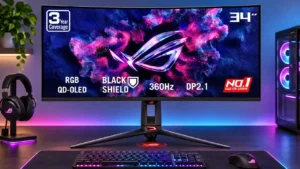
This 360Hz QD-OLED ultrawide delivers exceptional gaming motion, vibrant HDR and dramatically cleaner text. Its high price, less-than-perfect bright-room blacks and occasional HDR dimming are the main reasons to hesitate.
The 360Hz QD-OLED panel delivers exceptional HDR gaming, responsive motion, and cleaner text than earlier ultrawides. Its 3440×1440 resolution is less sharp than 4K, and premium pricing remains a hurdle.
A huge, sharp ultrawide workspace and unusually capable Thunderbolt dock make the U4025QW outstanding for demanding productivity and editing. Its high price, modest HDR, and imperfect motion handling keep it...
Lightning-fast 360Hz OLED gaming, rich color and an unusually flexible USB-C/KVM setup are the big draws. Strong room lighting, limited full-screen HDR brightness and static-content burn-in concerns keep it from...