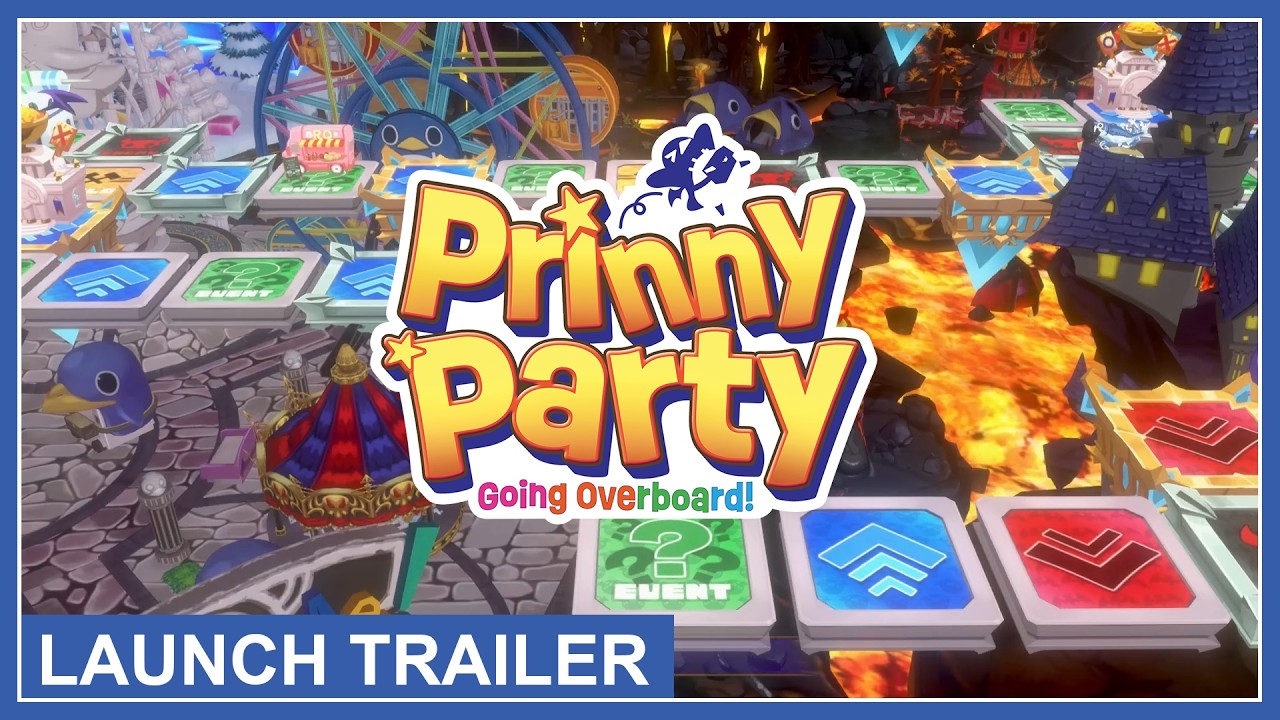
Prinny Party: Going Overboard! Review

Publisher: NIS America
Released: November 11, 2026
Updated: 8 minutes ago
3.3
Overall review score
228
Review insights
49
Scored features
16
Expert reviews
Content guidance
Scorata recommended age 10+

Cartoon fantasy combat includes repeated attacks, defeated enemies, explosive characters, and battles against powerful monsters. The tone is comical rather than realistically graphic.

Official rating E10+

Bottom Line

Throwing enemies, upgrading facilities, and outsmarting friends make this a delightful tactical party game. The single board, drawn-out matches, and rough solo experience make it harder to recommend beyond dedicated groups.

Disgaea fans who have nearby friends to play with and enjoy long, tactical party sessions will appreciate the inventive upgrades, throwing tricks, and competitive betrayals.

Solo players, online-only friend groups, and casual party-game fans seeking short matches or lots of minigames are likely to find the format limiting.

Verdict

Prinny Party: Going Overboard! turns Disgaea’s love of wild stat growth, throwable enemies, and bending the rules into an unusually strategic board-game contest. Its best moments come from building stronger shops, manipulating the Dark Assembly, and temporarily cooperating against bosses before stealing the win from a friend. Distinctive character classes make those encounters more interesting than the simple premise suggests. But the game asks for patience: the systems can be hard to learn, matches sometimes last hours, and the same board soon feels familiar. Computer opponents are often erratic, while solo defeats can be punishing. Conventional online multiplayer is missing, although Steam Remote Play Together and Switch 2 GameShare provide some alternatives. For Disgaea devotees with nearby friends and enough time, this can be memorable; for casual party players, the content and accessibility shortcomings are difficult to overlook.

Feature Scorecards

Summary

49 reviewed features
  • Very positive 4.5-5.0
    11 (22%)
  • Positive 3.5-4.4
    11 (22%)
  • Neutral 2.5-3.4
    7 (14%)
  • Negative 1.5-2.4
    18 (37%)
  • Very negative below 1.5
    2 (4%)

Pros highlights

  • 4.4
    12 reviews moderate consensus
    character ability integration: 4.4, 12 reviews, moderate consensus
    Melee specialists, long-range fighters, healers, and trap users feel meaningfully different. Their weaknesses encourage positioning and varied team tactics.
  • 4.0
    11 reviews low consensus
    fun factor: 4.0, 11 reviews, low consensus
    Absurd combat, surprise turnarounds, and opportunistic betrayal make it genuinely entertaining with the right group. The excitement fades faster for players stuck in repetitive or one-sided matches.
  • 4.9
    10 reviews strong consensus
    Throwing mechanics: 4.9, 10 reviews, strong consensus
    Throwing characters, enemies, and buildings is a standout mechanic, enabling clever repositioning, explosive Prinnies, and mischievous sabotage.
  • 4.8
    9 reviews strong consensus
    faithfulness to franchise: 4.8, 9 reviews, strong consensus
    Throwing, class abilities, stat grinding, the Dark Assembly, and familiar music make the spin-off feel authentically Disgaea despite the new format.
  • 4.8
    8 reviews strong consensus
    Facility building and stacking: 4.8, 8 reviews, strong consensus
    Building and stacking shops, hospitals, and cannons gives board construction both economic and tactical impact. More powerful facilities offer satisfying payoffs.
  • 4.7
    8 reviews strong consensus
    Dark Assembly mechanics: 4.7, 8 reviews, strong consensus
    Spending shared funds on bills, bonuses, and outrageous rule changes is a clever, suitably mischievous way to reshape an unfolding match.

Cons highlights

  • 1.7
    12 reviews strong consensus
    content variety: 1.7, 12 reviews, strong consensus
    The lone main board and limited modes are the most persistent frustrations. Different classes and random events add wrinkles, but they rarely make repeated sessions feel entirely fresh.
  • 2.1
    10 reviews moderate consensus
    solo play quality: 2.1, 10 reviews, moderate consensus
    Solo sessions are considerably less reliable than group play: harsh boss fights and AI behavior can force retries. A minority still enjoys experimenting alone with facilities and upgrades.
  • 1.9
    9 reviews strong consensus
    replay value: 1.9, 9 reviews, strong consensus
    Different classes and rule settings provide some incentive to return. The same board, recurring goal, and limited modes make long-term replayability a common concern.
  • 2.3
    9 reviews moderate consensus
    Roulette and RNG balance: 2.3, 9 reviews, moderate consensus
    Reels make stats, movement, and damage unpredictable, creating surprising reversals but also frustrating misses and uneven character growth.
  • 2.0
    7 reviews strong consensus
    pacing: 2.0, 7 reviews, strong consensus
    Extended turns, AI deliberations, two-turn knockouts, and multi-hour matches repeatedly interrupt momentum. Playing with friends helps but does not eliminate downtime.
  • 2.1
    6 reviews strong consensus
    companion AI: 2.1, 6 reviews, strong consensus
    CPU rivals can be aggressive, erratic, and slow to watch; repeatedly targeting leaders can derail boss progress. Humans provide livelier and fairer-feeling rivalry.

Use Cases

Best for

  • 4.4
    13 reviews moderate consensus
    Local multiplayer: 4.4, 13 reviews, moderate consensus
    The game is at its best with nearby friends who enjoy tactical competition and playful betrayal. Several solo criticisms disappear when the board becomes a shared social experience.
  • 4.2
    5 reviews strong consensus
    Disgaea fans: 4.2, 5 reviews, strong consensus
    Players attached to the franchise’s characters and elaborate systems are best placed to enjoy the humor and tactical callbacks, particularly when they can bring like-minded friends.
  • 4.7
    3 reviews strong consensus
    Nintendo Switch 2 gaming: 4.7, 3 reviews, strong consensus
    GameShare provides an especially convenient way to play together without requiring everyone to own the game, giving this edition a meaningful social edge.

Not ideal for

  • Online co-op with friends
    1.4
    10 reviews strong consensus
    Online co-op with friends: 1.4, 10 reviews, strong consensus
    Traditional online multiplayer is absent, making sessions with distant friends difficult. Steam Remote Play Together and Switch 2 GameShare offer edition-specific workarounds rather than full matchmaking.
  • Casual gamers
    1.7
    3 reviews strong consensus
    Casual gamers: 1.7, 3 reviews, strong consensus
    People expecting quick, easygoing minigame parties may struggle with its unusual rules, long turns, and limited activity variety.

Compared With Category Average

Compared with other Video Games, this product is above average in save system reliability, platform-specific feature support, upgrade system, near average in fun factor, humor, below average in value for money, onboarding experience, content variety.

Comparison summary

40 compared features
  • Above average 0.4+ pts higher
    7 (18%)
  • Same as average within 0.3 pts
    9 (23%)
  • Below average 0.4+ pts lower
    24 (60%)

Largest category differences

Attribute This product Category average Difference
value for money 1.3 3.8 -2.5
onboarding experience 1.0 3.5 -2.5
content variety 1.7 3.9 -2.2
pause functionality 1.5 3.6 -2.1
replay value 1.9 3.9 -1.9
exploration quality 2.0 4.0 -2.0
polish 1.5 3.5 -2.0
solo play quality 2.1 3.8 -1.7

Consider This Instead

If you want better menu usability

Choose Bluey’s Happy Snaps. It scores 4.8 vs 2.0 for menu usability, with a 4.2 overall score.

Compare

Compared in Reviews

Products reviewers directly compared with this model, grouped into quick takeaways.

  • Similar: Chara World progression The board progression also recalls Chara World appearing in Disgaea Mayhem.
  • Similar: Publisher release disappointment A critic likens this disappointingly thin release to the earlier Disgaea Mayhem.

Mario Party

  • Compared: Minigame design It favors continuous combat and construction over Mario Party-style minigame interruptions.
  • Alternative: Actual structure versus expected format Despite the name, the gameplay is far removed from Mario Party.
  • Alternative: Minigame-free play Unlike Mario Party, this game centers on building character strength and altering the board.

Disgaea

  • Similar: Tactical depth and humor This spin-off carries the main franchise’s tactics and eccentric style into a board game.
  • Similar: Strategy RPG mechanics Uses the familiar Disgaea character classes and tactical battling within a collaborative board game.

FAQ

Is Prinny Party: Going Overboard! fun with friends?

Yes, its cooperative boss battles and opportunistic betrayals are most enjoyable with local friends willing to commit to the strategy-heavy format.

Does it support traditional online multiplayer?

No. The game lacks ordinary online matchmaking; Steam Remote Play Together and Nintendo Switch 2 GameShare offer some ways to play with friends remotely.

How well does it work for solo players?

Solo play is possible, but powerful bosses, erratic CPU opponents, and punishing knockouts make it considerably less consistent than playing with people.

How many boards and minigames are included?

There is one main playable board with smaller event-accessible areas, and there are no traditional standalone minigames. The activity comes from combat, upgrades, facilities, and interfering with rivals.

How long does a typical match last?

The selectable settings can produce sessions lasting around 45 minutes or several hours. Saves help groups continue lengthy matches later.

Does prior Disgaea experience matter?

It is not required to understand the objective, but familiarity with the characters, throwing, stats, and Dark Assembly makes the callbacks and systems more rewarding.

Sample Expert Reviews We Analyzed

These are a few of the reviews included in our analysis.
Video Reviews

Article Reviews

tech-gaming.com

Prinny Party turns Disgaea’s love of wild stats, tossing friends and foes, and spirited rule-bending into a new way to torment your friends...

Review score
3.4

Top Video Games to Consider

#1 Well Dweller
4.7

Best for fluid traversal, rewarding exploration, striking art, and forgiving quality-of-life features. Skip it if you want deep combat, radical genre innovation, or consistently demanding bosses.

Pros: difficulty balance, boss design

Cons: innovation, sandbox freedom

#2 Hades II
4.5

Best for superb combat, inventive builds, and richly voiced characters. Skip it if repeated runs, resource gathering, or visually busy battles outweigh the appeal of steady progress.

Pros: overall quality, combat system

Cons: pacing, grind level

#3 Valheim
4.5

Good if you want a beautiful, demanding survival sandbox built around exploration, building, progression, and memorable co-op. Skip it if long resource runs, harsh death recovery, and deliberate pacing sound...

Pros: town-building system, exploration quality

Cons: grind level, fast travel convenience

#4 Clair Obscur: Expedition 33
4.5

Choose Clair Obscur if you want a story-rich RPG with thrilling timed combat, gorgeous art, and standout music. Skip it if poor maps, tight parry timing, or occasional bugs and...

Pros: narrative quality, combat system

Cons: map and navigation design, menu usability
