
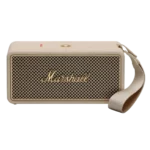
Marshall Middleton II Feature Scores
Explore all 62 feature scores for Marshall Middleton II, organized into pros and cons.
Scores by Feature
Summary
62 reviewed features-
Very positive 4.5-5.034 (55%)
-
Positive 3.5-4.413 (21%)
-
Neutral 2.5-3.47 (11%)
-
Negative 1.5-2.47 (11%)
-
Very negative below 1.51 (2%)
Pros
Sort
-
Design is one of the most consistently praised traits. Reviewers and customers repeatedly call the retro Marshall styling premium, distinctive, attractive, and closer to décor than a generic portable speaker.
-
Battery life is a major strength, with many reviewers praising roughly 30-hour endurance and multi-day use. A few users did not reach the full claim, and one customer found the newer model shorter-lived than the original.
-
Overall sound quality is a major strength, with broad praise for clarity, stereo width, bass, and musicality. Even critical reviewers generally describe the sound as good, while the main reservations involve price, high-frequency detail, or reliability rather than core audio quality.
-
Bass is one of the most praised sound traits: deep, punchy, controlled, and unusually substantial for the size. It can compress at maximum volume and cannot reproduce the deepest sub-bass, but most reviewers still rate it highly.
-
Reviewers are highly positive about the IP67 protection and repeatedly frame it as suitable for pools, rain, beaches, and outdoor use. One reviewer still considered it less rugged than purpose-built outdoor rivals.
-
Most reviewers see the Middleton II as a premium, well-made product with strong sound and practical features. A few customer failures and one casing-quality concern prevent the overall quality picture from being uniformly positive.
-
Physical controls are a standout usability feature, letting users handle playback, volume, bass, and treble without opening the app. Reviewers repeatedly described the layout as intuitive and convenient.
-
The 360-degree presentation is repeatedly praised for producing a wide, immersive sound from many listening positions. Reviewers generally found the effect convincing rather than just a marketing claim.
-
Stereo imaging is one of the clearest strengths. Reviewers repeatedly praise unusually convincing left-right separation and a soundstage that extends beyond the compact cabinet.
-
EQ flexibility is a strong point. Reviewers liked the physical bass and treble controls plus the app’s five-band EQ, though one noted that more advanced adjustment options would still be welcome.
-
The reverse-charging power-bank function is widely seen as genuinely useful for travel and outdoor use. One customer did report that this function failed before the speaker later stopped charging entirely.
-
The Middleton II gets impressively loud for its size and easily handles rooms, backyards, and smaller gatherings. Reviewers still caution that it is not a true high-output party speaker.
-
Wireless stability is strong in testing, with reviewers reporting reliable connections around homes and gardens plus fast reconnection to paired devices. The newer Bluetooth implementation appears dependable in normal use.
-
The replaceable battery is repeatedly praised as a meaningful long-term advantage. Reviewers value the ability to extend the speaker’s useful life instead of treating the battery as permanently sealed.
-
Most reviewers describe the tuning as balanced, with clean mids and controlled bass. A few found the upper mids and treble less detailed or somewhat overshadowed by the low end.
-
Everyday operation is straightforward thanks to direct controls, simple pairing, and a practical feature set. Reviewers generally found it easy to live with across desk, room, and portable use.
-
It generally stays composed at high volume, with multiple reviewers reporting little obvious distortion. The main caveat is bass compression or rougher treble when pushed close to maximum output.
-
The Marshall app is consistently described as simple, well organized, and easy to use. Reviewers liked quick setup, clear battery information, and straightforward access to EQ and device settings.
-
The 3.5mm auxiliary input is repeatedly welcomed as a useful fallback when Bluetooth is not ideal. Reviewers also liked that the port is easy to access.
-
The built-in microphone is a welcome addition and generally works well for hands-free calls. Pickup is strongest at close to moderate distance rather than across a large room.
-
Overall satisfaction is mostly high, with many customers calling the speaker excellent or saying they would buy it again. Repeated charging failures and delayed LE Audio support create a meaningful minority of strongly negative experiences.
-
The IP67 dust protection earned strong confidence for outdoor use. Reviewers specifically saw the sealed design as well suited to dirt, sand, and general outdoor exposure.
-
Quick charging is repeatedly praised as practical, with short top-ups restoring several hours of playback. Reviewers found this especially useful before gatherings or when the battery is nearly empty.
-
Low-volume listening is a strength, especially for desks and quiet rooms. Reviewers and a customer said the speaker retains a full, satisfying sound without needing to be played loudly.
-
Speakerphone performance is good at close range, with clear calls reported by several reviewers. Quality drops with distance, where voices can become less clear or more echoey.
-
The detachable strap is generally useful and later versions feel more durable, but opinions are mixed because the speaker lacks a full carry handle. That matters more given its relatively heavy weight.
-
The raised, tactile controls are generally easier to feel and use than before. One reviewer noted that some strip controls can be pressed accidentally, so the layout is not flawless.
-
Bluetooth range is a notable upgrade, with reviewers reporting much longer reach and reliable use around a house, garden, or park. The extended range reduces the likelihood of dropouts in everyday use.
-
Multipoint is treated as a useful everyday upgrade, allowing two source devices to remain connected. Reviewers liked the flexibility for switching between devices without repeated pairing.
-
The speaker is particularly well suited to desks, kitchens, and small-to-medium rooms. It can fill these spaces comfortably without requiring maximum volume.
-
Detail retrieval is generally good, with reviewers hearing subtle percussion, vocals, and spatial information that smaller speakers can lose. The main weakness is reduced high-frequency detail in some dense or bass-heavy tracks.
-
A USB-C charging cable is included, and reviewers explicitly noted it in the box. The included cable makes setup and charging more convenient.
-
Music playback is consistently enjoyable, with reviewers especially liking rock and bass-driven material. The warm, energetic presentation also works across a broader range of genres.
-
Bluetooth pairing is quick and straightforward, with one reviewer demonstrating near-instant Fast Pair connection. Basic wireless setup is easy.
-
One hands-on reviewer had enough confidence in the rugged build to say an accidental drop would not cause immediate concern. That supports strong perceived impact durability.
-
The companion app can be installed and used without creating an account, which one reviewer explicitly appreciated. That makes the software experience relatively privacy-friendly.
-
Bluetooth setup was described as extremely easy by a customer, with quick connection and little friction. Pairing simplicity is a clear usability strength.
-
Close-range call testing produced clear, rich voice pickup, even with quiet speech. Voice quality appears strongest when the user stays near the speaker.
-
The stronger amplifier setup gives the speaker useful headroom and low-frequency extension. Reviewers described the added reserve as helping bass feel more substantial without immediately losing control.
-
LC3 support was praised for reducing energy use while maintaining good audio performance. That gives the newer Bluetooth implementation a modest efficiency advantage.
-
The ability to float adds extra reassurance around pools despite the speaker’s weight. One reviewer specifically saw it as useful peace of mind for poolside use.
-
Auracast gives the Middleton II a flexible path to grouped playback with compatible speakers and broadcasts. Reviewers viewed it as a useful, more future-facing inter-speaker option.
-
The LED bars provide useful feedback for battery, volume, bass, and treble levels. A customer specifically appreciated being able to see power and volume status at a glance.
-
Repairability and replaceable parts make the Middleton II less disposable than many sealed portable speakers. Reviewers viewed that approach as a meaningful sustainability advantage.
-
USB-C charging is convenient and uses a cable included in the box. Reviewers appreciated the modern charging connection and easy cable compatibility.
-
One customer reported a good unboxing experience and that the speaker arrived in good condition. There is limited commentary on packaging beyond that positive experience.
-
The feature set covers the essentials, including EQ, battery controls, microphone use, and Auracast. Some reviewers still miss extras found on other Marshall models, so the smart feature package feels useful rather than exhaustive.
Cons
Sort
-
Power reliability is the clearest customer concern. Multiple buyers report units that would not charge, arrived dead, stopped holding power, or failed across more than one replacement, although another customer described Marshall speakers as reliable.
-
Support experiences are inconsistent. One customer praised Marshall’s warranty replacement, while others felt help was limited or unhelpful when charging failures and delayed LE Audio support arose.
-
Weight is one of the most repeated drawbacks. At about 1.8 kg, it feels substantial and premium, but several reviewers and customers found it heavy for bags, walks, or truly portable use.
-
Price is a recurring concern. Several reviewers think the Middleton II is expensive for its size, especially when the Kilburn III or cheaper rivals are close enough in price to complicate the value proposition.
-
One reviewer found noticeable audio delay with video playback and said lip sync was not correct. Buyers planning to use the speaker for TV or video should expect Bluetooth latency.
-
AirPlay is not supported, which one iPhone-focused reviewer specifically called a letdown. Apple users wanting Wi-Fi-based AirPlay streaming will need another option.
-
Backward compatibility is limited because the Middleton II does not wirelessly stack with the original first-generation Middleton. That is a meaningful drawback for owners hoping to reuse an older unit in a paired setup.
-
The absence of conventional multi-speaker pairing disappointed at least one reviewer. Auracast offers another route to grouped playback, but it does not fully replace the expected pairing option for everyone.
-
A customer specifically missed having a remote control. The speaker depends on its physical controls, app, or connected device instead.
-
One reviewer was disappointed that the speaker remains Bluetooth-only with no Wi-Fi streaming. That limits its flexibility as a more integrated at-home speaker.
-
Codec support is mixed: AAC, SBC, and LC3 are useful additions, but several reviewers criticize the lack of aptX or LDAC. One customer was also frustrated that promised LE Audio functionality had not arrived.
-
Higher-resolution wireless audio options are limited. Reviewers specifically note that the speaker does not provide the broader high-res codec support available from some competitors.
-
Complex arrangements can become somewhat cluttered, even though the stereo layout helps create space. The speaker is cohesive with most music but not flawless when many instruments compete at once.
-
Construction feels premium overall, but there is a specific concern about the removable outer wrap lifting at the corners. Other users praised the materials, so build impressions are positive with a notable casing caveat.
-
Value opinions are split. Some reviewers and customers consider it worth the premium or a strong buy at the right price, while others think cheaper rivals or nearby Marshall models offer better value.