
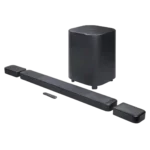
JBL Bar 1300MK2 Feature Scores
Explore all 60 feature scores for JBL Bar 1300MK2, organized into pros and cons.
Scores by Feature
Summary
60 reviewed features-
Very positive 4.5-5.042 (70%)
-
Positive 3.5-4.411 (18%)
-
Neutral 2.5-3.41 (2%)
-
Negative 1.5-2.45 (8%)
-
Very negative below 1.51 (2%)
Pros
Sort
-
Rear-speaker versatility is arguably the signature feature: they can serve as surrounds, docked front extensions, Bluetooth speakers, broadcast speakers and a quiet Night Listening pair.
-
Overall product quality is rated very highly across most sources, with repeated praise for the combination of sound, modularity and easy home-theater deployment.
-
Dialogue is consistently clear through action and heavy bass, with PureVoice usually helping without sounding harsh. One long-term test found its benefit more scene-dependent.
-
Bass is one of the defining strengths: deep, physical and room-shaking, yet often controlled enough to preserve dialogue. A few reviewers found default bass too dominant or heard artifacts when heavily boosted.
-
Dolby Atmos is a standout strength, with convincing overhead motion, broad immersion and strong object placement. Height performance still depends on ceiling and room geometry.
-
Setup is consistently praised as fast and simple for such a complex surround package, with pre-paired speakers and guided calibration doing most of the work.
-
Maximum volume is enormous, easily filling large rooms and sometimes becoming excessive in smaller spaces. Reviewers consistently agree there is far more output than most users need.
-
Overall sound quality is a major strength: powerful, expansive and cinematic, with enough refinement for both movies and music despite some low-volume and tonal caveats.
-
Build quality earns strong marks for solid construction, durable finishes, secure modular parts and premium-feeling hardware.
-
As a home-theater package, the system earns very high marks for delivering real surround, strong bass and a clean install without a receiver or permanently wired rears.
-
The soundstage is consistently described as wide and tall, with convincing off-center balance and strong overhead dimension once the room and levels cooperate.
-
The redesigned subwoofer is a core strength, delivering deep, hard-hitting bass and substantial headroom. Some reviewers still trim its default level for a more neutral balance.
-
Music performance is much better than typical soundbar expectations, with strong stereo separation, engaging bass and convincing Atmos music. It tends to sound most cohesive when played moderately loud.
-
The system usually blends bar, sub and rears into a convincing whole, especially after calibration or at moderate volume. Some music mixes can sound less unified at lower levels.
-
Room calibration is usually a major win: several testers heard tighter, better-balanced surround after running it. The main complaint is software presentation, especially the lack of an easy calibration on/off comparison.
-
The hidden front display is widely liked because it clearly shows input, volume and Atmos status, then dims so it does not distract during viewing.
-
Surround performance is highly convincing because real rear speakers create genuine wraparound effects; upmixing can also add useful ambience to stereo TV.
-
The included remote is responsive and unusually useful, giving fast access to volume, bass, rear and height adjustments without depending on the app.
-
Dynamics are a major asset, giving action scenes sudden impact and games a strong sense of scale without routinely collapsing into distortion.
-
The detachable rears deliver convincing real surround and useful standalone playback. Their small size can limit bass and absolute authority compared with larger powered satellites.
-
Value depends heavily on price. Many reviewers think the complete performance and flexibility justify the premium, while a few recommend waiting for discounts or object to the flagship MSRP.
-
App impressions are split. Several reviewers found JBL One clean, responsive and easy, while others encountered confusing calibration screens or repeated connection drops.
-
The docking magnets are exceptionally strong and satisfying, keeping the detachable speakers secure while making charging easy.
-
Wall-mount support is excellent: brackets and screws for the bar and rears are included, something several reviewers note rivals often charge extra for.
-
The styling is intentionally understated and some reviewers find it premium and clean, while others think the long black-bar look is too ordinary for the price.
-
The detachable rears generally last long enough for extended viewing, with real-world reports around 7.5–8.5 hours at louder use and roughly 10 hours viewed as ample.
-
The tonal balance is broadly strong, with clear mids and highs and powerful bass. Some listeners trim bass or EQ slightly recessed vocals for their preferred balance.
-
Broadcast, Night Listening and other processing features are seen as genuinely useful rather than filler, although always-on AI processing may bother purists.
-
Detail retrieval is generally strong and helps sell spatial effects, though one reviewer found very subtle soundtrack cues less resolved than on a full separates system.
-
Gaming sounds excellent when connected appropriately, thanks to low latency, strong positional cues, Atmos effects and powerful dynamics.
-
Despite its huge output, one reviewer found it worked very well in a small bedroom, while the adjustable levels help keep scale manageable.
-
USB-C power is a practical escape hatch for anyone who does not want to keep docking the battery-powered rears, and they can remain powered while in use.
-
Low-volume performance is mixed: bass can remain surprisingly impactful and Night mode is excellent, but subtle detail often improves noticeably once the system is played louder.
-
The seven-band EQ gives useful control over the strong bass and overall balance, although JBL One does not provide multiple saved EQ profiles.
-
The detachable speakers work well as portable Bluetooth units, especially as a stereo pair, adding useful value beyond home theater.
-
The system stays clean at very high output overall, but the small detachable speakers can introduce some distortion when pushed hard on their own.
-
Sound elevation is convincing, with effects audibly traveling overhead and around the listener, though some tests found height stronger at the front than the rear.
-
AirPlay playback was handled cleanly for stereo music, making the bar useful beyond movies.
-
DTS:X support is treated as a meaningful advantage alongside Dolby Atmos, giving disc and movie fans broad immersive-format coverage.
-
The Mk2 is viewed as a meaningful improvement over the original Bar 1300, with stronger sound, updated features and more polished modular behavior.
-
Bluetooth pairing and playback were described as solid when the detachable speakers were used independently.
-
The opposed-driver subwoofer construction is praised for its engineering and stability, supporting strong bass without making cabinet behavior the focus.
-
The pre-paired rear speakers integrate smoothly with the main bar, making changes between docked and surround layouts unusually painless.
-
The optional wireless TV connection is described as operating with no perceptible latency, supporting convincing lip sync and clean installation.
-
Physical controls on the main bar and detachable speakers are effective and provide a useful fallback to app control.
-
Core system operation is generally dependable, with pre-paired components and reports of trouble-free connections. App-specific drops remain a separate weakness.
-
Spotify Connect music playback was handled smoothly and musically in stereo during hands-on use.
-
Stereo imaging is strong, with explicit praise for separation and a broad, well-organized presentation on music.
-
The optional wireless TV/One Commander arrangement is reported to run cleanly and reliably in testing.
-
Voice reproduction is crisp and easy to follow, especially with PureVoice active during busy scenes.
-
The system offers a strong selection of wired inputs, and reviewers appreciate having multiple HDMI connections alongside optical and other options.
-
USB-C charging can refill the rear speakers in a little over four hours, a reasonable recovery time for their portable use.
-
One review judged JBL One a low privacy risk, while still noting that connected assistants and streaming services carry their own policies.
Cons
Sort
-
The lack of HDMI 2.1 features such as 4K/120, VRR and ALLM is repeatedly criticized as a major omission at this price.
-
Gaming passthrough is the biggest repeated weakness: the HDMI inputs stop at 4K/60, forcing 4K/120 console users to connect directly to a capable TV.
-
The low-profile bar fits beneath many TVs, but its width and the sizable sub demand real space. Several reviewers recommend pairing it with larger screens and measuring the furniture first.
-
The system is physically substantial, with the subwoofer in particular described as big and heavy, reducing placement convenience.
-
Stereo-pairing the detachable speakers was troublesome in one detailed test, requiring repeated attempts before the connection worked.
-
Packaging has one specific weakness: exposed driver domes can be vulnerable if the main bar is grabbed incorrectly while unpacking.
-
Video passthrough is useful for multiple sources and Dolby Vision, but its 4K/60 ceiling is a meaningful limitation for modern gaming.