
Cambridge Audio L/R X Feature Scores
Explore all 54 feature scores for Cambridge Audio L/R X, organized into pros and cons.
Scores by Feature
Summary
54 reviewed features-
Very positive 4.5-5.023 (43%)
-
Positive 3.5-4.422 (41%)
-
Neutral 2.5-3.49 (17%)
Pros
Sort
-
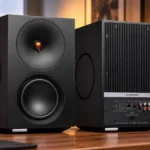
Clean lines, a floating base, colorful finishes, and walnut veneer make the speakers distinctive living-room objects. Enthusiasm for the look is broad, though taste and household preferences differ.
-
The dominant impression is big, clear, energetic sound from compact cabinets. Most enthusiasm comes with caveats about tuning, midrange refinement, or the deepest loudest bass.
-
The complete package draws strong recommendations for combining serious sound with everyday convenience. Even the preliminary and promotional accounts emphasize its unusually comprehensive design.
-
The speakers can play remarkably loudly for their size while staying composed. Available output is ample for normal room listening, though party-level extremes have limits.
-
StreamMagic earns praise for its polished interface, straightforward setup, and useful acoustic controls. Its broad feature set can take some time to learn.
-
The extensive digital and analog connections are a major strength, allowing several household sources to share one system.
-
Bass delivers unusual weight, punch, and control for compact speakers. Wall placement can make it overpowering, and the deepest movie rumble or loudest passages may still call for a subwoofer.
-
Wireless linking gives welcome freedom to move the speakers without a connecting cable. A wired option offers faster wake-up and a fallback for difficult wireless conditions, while extended wireless testing found no dropouts.
-
App-guided network setup is generally quick and intuitive, and integrated electronics simplify system assembly. Ethernet can make initial discovery faster than fully wireless setup.
-
HDMI eARC makes TV use convenient, including volume control from the television remote. Tested power and volume integration worked as expected.
-
Dynamic scale and headroom are standout strengths on demanding music. Protection and limiting can soften impact when the system is pushed to its upper range.
-
A wide, open stage and convincing separation are frequent strengths, sometimes making the cabinets seem to disappear. Spatially deep acoustic recordings reveal less air and precision than the best alternatives.
-
Integrated streaming and extensive customization make the speakers unusually complete. Direct service access removes the need for a separate streamer or hub.
-
Voices are generally clear, full-bodied, and convincingly centered. A little extra consonant emphasis can accompany the forward presentation.
-
Room settings can quickly improve brightness, bass control, and listening comfort. They require manual input rather than microphone measurement, and physical placement still matters.
-
Energetic beats, demanding rock, and a wide range of genres benefit from the speakers’ scale and control. Spacious jazz and classical recordings can expose subtler refinement limits.
-
Percussion and layered arrangements generally stay clear and distinct without sounding sterile. One measurement-led account notes a mild clarity compromise from the recessed lower treble.
-
Quiet listening usually retains detail and bass weight, helped by DynamEQ. One listening account found DynamEQ needed improvement and advised restrained adjustment.
-
Treble ranges from airy and natural to bright or hard at volume, depending on the room and material. App adjustments improve comfort, while one extended listening test found it consistently fatigue-free.
-
Precise assembly, flawless edges, and uniform finishes suggest craftsmanship beyond the price class.
-
The system works well as a powerful stereo TV and movie setup. Surround decoding, a dedicated LFE channel, and very deep cinematic rumble remain outside its standalone strengths.
-
Seamless cabinet assembly and the force-cancelling radiator arrangement earn praise for thoughtful construction.
-
TV dialogue is notably intelligible, and Movie mode can further emphasize speech clarity.
-
Built-in amplification makes the system self-contained and removes the task of choosing a matching amplifier.
-
The remote is convenient to use and gets strong praise for its feel in one account. Another found its clipped housing came apart when dropped, though it snapped back together.
-
Subwoofer integration offers useful level, phase, and bass-management controls. One test needed unusually high subwoofer gain to compensate for low output from the speakers.
-
Wide file compatibility is a practical strength. One comparison considers the inter-speaker resolution gap too small to drive a buying decision.
-
Bass controls can reduce room-driven excess and help manage an added subwoofer. The adjustable high-pass filter is a welcome capability.
-
Balance is sensitive to room settings and placement: some listeners find it convincingly even, while others hear bass excess, forward mids, or treble irregularities. Tuning often improves the result.
-
High-volume playback is generally judged composed, including an encouraging absence of concentrated distortion peaks in measurement-led testing.
-
Wide horizontal coverage helps several seats share good sound and stable imaging. Listening height matters more, with the larger model showing a narrower vertical window.
-
The integrated moving-magnet phono input is valued for making vinyl playback a simple turntable-and-speakers setup. These comments praise convenience rather than establish a tested fidelity verdict.
-
The price is substantial, but integrated streaming, amplification, inputs, and finish quality help justify it. Value depends on whether those conveniences matter more than cheaper alternatives.
-
EQ helps tame excess bass and lively highs, though the controls are relatively basic. Listeners wanting deeper adjustment may find the available tools limited.
-
Signal-to-noise performance is praised as setting a new standard among compact active speakers.
-
The gentle lighting beneath the cabinets adds an especially appealing floating effect.
-
High-quality packaging and dedicated lifting straps make unpacking feel thoughtfully handled.
-
Removing the inter-speaker cable makes repositioning easier and reduces an annoying wire across the room.
-
Gaming audio is positively assessed alongside TV, movies, and music, without a separate latency test.
-
Automatic discovery of the second speaker makes initial pairing effortless.
-
Reducing treble brightness through the app can improve comfort while preserving openness.
-
The supplied cable and essentials make it easy to get started, and lifting straps ease unpacking. Missing matching stands at launch drew criticism.
-
Older and noisier recordings can remain pleasantly listenable, but especially bright material may still become sibilant at high volume.
-
Using the wired speaker link can shorten the secondary speaker’s wake-up time.
-
Protection offers reassurance against damage, but can soften transients near maximum output. Exposed front woofers also deserve care around curious children or pets.
Cons
Sort
-
StreamMagic lacks native grouping of multiple Cambridge systems. Whole-home playback instead depends on platforms such as AirPlay, Google Cast, or Roon.
-
SBC and AAC support feels basic for this class, with higher-quality Bluetooth codecs missed.
-
The absence of a built-in display is a small usability drawback.
-
Very small rooms favor the competing KEF in one direct comparison; the Cambridge’s strengths are more convincing where its larger scale has room to work.
-
The cabinets are heavy enough to make ordinary bookshelf support a concern.
-
Basic playback and volume controls are accessible on the main cabinet. Track skipping and radio-station navigation remain shortcomings.
-
Bluetooth is usable, but Wi-Fi is favored when maximizing sound quality matters.
-
The two-box format saves space compared with separates, but these substantial speakers need clearance and supportive surfaces. Stands are often the more practical choice than desks or shallow shelves.
-
Vocals can sound warm and substantial, but dense guitars and acoustic recordings sometimes lose texture or clarity. Positioning helps, although some fullness remains.